


![4-Chloro-3-(trifluoromethyl)-1H-pyrrolo[2,3-b]pyridine structure](https://static.chemtradehub.com/structs/869/869335-75-1-a9d0.webp "4-Chloro-3-(trifluoromethyl)-1H-pyrrolo[2,3-b]pyridine structure")
Amplified fluorescence detection of adenosine via catalyzed hairpin assembly and host–guest interactions between β-cyclodextrin polymer and pyrene
文献情報
出版日
2016-03-07
DOI
10.1039/C5AN02658J
インパクトファクター
4.616
著者
Haihua Huang, Xiaohai Yang, Kemin Wang, Qing Wang, Qiuping Guo, Jin Huang, Jianbo Liu, Chunxia Song
原文を見る
要旨
Nowadays, enzyme-free nucleic acid-based signal amplification strategies are frequently utilized in the design of biosensors due to their excellent sensitivity. Developing more extended analytical methods is fundamental for basic studies in the biological and biomedical fields. Herein, we introduce an enzyme-free amplified detection strategy for the small molecule adenosine. The approach is based on adenosine–aptamer binding triggered catalyzed hairpin assembly and host–guest interactions between β-cyclodextrin polymer (β-CDP) and pyrene. Two hairpin probes (probe H1 and probe H2) and an aptamer-trigger/inhibitor duplex probe were employed in the system and the pyrene-labeled probe H1 was chosen as the signal unit. In the absence of adenosine, the aptamer-trigger was inhibited by the inhibitor strand. The hairpin probes were in the closed hairpin formation without activation of the trigger strand. Pyrene labeled at the 5′-termini of the single-stranded stem of probe H1 could be easily trapped in the hydrophobic cavity of β-CDP because of weak steric hindrance, leading to a significant fluorescence enhancement. Once the hairpin assembly was catalyzed by the adenosine–aptamer binding event, a hybridized DNA duplex H1/H2 was created continuously. Pyrene labeled at the 5′-termini of the DNA duplex H1/H2 finds it difficult to enter the cavity of β-CDP due to steric hindrance, leading to a weaker fluorescence signal. Thus, the target could be detected by this simple mix-and-detect amplification method without a need for expensive and perishable protein enzymes. As low as 42 nM of adenosine was detected by this assay, which is comparable to that of some reported colorimetric methods. Meanwhile, the proposed method was further successfully applied to detect adenosine in human serum samples, showing great potential for adenosine detection from complex fluids.
おすすめジャーナル

Journal of Medicinal Chemistry

Israel Journal of Chemistry

Proceedings of the National Academy of Sciences of the United States of America

Kinetics and Catalysis

Journal of Catalysis

Molecular Pharmacology

Russian Chemical Reviews

Helvetica Chimica Acta

Journal of Heterocyclic Chemistry

Organic Preparations and Procedures International
関連文献
Experimental and theoretical investigation of long-wavelength fluorescence emission in push–pull benzazoles: intramolecular proton transfer or charge transfer in the excited state?
Guilherme Wiethaus, Josene Maria Toldo, Fabiano da Silveira Santos, Rodrigo da Costa Duarte, Paulo Fernando Bruno Gonçalves, Fabiano Severo Rodembusch
2019-01-28
Paper
DOI: 10.1039/C8CP05186K
Understanding dissolution process of chitin crystal in ionic liquids: theoretical study
Takuya Uto, Satoshi Idenoue, Kazuya Yamamoto, Jun-ichi Kadokawa
2018-07-30
Paper
DOI: 10.1039/C8CP02749H
Interface Schottky barrier in Hf2NT2/MSSe (T = F, O, OH; M = Mo, W) heterostructures
Tao Jing, Dongmei Liang, Jinxin Hao, Mingsen Deng, Shaohong Cai
2019-02-19
Paper
DOI: 10.1039/C9CP00028C
Role of suppressed oxygen vacancies in the BiFeO3 nanofiller to improve the polar phase and multifunctional performance of poly(vinylidene fluoride)
Abhishek Sasmal, Shrabanee Sen, P. Sujatha Devi
2019-02-21
Paper
DOI: 10.1039/C8CP07281G
Insights on magnesium and sulfate ions’ adsorption on the surface of sodium alumino-silicate hydrate (NASH) gel: a molecular dynamics study
Yu Zhang, Tao Li, Dongshuai Hou, Jinglin Zhang, Jinyang Jiang
2018-06-19
Paper
DOI: 10.1039/C8CP02469C
Tuning the magnetic properties of beryllium chains
Noelia Faginas-Lago, Thierry Leininger, Stefano Evangelisti
2019-02-27
Paper
DOI: 10.1039/C8CP07159D
UPS and UV spectroscopies combined to position the energy levels of TiO2 anatase and rutile nanopowders
Clément Maheu, Luis Cardenas, Eric Puzenat, Pavel Afanasiev, Christophe Geantet
2018-09-17
Paper
DOI: 10.1039/C8CP04614J
Effect of intermediate phases on the optical properties of PbI2-rich CH3NH3PbI3 organic–inorganic hybrid perovskite
Alonso W. P. Sanches, Marco A. T. da Silva, Neusmar J. A. Cordeiro, Alexandre Urbano, Sidney A. Lourenço
2019-02-11
Paper
DOI: 10.1039/C8CP06916F
Time-resolved IR spectroscopy reveals mechanistic details of ion transport in the sodium pump Krokinobacter eikastus rhodopsin 2
Marvin Asido, Peter Eberhardt, Clara Nassrin Kriebel, Markus Braun, Clemens Glaubitz, Josef Wachtveitl
2019-02-01
Paper
DOI: 10.1039/C8CP07418F
こちらもおすすめ
化合物よくある質問
2-ブロモ-9,9-ジフェニル-9H-フルオレンの主な用途は何ですか?
2-溴-9,9-二苯基芴は、医薬品、工業材料、有機合成の研究分野で応用されます。特に、レーザー材料や機能性ポリマーの合成に使用されることがあります。また、蛍光色...
474918-32-62-Bromo-9,9-diphenyl...
化合物よくある質問
四氯化铱の市場動向や研究トレンドはどうですか?
四氯化铱の市場は研究開発分野で注目されており、特にナノ技術や金属有機框架(MOFs)の分野での需要が増加傾向にあります。価格は安定しており、中国や韓国での生産が...
207399-11-9Tetrachloroiridium h...
882-06-44-Nitrocinnamic acid
化合物よくある質問
1-(4-溴-3-氟苯基)-2-氯乙酮を含む廃棄物はどのように処理すべきですか?
1-(4-溴-3-氟苯基)-2-氯乙酮 (CAS番号: 1260857-14-4) の廃棄物は専門的な廃棄処理が必要です。まず、廃棄物は密閉された容器に収集し、...
1260857-14-41-(4-Bromo-3-fluorop...
化合物よくある質問
苦参酚Kとは何ですか?
苦参酚Kは、CAS番号101236-49-1を持つ化合物で、主に天然由来の生薬から抽出されます。この化合物は、抗炎症作用や抗癌作用を持つことが報告されています。
101236-49-1Kushenol K
化合物よくある質問
POTASSIUM (1-(TERTBUTOXYCARBONYL)AZETIDIN-3-YL)TRIFLUOROBORATE を含む廃棄物はどのように処理すべきですか?
POTASSIUM (1-(TERTBUTOXYCARBONYL)AZETIDIN-3-YL)TRIFLUOROBORATE を含む廃棄物は、まず安全なエント...
1430219-73-0Potassium (1-(tert-b...
化合物よくある質問
4-庚基-4’-联苯羧酸の市場動向や研究トレンドはどうですか?
4-庚基-4’-聯苯羧酸は、特殊化学品や合成化学の分野で用いられる化学物質ですが、市場動向としては、研究開発の進展とともに需要が増加しています。また、環境配慮型...
58573-94-74'-Heptyl-4-biphenyl...
化合物よくある質問
6-ブロモ-3-メトキシ-1-フェニル-1H-インドゾールを含む廃棄物はどのように処理すべきですか?
6-ブロモ-3-メトキシ-1-フェニル-1H-インドゾールを含む廃棄物は、適切な化学廃棄処理が必要です。通常、廃棄物は密閉容器に収集され、専門の廃棄処理業者に引...
1332527-03-36-Bromo-3-methoxy-1-...
化合物よくある質問
4,4-二甲基-2-吡咯烷酮はどの業界で使用されていますか?
4,4-二甲基-2-吡咯烷酮は医薬、ポリマー、センサー、半導体などの業界で広く使用されています。特に溶媒としての性能が高く評価されています。
66899-02-34,4-dimethylpyrrolid...
51312-42-6Sodium Phosphotungst...
掲載誌
Analyst

CiteScore:
7.8
自己引用率:
5.6%
年間論文数:
653
Analyst publishes analytical and bioanalytical research that reports premier fundamental discoveries and inventions, and the applications of those discoveries, unconfined by traditional discipline barriers.
おすすめ化合物
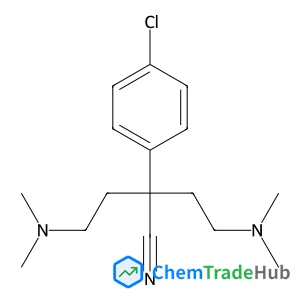
2-(4-Chlorophenyl)-4-(dimethylamino)-2-(2-(dimethylamino)ethyl)butanenitrile
CAS番号:
1246816-57-8
分子式:
C16H24ClN3

![Pyrazolo[1,5-a]pyridine-3-carbothioamide structure](https://static.chemtradehub.com/structs/885/885275-44-5-aae0.webp "Pyrazolo[1,5-a]pyridine-3-carbothioamide structure")
おすすめサプライヤー



免責事項
このページに表示される学術雑誌情報は、参考および研究目的のみを目的としています。当社は雑誌出版社とは提携しておらず、投稿の取り扱いも行っておりません。出版に関するお問い合わせは、各雑誌出版社に直接ご連絡ください。
表示されている情報に誤りがある場合は、support@chemtradehub.com までご連絡ください。迅速に確認し、対応いたします。