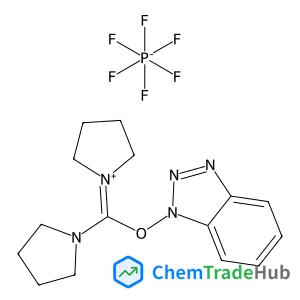
(1H-Benzotriazol-1-yloxy)(di-1-pyrrolidinyl)methylium hexafluorophosphate
CAS番号:
105379-24-6
分子式:
C15H21F6N5OP
Lukas Trombach, Sebastian Ehlert, Stefan Grimme, Peter Schwerdtfeger
The design, implementation, and evaluation of a computationally efficient approach for exploring the chemical nature and bulk properties of the super-heavy main-group elements (SHEs) Cn–Og with nuclear charges of Z = 112–118 is described. The approach combines plane-wave density-functional theory (DFT) based on a newly devised set of projector-augmented wave potentials (PAWs) with the D3 dispersion correction, whose parameter-space is extended for this purpose. Regarding both, the fitting of the PAWs as well as the calculation of the D3 parameters, it is shown that the peculiar electronic structure of the SHEs with strong relativistic effects makes it necessary to adapt the well established computational protocols. Eventually, the methodology is tested employing various common functionals (PW91, PBE, PBE-D3, PBE0-D3, PBEsol and SCAN) by comparison to experimental and high-level results for the bulk of Cn and Og, as well as by calculating adsorption energies of Cn–Og on a gold surface and comparing these to the lighter congeners Hg–Rn as well as experimentally derived data. These tests establish that our approach provides a consistent and accurate description of the reactivity of the SHEs and is largely in excellent agreement with experimental and high-level references, and moreover underline the great relevance of dispersion interactions, as well the game-changing impact of spin–orbit coupling on SHE reactivity. Ultimately, the conducted calculations provide novel insights into the chemical behavior and nature of the SHEs, showcase the breakdown of periodic trends in the seventh period, and allow us to revisit and confirm an empirical relation between adsorption on gold and the cohesive energy.
Tao Li, MingYu Li, JunJun Wang, Jie Li, YunRui Duan, Hui Li
DOI: 10.1039/C8CP05014G
Long Van Duong, Miquel Solà, Hadi Behzadi, Mohammad Jafar Momeni
DOI: 10.1039/C8CP03737J
L. Wang, X. M. Zhang, L. Deng, J. F. Tang, S. F. Xiao, H. Q. Deng, W. Y. Hu
DOI: 10.1039/C8CP02287A
Yan Chen, Xiaoyang Shi, Mingjia Li, Yilun Liu
DOI: 10.1039/C8CP01334A
Pengxiang Xu, Jiaping Lin, Liangshun Zhang
DOI: 10.1039/C8CP02062K
Zi-xiang Cui, Ya-nan Feng, Yong-qiang Xue, Juan Zhang, Rong Zhang, Jie Hao, Jia-yi Liu
DOI: 10.1039/C8CP04895A
E. Panabière, N. Emery, O. Dubrunfaut, J. P. Pereira-Ramos
DOI: 10.1039/C8CP06770H
A. Ponzi, N. Quadri, C. Angeli, P. Decleva
DOI: 10.1039/C8CP06103C
Sumit Bawari, Nisheal M. Kaley, Shubhadeep Pal, Thazhe Veettil Vineesh, Shamasree Ghosh, Jagannath Mondal, Tharangattu N. Narayanan
DOI: 10.1039/C8CP01020J
D. Bloos, R. Marx, P. Lutz, M. Kern, O. Laguta, C. Dietrich, J. van Slageren
DOI: 10.1039/C7CP07443C
2-溴-9,9-二苯基芴は、医薬品、工業材料、有機合成の研究分野で応用されます。特に、レーザー材料や機能性ポリマーの合成に使用されることがあります。また、蛍光色...
四氯化铱の市場は研究開発分野で注目されており、特にナノ技術や金属有機框架(MOFs)の分野での需要が増加傾向にあります。価格は安定しており、中国や韓国での生産が...
1-(4-溴-3-氟苯基)-2-氯乙酮 (CAS番号: 1260857-14-4) の廃棄物は専門的な廃棄処理が必要です。まず、廃棄物は密閉された容器に収集し、...
苦参酚Kは、CAS番号101236-49-1を持つ化合物で、主に天然由来の生薬から抽出されます。この化合物は、抗炎症作用や抗癌作用を持つことが報告されています。
POTASSIUM (1-(TERTBUTOXYCARBONYL)AZETIDIN-3-YL)TRIFLUOROBORATE を含む廃棄物は、まず安全なエント...
4-庚基-4’-聯苯羧酸は、特殊化学品や合成化学の分野で用いられる化学物質ですが、市場動向としては、研究開発の進展とともに需要が増加しています。また、環境配慮型...
6-ブロモ-3-メトキシ-1-フェニル-1H-インドゾールを含む廃棄物は、適切な化学廃棄処理が必要です。通常、廃棄物は密閉容器に収集され、専門の廃棄処理業者に引...
4,4-二甲基-2-吡咯烷酮は医薬、ポリマー、センサー、半導体などの業界で広く使用されています。特に溶媒としての性能が高く評価されています。

Physical Chemistry Chemical Physics (PCCP) is an international journal co-owned by 19 physical chemistry and physics societies from around the world. This journal publishes original, cutting-edge research in physical chemistry, chemical physics and biophysical chemistry. To be suitable for publication in PCCP, articles must include significant innovation and/or insight into physical chemistry; this is the most important criterion that reviewers and Editors will judge against when evaluating submissions. The journal has a broad scope and welcomes contributions spanning experiment, theory, computation and data science. Topical coverage includes spectroscopy, dynamics, kinetics, statistical mechanics, thermodynamics, electrochemistry, catalysis, surface science, quantum mechanics, quantum computing and machine learning. Interdisciplinary research areas such as polymers and soft matter, materials, nanoscience, energy, surfaces/interfaces, and biophysical chemistry are welcomed if they demonstrate significant innovation and/or insight into physical chemistry. Joined experimental/theoretical studies are particularly appreciated when complementary and based on up-to-date approaches.