












On the hydrogen evolution reaction activity of graphene–hBN van der Waals heterostructures
文献情報
出版日
2018-03-13
DOI
10.1039/C8CP01020J
インパクトファクター
3.676
著者
Sumit Bawari, Nisheal M. Kaley, Shubhadeep Pal, Thazhe Veettil Vineesh, Shamasree Ghosh, Jagannath Mondal, Tharangattu N. Narayanan
原文を見る
要旨
Although graphene technology has reached technology readiness level 9 and hydrogen fuel has been identified as a viable futuristic energy resource, pristine atomic layers such as graphene are found to be inactive towards the hydrogen evolution reaction (HER). Enhancing the intrinsic catalytic activity of a material and increasing its number of active sites by nanostructuring are two strategies in novel catalyst development. Here, electrocatalytically inert graphene (G) and hexagonal boron nitride (hBN) are made active for the HER by forming van der Waals (vdW) heterostructures via vertical stacking. The HER studies are conducted using defect free shear exfoliated graphite and hBN modified glassy carbon electrodes via layer by layer sequential stacking. The G/hBN stacking pattern (AA, AB, and AB′) and stacking sequence (G/hBN or hBN/G) have been found to play important roles in the HER activity. Enhancement in the intrinsic activity of graphene by the formation of G/hBN vdW stacks has been further confirmed with thermally reduced graphene oxide and hBN based structures. Tunability in the HER performance of the G/hBN vdW stack is also confirmed via a three-dimensional rGO/hBN electrode. HER active sites in the G/hBN vdW structures are then mapped using density functional theory calculations, and an atomistic interpretation has been identified.
関連文献
Monomer stoichiometry imbalance-promoted formation of multisubstituted polynaphthalenes by palladium-catalyzed polycouplings of aryl iodides and internal diynes
2018-01-24
Paper
DOI: 10.1039/C7PY01926B
Synthesis and properties of poly(trifluoroethylene) via a persistent radical mediated polymerization of trifluoroethylene
Maxime Colpaert, Sanjib Banerjee, Vincent Ladmiral, Taizo Ono, Bruno Améduri
2018-01-24
Paper
DOI: 10.1039/C7PY02018J
Ugi multicomponent reaction to prepare peptide–peptoid hybrid structures with diverse chemical functionalities
Manuel Hartweg, Elham Radvar, Dominic Collis, Mehedi Reza, Janne Ruokolainen, Robert Rambo, Ian W. Hamley, Helena S. Azevedo, C. Remzi Becer
2017-12-21
Paper
DOI: 10.1039/C7PY01953J
SET-LRP mediated by TREN in biphasic water–organic solvent mixtures provides the most economical and efficient process
Adrian Moreno, Silvia Grama, Tong Liu, Marina Galià, Virgil Percec
2017-11-24
Paper
DOI: 10.1039/C7PY01841J
Microplasma-assisted rapid, chemical oxidant-free and controllable polymerization of dopamine for surface modification
Zhe Wang, Chao Xu, Yuexiang Lu, Guoyu Wei, Gang Ye, Taoxiang Sun, Jing Chen
2017-06-26
Paper
DOI: 10.1039/C7PY00805H
Acrylate-based poly-high internal phase emulsions for effective enzyme immobilization and activity retention: from computationally-assisted synthesis to pharmaceutical applications
G. Tripodo, G. Marrubini, M. Corti, G. Brusotti, C. Milanese, M. Sorrenti, L. Catenacci, G. Massolini, E. Calleri
2017-11-29
Paper
DOI: 10.1039/C7PY01626C
Cleavage of macromolecular RAFT chain transfer agents by sodium azide during characterization by aqueous GPC
Reece W. Lewis, Richard A. Evans, Nino Malic, Kei Saito
2017-06-01
Paper
DOI: 10.1039/C7PY00682A
こちらもおすすめ
化合物よくある質問
2-ブロモ-9,9-ジフェニル-9H-フルオレンの主な用途は何ですか?
2-溴-9,9-二苯基芴は、医薬品、工業材料、有機合成の研究分野で応用されます。特に、レーザー材料や機能性ポリマーの合成に使用されることがあります。また、蛍光色...
474918-32-62-Bromo-9,9-diphenyl...
化合物よくある質問
四氯化铱の市場動向や研究トレンドはどうですか?
四氯化铱の市場は研究開発分野で注目されており、特にナノ技術や金属有機框架(MOFs)の分野での需要が増加傾向にあります。価格は安定しており、中国や韓国での生産が...
207399-11-9Tetrachloroiridium h...
882-06-44-Nitrocinnamic acid
化合物よくある質問
1-(4-溴-3-氟苯基)-2-氯乙酮を含む廃棄物はどのように処理すべきですか?
1-(4-溴-3-氟苯基)-2-氯乙酮 (CAS番号: 1260857-14-4) の廃棄物は専門的な廃棄処理が必要です。まず、廃棄物は密閉された容器に収集し、...
1260857-14-41-(4-Bromo-3-fluorop...
化合物よくある質問
苦参酚Kとは何ですか?
苦参酚Kは、CAS番号101236-49-1を持つ化合物で、主に天然由来の生薬から抽出されます。この化合物は、抗炎症作用や抗癌作用を持つことが報告されています。
101236-49-1Kushenol K
化合物よくある質問
POTASSIUM (1-(TERTBUTOXYCARBONYL)AZETIDIN-3-YL)TRIFLUOROBORATE を含む廃棄物はどのように処理すべきですか?
POTASSIUM (1-(TERTBUTOXYCARBONYL)AZETIDIN-3-YL)TRIFLUOROBORATE を含む廃棄物は、まず安全なエント...
1430219-73-0Potassium (1-(tert-b...
化合物よくある質問
4-庚基-4’-联苯羧酸の市場動向や研究トレンドはどうですか?
4-庚基-4’-聯苯羧酸は、特殊化学品や合成化学の分野で用いられる化学物質ですが、市場動向としては、研究開発の進展とともに需要が増加しています。また、環境配慮型...
58573-94-74'-Heptyl-4-biphenyl...
化合物よくある質問
6-ブロモ-3-メトキシ-1-フェニル-1H-インドゾールを含む廃棄物はどのように処理すべきですか?
6-ブロモ-3-メトキシ-1-フェニル-1H-インドゾールを含む廃棄物は、適切な化学廃棄処理が必要です。通常、廃棄物は密閉容器に収集され、専門の廃棄処理業者に引...
1332527-03-36-Bromo-3-methoxy-1-...
化合物よくある質問
4,4-二甲基-2-吡咯烷酮はどの業界で使用されていますか?
4,4-二甲基-2-吡咯烷酮は医薬、ポリマー、センサー、半導体などの業界で広く使用されています。特に溶媒としての性能が高く評価されています。
66899-02-34,4-dimethylpyrrolid...
51312-42-6Sodium Phosphotungst...
掲載誌
Physical Chemistry Chemical Physics

CiteScore:
5.5
自己引用率:
10.3%
年間論文数:
3036
Physical Chemistry Chemical Physics (PCCP) is an international journal co-owned by 19 physical chemistry and physics societies from around the world. This journal publishes original, cutting-edge research in physical chemistry, chemical physics and biophysical chemistry. To be suitable for publication in PCCP, articles must include significant innovation and/or insight into physical chemistry; this is the most important criterion that reviewers and Editors will judge against when evaluating submissions. The journal has a broad scope and welcomes contributions spanning experiment, theory, computation and data science. Topical coverage includes spectroscopy, dynamics, kinetics, statistical mechanics, thermodynamics, electrochemistry, catalysis, surface science, quantum mechanics, quantum computing and machine learning. Interdisciplinary research areas such as polymers and soft matter, materials, nanoscience, energy, surfaces/interfaces, and biophysical chemistry are welcomed if they demonstrate significant innovation and/or insight into physical chemistry. Joined experimental/theoretical studies are particularly appreciated when complementary and based on up-to-date approaches.
おすすめ化合物
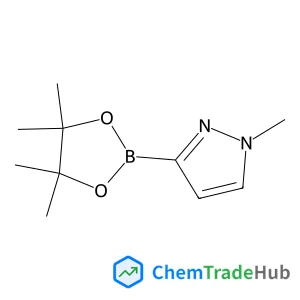
1-Methyl-3-(4,4,5,5-tetramethyl-1,3,2-dioxaborolan-2-yl)-1H-pyrazole
CAS番号:
1020174-04-2
分子式:
C10H17BN2O2
おすすめサプライヤー






免責事項
このページに表示される学術雑誌情報は、参考および研究目的のみを目的としています。当社は雑誌出版社とは提携しておらず、投稿の取り扱いも行っておりません。出版に関するお問い合わせは、各雑誌出版社に直接ご連絡ください。
表示されている情報に誤りがある場合は、support@chemtradehub.com までご連絡ください。迅速に確認し、対応いたします。