












Effect of nano-pillared surfaces with an arrangement density gradient on droplet coalescence dynamics
文献情報
出版日
2018-09-04
DOI
10.1039/C8CP05014G
インパクトファクター
3.676
著者
Tao Li, MingYu Li, JunJun Wang, Jie Li, YunRui Duan, Hui Li
原文を見る
要旨
The ability to predict and control the coalescence of droplets is of great importance for both industrial and technological applications, including 3D printing, micro-cladding, and self-assembly. Here, a textured surface decorated with nano-pillared arrays was designed and its arrangement density (f) was found to significantly affect the coalescence dynamics of droplets through changing their wettability. A large arrangement density f of the nano-pillared arrays would induce a Cassie wetting state for droplets, which supports the coalescence process. But when decreasing f to a value that produces a Wenzel wetting state, the coalescence is heavily impeded by the nano-pillars. However, a very small arrangement density f is also favorable for coalescence because the pinning effect resulting from the nano-pillars becomes ignored. More importantly, special substrates were well designed by nano-pillars with a density gradient in order to control the coalescence dynamics for some potential applications. This work helps to shed light on the coalescence dynamics of droplets on a microtextured surface modified with different arranged nano-pillars and thereby provides guidance on how to control their behaviors.
関連文献
Thermoresponsive laterally-branched polythiophene phenylene derivative as water-soluble temperature sensor
Victor R. De la Rosa, David Barker, Richard Hoogenboom
2017-06-21
Paper
DOI: 10.1039/C7PY00919D
New fluorescent through-space conjugated polymers: synthesis, optical properties and explosive detection
Yingying Zhang, Pingchuan Shen, Bairong He, Wenwen Luo, Zujin Zhao
2017-12-04
Paper
DOI: 10.1039/C7PY01700F
Preparation of graphene/poly(2-acryloxyethyl ferrocenecarboxylate) nanocomposite via a “grafting-onto” strategy
Yan Deng, Wenbin Liu, Yongjun Li, Xiaoyu Huang
2017-12-04
Paper
DOI: 10.1039/C7PY01932G
Light-responsive polymer brushes: active topographic cues for cell culture applications
A. C. Manikas, V. Pagliarulo, P. Ferraro, S. Cavalli
2017-04-28
Paper
DOI: 10.1039/C7PY00462A
Acrylate-based poly-high internal phase emulsions for effective enzyme immobilization and activity retention: from computationally-assisted synthesis to pharmaceutical applications
G. Tripodo, G. Marrubini, M. Corti, G. Brusotti, C. Milanese, M. Sorrenti, L. Catenacci, G. Massolini, E. Calleri
2017-11-29
Paper
DOI: 10.1039/C7PY01626C
Olefin cross metathesis and ring-closing metathesis in polymer chemistry
Fern Sinclair, Joëlle Prunet, Michael P. Shaver
2017-04-24
Review Article
DOI: 10.1039/C7PY00340D
Syntheses, characterizations and functions of cationic polyethers with imidazolium-based ionic liquid moieties
Shigetaka Hayano, Keisuke Ota, Hoang The Ban
2018-01-24
Paper
DOI: 10.1039/C7PY01985H
Thermoresponsive nanogels with film-forming ability
Ana S. Sonzogni, Stefanie Wedepohl, Marcelo Calderón
2018-01-18
Paper
DOI: 10.1039/C7PY01798G
こちらもおすすめ
化合物よくある質問
2-ブロモ-9,9-ジフェニル-9H-フルオレンの主な用途は何ですか?
2-溴-9,9-二苯基芴は、医薬品、工業材料、有機合成の研究分野で応用されます。特に、レーザー材料や機能性ポリマーの合成に使用されることがあります。また、蛍光色...
474918-32-62-Bromo-9,9-diphenyl...
化合物よくある質問
四氯化铱の市場動向や研究トレンドはどうですか?
四氯化铱の市場は研究開発分野で注目されており、特にナノ技術や金属有機框架(MOFs)の分野での需要が増加傾向にあります。価格は安定しており、中国や韓国での生産が...
207399-11-9Tetrachloroiridium h...
882-06-44-Nitrocinnamic acid
化合物よくある質問
1-(4-溴-3-氟苯基)-2-氯乙酮を含む廃棄物はどのように処理すべきですか?
1-(4-溴-3-氟苯基)-2-氯乙酮 (CAS番号: 1260857-14-4) の廃棄物は専門的な廃棄処理が必要です。まず、廃棄物は密閉された容器に収集し、...
1260857-14-41-(4-Bromo-3-fluorop...
化合物よくある質問
苦参酚Kとは何ですか?
苦参酚Kは、CAS番号101236-49-1を持つ化合物で、主に天然由来の生薬から抽出されます。この化合物は、抗炎症作用や抗癌作用を持つことが報告されています。
101236-49-1Kushenol K
化合物よくある質問
POTASSIUM (1-(TERTBUTOXYCARBONYL)AZETIDIN-3-YL)TRIFLUOROBORATE を含む廃棄物はどのように処理すべきですか?
POTASSIUM (1-(TERTBUTOXYCARBONYL)AZETIDIN-3-YL)TRIFLUOROBORATE を含む廃棄物は、まず安全なエント...
1430219-73-0Potassium (1-(tert-b...
化合物よくある質問
4-庚基-4’-联苯羧酸の市場動向や研究トレンドはどうですか?
4-庚基-4’-聯苯羧酸は、特殊化学品や合成化学の分野で用いられる化学物質ですが、市場動向としては、研究開発の進展とともに需要が増加しています。また、環境配慮型...
58573-94-74'-Heptyl-4-biphenyl...
化合物よくある質問
6-ブロモ-3-メトキシ-1-フェニル-1H-インドゾールを含む廃棄物はどのように処理すべきですか?
6-ブロモ-3-メトキシ-1-フェニル-1H-インドゾールを含む廃棄物は、適切な化学廃棄処理が必要です。通常、廃棄物は密閉容器に収集され、専門の廃棄処理業者に引...
1332527-03-36-Bromo-3-methoxy-1-...
化合物よくある質問
4,4-二甲基-2-吡咯烷酮はどの業界で使用されていますか?
4,4-二甲基-2-吡咯烷酮は医薬、ポリマー、センサー、半導体などの業界で広く使用されています。特に溶媒としての性能が高く評価されています。
66899-02-34,4-dimethylpyrrolid...
51312-42-6Sodium Phosphotungst...
掲載誌
Physical Chemistry Chemical Physics

CiteScore:
5.5
自己引用率:
10.3%
年間論文数:
3036
Physical Chemistry Chemical Physics (PCCP) is an international journal co-owned by 19 physical chemistry and physics societies from around the world. This journal publishes original, cutting-edge research in physical chemistry, chemical physics and biophysical chemistry. To be suitable for publication in PCCP, articles must include significant innovation and/or insight into physical chemistry; this is the most important criterion that reviewers and Editors will judge against when evaluating submissions. The journal has a broad scope and welcomes contributions spanning experiment, theory, computation and data science. Topical coverage includes spectroscopy, dynamics, kinetics, statistical mechanics, thermodynamics, electrochemistry, catalysis, surface science, quantum mechanics, quantum computing and machine learning. Interdisciplinary research areas such as polymers and soft matter, materials, nanoscience, energy, surfaces/interfaces, and biophysical chemistry are welcomed if they demonstrate significant innovation and/or insight into physical chemistry. Joined experimental/theoretical studies are particularly appreciated when complementary and based on up-to-date approaches.
おすすめ化合物



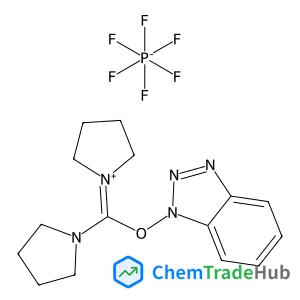
(1H-Benzotriazol-1-yloxy)(di-1-pyrrolidinyl)methylium hexafluorophosphate
CAS番号:
105379-24-6
分子式:
C15H21F6N5OP
おすすめサプライヤー



免責事項
このページに表示される学術雑誌情報は、参考および研究目的のみを目的としています。当社は雑誌出版社とは提携しておらず、投稿の取り扱いも行っておりません。出版に関するお問い合わせは、各雑誌出版社に直接ご連絡ください。
表示されている情報に誤りがある場合は、support@chemtradehub.com までご連絡ください。迅速に確認し、対応いたします。