












![4-{2-[4-(2-Methyl-2-propanyl)phenyl]ethoxy}quinazoline structure](https://static.chemtradehub.com/structs/120/120928-09-8-d3db.webp "4-{2-[4-(2-Methyl-2-propanyl)phenyl]ethoxy}quinazoline structure")
Percolation behaviors of ionic and electronic transfers in Li3−2xCoxN
文献情報
出版日
2019-01-08
DOI
10.1039/C8CP06770H
インパクトファクター
3.676
著者
E. Panabière, N. Emery, O. Dubrunfaut, J. P. Pereira-Ramos
原文を見る
要旨
Nitridocobaltates Li3−2xCoxN, with Li3N-type layered structure, are promising compounds as negative electrode materials for Li-ion batteries. In the present paper, we report the first detailed broadband dielectric spectroscopy (BDS) study on lithiated transition metal nitrides. The ionic and electronic conductivities of Li3−2xCox□xN compounds (0 ≤ x ≤ 0.44) are investigated as a function of the concentration x of cobalt ions, cationic vacancies (□) and lithium ions. Dielectric and conductivity spectra were recorded within the frequency range of 60–1010 Hz from 200 to 300 K. Experimental results exhibit two types of electric conduction: the first one is due to lithium ion diffusion (for 0 ≤ x ≤ 0.25) and the second one due to electronic transfers (for x ≥ 0.3). Furthermore, two percolation transitions are evidenced and associated with 3D ionic transfers (threshold at x ≈ 0.11) on the one hand and 2D electronic transfers (threshold at x ≈ 0.30) on the other hand. Upon increasing the frequency, dielectric relaxations appear from larger to smaller sample scales. These successive polarizations appear with increasing frequency in the following order: (a) sample/silver paint interface; (b) particles (aggregates of grains); (c) grains (crystallites); (d) local ionic and electronic motions within the grains. Evolutions of dielectric relaxation parameters (dielectric strength and relaxation frequency) with Co content confirm the two percolation transitions. Surprisingly, the grain conductivity has a large discontinuity immediately below the electronic percolation threshold where any local- and long-range ionic movement disappears without electronic transfer. This discontinuity would be due to a narrow transition from ionic to electronic conduction when x increases.
関連文献
Ultra-fast aqueous polymerisation of acrylamides by high power visible light direct photoactivation RAFT polymerisation
Reece W. Lewis, Richard A. Evans, Nino Malic, Kei Saito
2017-11-27
Paper
DOI: 10.1039/C7PY01752A
Facile synthesis of optically active helical poly(phenyl isocyanide) brushes on a silicon surface and their chiral resolution ability
Ben-Fa Chu, Jia-Hong Chu, Song-Qing Zhao, Na Liu, Zong-Quan Wu
2018-02-28
Communication
DOI: 10.1039/C8PY00097B
In situ polymerization of supramolecular nanorods assembled from polymerizable perylene bisimide
Zhibo Li
2017-07-03
Paper
DOI: 10.1039/C7PY00895C
Co-delivery of doxorubicin and methotrexate by dendritic chitosan-g-mPEG as a magnetic nanocarrier for multi-drug delivery in combination chemotherapy
Mahdi Rahimi, Kazem D. Safa, Roya Salehi
2017-11-03
Paper
DOI: 10.1039/C7PY01701D
Syntheses, characterizations and functions of cationic polyethers with imidazolium-based ionic liquid moieties
Shigetaka Hayano, Keisuke Ota, Hoang The Ban
2018-01-24
Paper
DOI: 10.1039/C7PY01985H
Elaboration of bio-epoxy/benzoxazine interpenetrating polymer networks: a composition-to-morphology mapping
P. Verge, S. Peralta, Y. Habibi, C. Vancaeyzeele, F. Vidal
2017-12-19
Paper
DOI: 10.1039/C7PY01755C
Light-responsive polymer brushes: active topographic cues for cell culture applications
A. C. Manikas, V. Pagliarulo, P. Ferraro, S. Cavalli
2017-04-28
Paper
DOI: 10.1039/C7PY00462A
Transiently malleable multi-healable hydrogel nanocomposites based on responsive boronic acid copolymers
Adérito J. R. Amaral, Mina Emamzadeh, George Pasparakis
2018-01-10
Paper
DOI: 10.1039/C7PY01202K
Advantages and limitations of diisocyanates in intramolecular collapse
Feng Wang, Charles E. Diesendruck
2017-05-26
Paper
DOI: 10.1039/C7PY00712D
こちらもおすすめ
化合物よくある質問
2-ブロモ-9,9-ジフェニル-9H-フルオレンの主な用途は何ですか?
2-溴-9,9-二苯基芴は、医薬品、工業材料、有機合成の研究分野で応用されます。特に、レーザー材料や機能性ポリマーの合成に使用されることがあります。また、蛍光色...
474918-32-62-Bromo-9,9-diphenyl...
化合物よくある質問
四氯化铱の市場動向や研究トレンドはどうですか?
四氯化铱の市場は研究開発分野で注目されており、特にナノ技術や金属有機框架(MOFs)の分野での需要が増加傾向にあります。価格は安定しており、中国や韓国での生産が...
207399-11-9Tetrachloroiridium h...
882-06-44-Nitrocinnamic acid
化合物よくある質問
1-(4-溴-3-氟苯基)-2-氯乙酮を含む廃棄物はどのように処理すべきですか?
1-(4-溴-3-氟苯基)-2-氯乙酮 (CAS番号: 1260857-14-4) の廃棄物は専門的な廃棄処理が必要です。まず、廃棄物は密閉された容器に収集し、...
1260857-14-41-(4-Bromo-3-fluorop...
化合物よくある質問
苦参酚Kとは何ですか?
苦参酚Kは、CAS番号101236-49-1を持つ化合物で、主に天然由来の生薬から抽出されます。この化合物は、抗炎症作用や抗癌作用を持つことが報告されています。
101236-49-1Kushenol K
化合物よくある質問
POTASSIUM (1-(TERTBUTOXYCARBONYL)AZETIDIN-3-YL)TRIFLUOROBORATE を含む廃棄物はどのように処理すべきですか?
POTASSIUM (1-(TERTBUTOXYCARBONYL)AZETIDIN-3-YL)TRIFLUOROBORATE を含む廃棄物は、まず安全なエント...
1430219-73-0Potassium (1-(tert-b...
化合物よくある質問
4-庚基-4’-联苯羧酸の市場動向や研究トレンドはどうですか?
4-庚基-4’-聯苯羧酸は、特殊化学品や合成化学の分野で用いられる化学物質ですが、市場動向としては、研究開発の進展とともに需要が増加しています。また、環境配慮型...
58573-94-74'-Heptyl-4-biphenyl...
化合物よくある質問
6-ブロモ-3-メトキシ-1-フェニル-1H-インドゾールを含む廃棄物はどのように処理すべきですか?
6-ブロモ-3-メトキシ-1-フェニル-1H-インドゾールを含む廃棄物は、適切な化学廃棄処理が必要です。通常、廃棄物は密閉容器に収集され、専門の廃棄処理業者に引...
1332527-03-36-Bromo-3-methoxy-1-...
化合物よくある質問
4,4-二甲基-2-吡咯烷酮はどの業界で使用されていますか?
4,4-二甲基-2-吡咯烷酮は医薬、ポリマー、センサー、半導体などの業界で広く使用されています。特に溶媒としての性能が高く評価されています。
66899-02-34,4-dimethylpyrrolid...
51312-42-6Sodium Phosphotungst...
掲載誌
Physical Chemistry Chemical Physics

CiteScore:
5.5
自己引用率:
10.3%
年間論文数:
3036
Physical Chemistry Chemical Physics (PCCP) is an international journal co-owned by 19 physical chemistry and physics societies from around the world. This journal publishes original, cutting-edge research in physical chemistry, chemical physics and biophysical chemistry. To be suitable for publication in PCCP, articles must include significant innovation and/or insight into physical chemistry; this is the most important criterion that reviewers and Editors will judge against when evaluating submissions. The journal has a broad scope and welcomes contributions spanning experiment, theory, computation and data science. Topical coverage includes spectroscopy, dynamics, kinetics, statistical mechanics, thermodynamics, electrochemistry, catalysis, surface science, quantum mechanics, quantum computing and machine learning. Interdisciplinary research areas such as polymers and soft matter, materials, nanoscience, energy, surfaces/interfaces, and biophysical chemistry are welcomed if they demonstrate significant innovation and/or insight into physical chemistry. Joined experimental/theoretical studies are particularly appreciated when complementary and based on up-to-date approaches.
おすすめ化合物
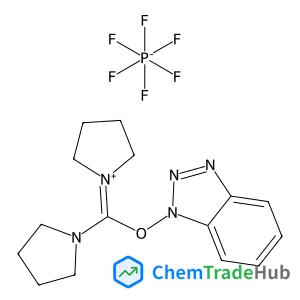
(1H-Benzotriazol-1-yloxy)(di-1-pyrrolidinyl)methylium hexafluorophosphate
CAS番号:
105379-24-6
分子式:
C15H21F6N5OP
おすすめサプライヤー




免責事項
このページに表示される学術雑誌情報は、参考および研究目的のみを目的としています。当社は雑誌出版社とは提携しておらず、投稿の取り扱いも行っておりません。出版に関するお問い合わせは、各雑誌出版社に直接ご連絡ください。
表示されている情報に誤りがある場合は、support@chemtradehub.com までご連絡ください。迅速に確認し、対応いたします。