












![2,6-Bis({(2R)-2-[hydroxy(diphenyl)methyl]-1-pyrrolidinyl}methyl)-4-methylphenol structure](https://static.chemtradehub.com/structs/877/877395-58-9-70bf.webp "2,6-Bis({(2R)-2-[hydroxy(diphenyl)methyl]-1-pyrrolidinyl}methyl)-4-methylphenol structure")
Extremely strong organic–metal oxide electronic coupling caused by nucleophilic addition reaction
文献情報
出版日
2015-05-13
DOI
10.1039/C5CP01817J
インパクトファクター
3.676
著者
Minoru Hanaya
原文を見る
要旨
Electronic interactions between organic materials and inorganic semiconductors play important roles in various electronic and optoelectronic functions and also provide new functions such as optical interfacial charge-transfer (ICT) transitions having the following features. ICT transitions enable the capture of lower-energy photons than HOMO–LUMO gaps or band gaps and allow one-step charge separation without loss of energy. The hybrid material generated by the nucleophilic addition reaction between TiO2 and TCNQ exclusively exhibits strong ICT transitions. In this study, we report that strong organic–metal oxide electronic coupling is caused by the nucleophilic addition reaction, which enhances the ICT transitions. The electronic coupling between TiO2 and TCNQ occurs according to a two-step mechanism. First, the lowest unoccupied molecular orbital (LUMO (π*)) of TCNQ is elevated by the nucleophilic attack of a deprotonated hydroxy group on TiO2 to TCNQ and the electron distribution is moved toward TiO2. By this elevation and redistribution, the LUMO (π*) strongly interacts with the d(t2g) orbitals of a surface Ti atom. From avoided-crossing behavior with a large splitting energy of ca. 0.95 eV, the coupling energy was estimated to be as much as 0.5 eV in the mono-Ti model complex. This strong d–π* electronic coupling leads to strong coupling between complete ICT excited states and partial ICT excited states with a large splitting energy of ca. 0.92 eV, which considerably increases the probabilities of ICT transition. This study clarified the mechanisms of the strong organic–inorganic electronic coupling and the enhancement of ICT absorption in the TiO2–TCNQ hybrid material.
関連文献
Living radical polymerization of vinyl acetate and methyl acrylate mediated by Co(Salen*) complexes
Chei-Ming Liao, Ching-Chun Hsu, Fu-Sheng Wang, Bradford B. Wayland, Chi-How Peng
2013-03-14
Paper
DOI: 10.1039/C3PY00282A
A facile and highly efficient strategy for esterification of poly(meth)acrylic acid with halogenated compounds at room temperature promoted by 1,1,3,3-tetramethylguanidine
Qianbiao Li, Yinyin Bao, Hu Wang, Fanfan Du, Qing Li, Bangkun Jin, Ruke Bai
2013-03-22
Paper
DOI: 10.1039/C3PY00155E
Triphenylphosphine as phosphorus catalyst for reversible chain-transfer catalyzed polymerization (RTCP)
Liangjiu Bai, Lifen Zhang, Yuan Liu, Xiangqiang Pan, Zhenping Cheng, Xiulin Zhu
2013-03-04
Paper
DOI: 10.1039/C3PY00187C
Hybrid materials consisting of an all-conjugated polythiophene backbone and grafted hydrophilic poly(ethylene glycol) chains
Luminita Cianga, Luis J. del Valle, Ioan Cianga
2013-03-01
Paper
DOI: 10.1039/C3PY00029J
Linear and hyperbranched phosphorylcholine based homopolymers for blood biocompatibility
Manraj Jawanda, Benjamin F. L. Lai, Kazuhiko Ishihara, Ravin Narain
2013-03-13
Paper
DOI: 10.1039/C3PY00248A
A one component methodology for the fabrication of honeycomb films from biocompatible amphiphilic block copolymer hybrids: a linear–dendritic–linear twist
Marie V. Walter, Pontus Lundberg, Daniel Hult, Anders Hult, Michael Malkoch
2013-03-04
Paper
DOI: 10.1039/C3PY00053B
A self-healing supramolecular polymer gel with stimuli-responsiveness constructed by crown ether based molecular recognition
Xuzhou Yan, Donghua Xu, Jianzhuang Chen, Mingming Zhang, Bingjie Hu, Yihua Yu, Feihe Huang
2013-03-12
Paper
DOI: 10.1039/C3PY00283G
Synthesis and optical properties of new fluorinated second-order nonlinear optical copolymers: an attempt toward the balance between solubility and long-term alignment stability
Jialei Liu, Ling Qiu, Xinhou Liu, Shuhui Bo, Zhen Zhen
2013-02-01
Paper
DOI: 10.1039/C3PY20935K
Synthesis of well-defined poly(2-(dimethylamino)ethyl methacrylate) under mild conditions and its co-polymers with cholesterol and PEG using Fe(0)/Cu(ii) based SARA ATRP
Rosemeyre A. Cordeiro, Nuno Rocha, Joana P. Mendes, Krzysztof Matyjaszewski, Tamaz Guliashvili, Arménio C. Serra, Jorge F. J. Coelho
2013-03-04
Paper
DOI: 10.1039/C3PY00190C
A controlled and versatile NCA polymerization method for the synthesis of polypeptides‡
Inmaculada Conejos-Sánchez, Aroa Duro-Castano, Alexander Birke, Matthias Barz, María J. Vicent
2013-04-08
Communication
DOI: 10.1039/C3PY00347G
こちらもおすすめ
化合物よくある質問
2-ヒドロキシ-5-ニトロベンジンブロモイドの代替品はありますか?
2-ヒドロキシ-5-ニトロベンジンブロモイドは特定の化学反応に適しているため、代替品は限られています。しかし、同様の構造を持つ2-ヒドロキシ-4-ニトロベンジン...
772-33-82-(Bromomethyl)-4-ni...
化合物よくある質問
N-(2-ブロモフェニル)-1-チロール-3-オキソ-3-(ピペリジニル)プロペン-2-イル)ベンゼンアミドを取り扱う際の実験室安全事項は何ですか?
N-(2-ブロモフェニル)-1-チロール-3-オキソ-3-(ピペリジニル)プロペン-2-イル)ベンゼンアミドは有毒で、皮膚や粘膜に刺激を与える可能性があります。...
1800044-77-2N-[(1Z)-1-(2-Bromoph...
化合物よくある質問
1,3プロパンジオール,2-[2-(2アミノ-6クロロ-9Hピリミジン-9-イル)エチル-1,1,2,2-D4]-2,3-ジアセタートの市場動向や研究トレンドはどうですか?
この化合物は、新規治療薬の開発に注目されています。市場では、その有効性と安全性が評価され、研究分野では、分子生物学と医薬化学の新たな発見が期待されています。
1020718-81-31,3-Propanediol, 2-[...
579-44-2Ethanone, 2-hydroxy-...
化合物よくある質問
Succinimidyl-alanyl-phenylalanyl-prolyl-phenylalanine 4-nitroanilide はどの業界で使用されていますか?
Succinimidyl-alanyl-phenylalanyl-prolyl-phenylalanine 4-nitroanilide は主に医薬品開発やポ...
128802-73-3succinimidyl-alanyl-...
化合物よくある質問
メチル6-アミノ-5-クロロピリジン-2-カーボイル酸について、適用される法規ガイドラインは何ですか?
メチル6-アミノ-5-クロロピリジン-2-カーボイル酸(CAS番号: 1256794-05-4)の使用には、GHS( Globally Harmonized S...
1256794-05-4Methyl 6-amino-5-chl...
化合物よくある質問
エチル4-(シクロ Pentagonyl)アミノ-2-メチル硫化基ピリミジン-5-カルボキシレートを取り扱う際の実験室安全事項は何ですか?
取り扱いには、耐薬品性の容器を使用し、通気性の良い場所で操作することを推奨します。漏れ時は、SDS(安全データシート)を参照して適切な措置を取ること。手洗いと洗...
211245-62-4ethyl 4-(cyclopentyl...
化合物よくある質問
(S)-3-ベンZYルピペリジン塩酸塩とは何ですか?
(S)-3-ベンZYルピペリジン塩酸塩は、CAS番号1258940-00-9で表される化合物です。これは、(S)-3-苯基哌啶的盐酸盐であり、主に医薬品の原料と...
1258940-00-9(S)-3-Phenylpiperidi...
化合物よくある質問
3,5-二甲基金剛胺の主な用途は何ですか?
3,5-二甲基金剛胺は、主に医薬品の原料として使用され、また抗うつ薬や抗アルツハイマー薬の開発に利用されます。さらに、化粧品や食品添加物の製造でも重要な役割を果...
19988-45-52-(2,3-Dihydroxyphen...
化合物よくある質問
ビス(4-メチル-2-ペンチル)フェニルカルボン酸エステルの代替品はありますか?
ビス(4-メチル-2-ペンチル)フェニルカルボン酸エステル (CAS番号: 1398066-13-1) の代替品には、ビス(2-エチルヘキシル)フェノールカルボ...
1398066-13-1Bis(4-methyl-2-penty...
掲載誌
Physical Chemistry Chemical Physics

CiteScore:
5.5
自己引用率:
10.3%
年間論文数:
3036
Physical Chemistry Chemical Physics (PCCP) is an international journal co-owned by 19 physical chemistry and physics societies from around the world. This journal publishes original, cutting-edge research in physical chemistry, chemical physics and biophysical chemistry. To be suitable for publication in PCCP, articles must include significant innovation and/or insight into physical chemistry; this is the most important criterion that reviewers and Editors will judge against when evaluating submissions. The journal has a broad scope and welcomes contributions spanning experiment, theory, computation and data science. Topical coverage includes spectroscopy, dynamics, kinetics, statistical mechanics, thermodynamics, electrochemistry, catalysis, surface science, quantum mechanics, quantum computing and machine learning. Interdisciplinary research areas such as polymers and soft matter, materials, nanoscience, energy, surfaces/interfaces, and biophysical chemistry are welcomed if they demonstrate significant innovation and/or insight into physical chemistry. Joined experimental/theoretical studies are particularly appreciated when complementary and based on up-to-date approaches.
おすすめ化合物
![1-[3-(4-Morpholinylsulfonyl)phenyl]methanamine structure](https://static.chemtradehub.com/structs/933/933989-32-3-51af.webp "1-[3-(4-Morpholinylsulfonyl)phenyl]methanamine structure")
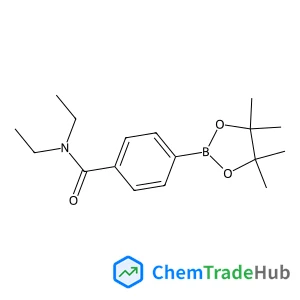
N,N-Diethyl-4-(4,4,5,5-tetramethyl-1,3,2-dioxaborolan-2-yl)benzamide
CAS番号:
325142-99-2
分子式:
C17H26BNO3
おすすめサプライヤー






免責事項
このページに表示される学術雑誌情報は、参考および研究目的のみを目的としています。当社は雑誌出版社とは提携しておらず、投稿の取り扱いも行っておりません。出版に関するお問い合わせは、各雑誌出版社に直接ご連絡ください。
表示されている情報に誤りがある場合は、support@chemtradehub.com までご連絡ください。迅速に確認し、対応いたします。