












A combined computational and experimental study of the [Co(bpy)3]2+/3+ complexes as one-electron outer-sphere redox couples in dye-sensitized solar cell electrolyte media
文献情報
出版日
2014-04-16
DOI
10.1039/C3CP55034F
インパクトファクター
3.676
著者
Narges Yaghoobi Nia, Pooria Farahani, Hassan Sabzyan, Mahmoud Zendehdel, Mohsen Oftadeh
原文を見る
要旨
A combined experimental and computational investigation conducted to understand the nature of the interactions between cobalt II/III redox mediators ([Co(bpy)3]2+/3+) and their impact on the performance of the corresponding dye-sensitized solar cells (DSCs) is reported. The fully optimized equilibrium structures of cobalt(II/III)-tris-bipyridine complexes in the gas phase and acetonitrile solvent are obtained by the density functional B3LYP method using LanL2DZ and 6-31G(d,p) basis sets. The harmonic vibrational frequencies, infrared intensities and Raman scattering activities of the complexes are also calculated. The scaled computational vibrational wavenumbers show very good agreement with the experimental values. Calculations of the electronic properties of the complexes are also performed at the TD-B3LYP/6-31G(p,d)[LanL2DZ] level of theory. Detailed interpretations of the infrared and Raman spectra of the complexes in different phases are reported. Detailed atomic orbital coefficients of the frontier molecular orbitals and their major contributions to electronic excitations of the complexes are also reported. These results are in good agreement with the experimental electrochemical values. Marcus diagram is derived for the electron transfer reaction Co(II) + D35+ → Co(III) + D35 using the Co–N bond length as a reaction coordinate.
関連文献
Enhancing paracellular and transcellular permeability using nanotechnological approaches for the treatment of brain and retinal diseases
Asmaa Khalil, Alexandre Barras, Rabah Boukherroub, David Devos, Sabine Szunerits
2023-09-13
Review Article
DOI: 10.1039/D3NH00306J
Recent progress of MXene as an energy storage material
Yuqiang Wu, Mengtao Sun
2024-01-05
Minireview
DOI: 10.1039/D3NH00402C
van der Waals 2D transition metal dichalcogenide/organic hybridized heterostructures: recent breakthroughs and emerging prospects of the device
Sherif Kamal, Yahya Khan, Marko Kralj
2023-10-30
Review Article
DOI: 10.1039/D3NH00310H
Fe(iii)-carboxythiolate layered metal–organic frameworks with interest as active materials for rechargeable alkali-ion batteries
Nusik Gedikoglu, Pablo Salcedo-Abraira, Nathalie Guillou, Nicolas Dupré, Christophe Payen, Philippe Poizot, Thomas Devic
2023-10-20
Paper
DOI: 10.1039/D3TA05353A
A PEDOT:PSS nanocomposite film doped with black phosphorus modified with silver nanoparticles for wearable photothermoelectric generators
Chia-Hao Tsai, Shih-Hung Tung, Jhih-Min Lin
2023-10-26
Paper
DOI: 10.1039/D3TA05836K
MnP4 electrode for Na-ion batteries: a complex and effective electrochemical mechanism
Julien Fullenwarth, Bernard Fraisse, Nicolas Dupré
2023-10-02
Paper
DOI: 10.1039/D3TA02329J
Carrier density and delocalization signatures in doped carbon nanotubes from quantitative magnetic resonance
M. Alejandra Hermosilla-Palacios, Marissa Martinez, Evan A. Doud, Tobias Hertel, Alexander M. Spokoyny, Sofie Cambré, Wim Wenseleers, Yong-Hyun Kim, Andrew J. Ferguson, Jeffrey L. Blackburn
2023-11-22
Communication
DOI: 10.1039/D3NH00480E
Sublimation-based wafer-scale monolayer WS2 formation via self-limited thinning of few-layer WS2
Mingxi Chen, Jianwei Chai, Jing Wu, Wen-Ya Wu, James Lourembam, Ming Lin, Jun-Young Kim, Jaewon Kim, Man-Fai Ng, Henry Medina, Shi Wun Tong, Dongzhi Chi
2023-10-05
Communication
DOI: 10.1039/D3NH00358B
Electrifying H2O2 synthesis with g-C3N4-based single atom catalysts
Jungki Ryu
2023-10-04
Editorial
DOI: 10.1039/D3NH90041J
High-performance ultrathin perfluorinated sulfonic acid membranes with thermo-morphology control for a vanadium redox flow battery
Yecheol Rho, Soonyong So
2023-10-23
Paper
DOI: 10.1039/D3TA04760A
こちらもおすすめ
化合物よくある質問
2,3-スチオエポキシマドルを取り扱う際の実験室安全事項は何ですか?
取り扱いにはPPE(プロテクティブ・パーソナル・エイド)が必要で、防ぐ手袋と保護眼鏡を着用してください。ドラフトチャンバーの使用を推奨します。漏洩した場合は、適...
4267-80-52,3-Thioepoxy Madol
53981-25-22-Amino-6-fluorophen...
化合物よくある質問
BOC-S-3-アミニ-4-(4-メチオキシベンチル)-ブタン酸の代替品はありますか?
この化合物の代替品としては、BOC保護基を有さないアミノ酸やその他の保護基化合物が考えられます。また、メチオキシ基を有しない他の芳香族アミノ酸も代替品として挙げ...
126800-59-7(3S)-4-(4-Methoxyphe...
化合物よくある質問
Methyl 2-(chloromethyl)-3-nitrobenzoate(1218910-61-2)の代替品はありますか?
Methyl 2-(chloromethyl)-3-nitrobenzoate(1218910-61-2)の代替品としては、化学組成を変えることで効果を達成する...
1218910-61-2Methyl 2-(chlorometh...
化合物よくある質問
(2R)-2-アミノ-N-ベンジル-3-ヒドロキシプロパナミドを含む廃棄物はどのように処理すべきですか?
(2R)-2-アミノ-N-ベンジル-3-ヒドロキシプロパナミドを含む廃棄物は、適切な廃棄物管理ガイドラインに基づき処理する必要があります。まず、廃棄物を適切に収...
175481-39-7(2R)-2-amino-N-benzy...
化合物よくある質問
6,7-二氢-咪唑並[1,2-a]ピリドイン-8(5h)-酮はどのように合成されますか?
6,7-二氢-咪唑並[1,2-a]ピリドイン-8(5h)-酮は、2-ブロモフェニルアセトインとリン酸ハロゲン化物を反応させることで合成できます。この反応は高温で...
457949-09-66,7-Dihydroimidazo[1...
化合物よくある質問
エチル(3R)-3-ピロリジニル酢酸水和塩とは何ですか?
エチル(3R)-3-ピロリジニル酢酸水和塩は、CAS番号1332459-32-1の化合物で、(R)-乙基2-(ピロリジン-3-基)酢酸塩水和塩と呼ばれます。この...
1332459-32-1Ethyl (3R)-3-pyrroli...
化合物よくある質問
(2S)-{[(2-メチルエチルオキシ]カルボニル}アミノ)[2-(トリアフルオロメチルフェニル]エチカシック酸の物理化学的性質は何ですか?
(2S)-{[(2-メチルエチルオキシ]カルボニル}アミノ)[2-(トリアフルオロメチルフェニル]エチカシック酸のCAS番号は1203454-45-8です。この...
1203454-45-8(2S)-({[(2-Methyl-2-...
化合物よくある質問
2-ブロモ-1-(2-メチル-2-プロパニル)-4-ニトロベンゼンはどのように保存すればよいですか?
2-ブロモ-1-(2-メチル-2-プロパニル)-4-ニトロベンゼンは、直射日光を避けて暗所で、室温(約15℃〜25℃)、乾燥した場所に保存する必要があります。ま...
6310-17-42-Bromo-1-(2-methyl-...
化合物よくある質問
1-[(4-硝基フェニル)スルホニル]-1H-1,2,4-三唑の市場動向や研究トレンドはどうですか?
市場動向としては、1-[(4-硝基フェニル)スルホニル]-1H-1,2,4-三唑は主に農業用除草剤や合成化学製品の原料として利用されています。研究トレンドとして...
57777-84-11-[(4-Nitrophenyl)su...
掲載誌
Physical Chemistry Chemical Physics

CiteScore:
5.5
自己引用率:
10.3%
年間論文数:
3036
Physical Chemistry Chemical Physics (PCCP) is an international journal co-owned by 19 physical chemistry and physics societies from around the world. This journal publishes original, cutting-edge research in physical chemistry, chemical physics and biophysical chemistry. To be suitable for publication in PCCP, articles must include significant innovation and/or insight into physical chemistry; this is the most important criterion that reviewers and Editors will judge against when evaluating submissions. The journal has a broad scope and welcomes contributions spanning experiment, theory, computation and data science. Topical coverage includes spectroscopy, dynamics, kinetics, statistical mechanics, thermodynamics, electrochemistry, catalysis, surface science, quantum mechanics, quantum computing and machine learning. Interdisciplinary research areas such as polymers and soft matter, materials, nanoscience, energy, surfaces/interfaces, and biophysical chemistry are welcomed if they demonstrate significant innovation and/or insight into physical chemistry. Joined experimental/theoretical studies are particularly appreciated when complementary and based on up-to-date approaches.
おすすめ化合物

![1-[4-(4-Methyl-1H-imidazol-1-yl)phenyl]ethanone structure](https://static.chemtradehub.com/structs/142/142161-53-3-7f55.webp "1-[4-(4-Methyl-1H-imidazol-1-yl)phenyl]ethanone structure")
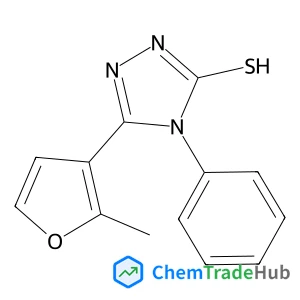
5-(2-Methyl-3-furyl)-4-phenyl-2,4-dihydro-3H-1,2,4-triazole-3-thione
CAS番号:
346464-59-3
分子式:
C13H11N3OS
おすすめサプライヤー






免責事項
このページに表示される学術雑誌情報は、参考および研究目的のみを目的としています。当社は雑誌出版社とは提携しておらず、投稿の取り扱いも行っておりません。出版に関するお問い合わせは、各雑誌出版社に直接ご連絡ください。
表示されている情報に誤りがある場合は、support@chemtradehub.com までご連絡ください。迅速に確認し、対応いたします。