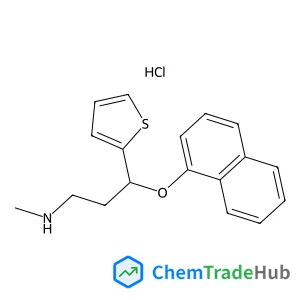
N-Methyl-3-(1-naphthyloxy)-3-(2-thienyl)-1-propanamine hydrochloride (1:1)
CAS番号:
1188266-11-6
分子式:
C18H20ClNOS
Sai Sushree Rath, Nehapadma Mohanty, Braja N. Patra
Dyes are potential pollutants in water due to their non-degradable nature and stability toward oxidizing agents and light. Among all the techniques available for the removal of dyes, the adsorption method is attracting the interest of researchers worldwide owing to its advantages, for instance, inexpensiveness, high efficiency and ease of synthesis. In this work, the emeraldine base form of polyaniline (EBPANI) was used as a nucleophile to synthesize polyaniline grafted maleic acid (PANI-g-MA) adsorbent, which was used to adsorb dyes selectively from wastewater upon modulation of the pH. The prepared grafted polymer was analysed using characterization techniques including transmission electron microscopy (TEM), scanning electron microscopy (SEM), X-ray diffraction (XRD), and Fourier transform infrared (FTIR) spectroscopy. PANI-g-MA demonstrated the adsorption of cationic and anionic dyes selectively at different pH values owing to the availability of different charges. The maximum adoption capacity for methylene blue (MB) dyes was found to be 181.81 mg g−1. The adsorption parameters, such as adsorbent dose, pH, temperature, initial dye concentration and contact time, along with the kinetics and thermodynamic parameters (ΔG°, ΔH°, ΔS°), were evaluated for potential application in the real world. The Langmuir isotherm model is best suited to explain this adsorption process. This type of adsorption follows pseudo-second-order kinetics.
Jialu Wang, Martha Sibrian-Vazquez, Jorge O. Escobedo, Mark Lowry, Lei Wang, Yu-Hsuan Chu, Richard G. Moore, Robert M. Strongin
DOI: 10.1039/C3AN01168B
Andrew J. Wilson, Katherine A. Willets
DOI: 10.1039/C6AN01266C
Asta Žukauskaitė, Ivan Petřík, Aleš Pěnčík, Martin Hönig, Jiří Grúz, Jitka Široká, Ondřej Novák
DOI: 10.1039/D0AN02118K
Shang-heng Tsai, Wei-Jen Ting, Chao-Chin Hu, C. Bor Fuh
DOI: 10.1039/C3AN02226A
Ya-Nan Wang, Xiao-Qing Zhang, Ru Sun, Yu-Jie Xu, Jian-Feng Ge
DOI: 10.1039/D1TB01106E
Ionut Tranca, Xin Zhou, Can Li
DOI: 10.1039/C5TA02193F
Fan Huang, Kersti Karu, Luiza C. Campos
DOI: 10.1039/D0AN02335C
Ying-Jie Tang, Wen-Le Fang, Kui Ren, Xiao-Feng Guo, Hong Wang
DOI: 10.1039/D1AN00161B
Hideo Nakano, Tsutomu Nakayama
DOI: 10.1039/D1AN02278D
3-イチチルビフェニルは、ビフェニルとイチプロピオニトリルを回収率約90%で反応させて合成されます。触媒は通常、亜リチウムホウ素を用います。
8-溴-5-三氟甲基喹啉は、5-トリフルオロメチル-2-メチル-1,3-ベンゼンジオールをブロモエタノールと反応させて生成します。この反応は塩基性条件下で行われ...
ジメチル4-(4,4,5,5-テトラメチル-1,3,2-ドioxaborolan-2-基)-2,6-ピリジンジカルボイル酸フェニルアミニドの代替品としては、4-...
N-(3,5-ヘキサクロロ-4-ピリドインイル)-8-メチオキシ-5-キノリンカーボン酸の市場動向は、主に産業用途での需要により影響を受けます。研究トレンドとし...
イソステアロイルグリセリルは一般的に安全性が高いとされていますが、過度な使用や個人差により皮�owsん炎などの反応が起こる可能性があります。使用前に医師に相談す...
1-(二苯甲基)-3,3-二氟-氮杂环丁烷の市場動向は、医薬品や合成化学の研究分野で注目を集めています。新興研究は、該当化合物の合成改良と生体内での作用メカニズ...
3-チオフェンスチオールのCAS番号は7774-73-4です。結晶性の白色粉末で、分子量は122.17です。この化合物は水に微溶解し、エタノールやジクロロメタン...
2-Methyl-2-propanyl (2S)-2-(aminomethyl)-1-piperidinecarboxylateは一定の安全性基準を満たしていま...
CAS番号1316822-90-8の化合物は安全性に関しては評価が不足していますが、一般的には生物学的に活性な物質であり、取り扱いには適切な安全防護措置が必要で...
Tert-butyl 2-(2-羟基乙基)哌嗪-1-羧酸は、冷暗所で保存し、直射日光から遠ざけてください。容器は密閉し、高湿度や高温を避けて保管してください。

Polymer Chemistry welcomes submissions in all areas of polymer science that have a strong focus on macromolecular chemistry. Manuscripts may cover a broad range of fields, yet no direct application focus is required.
![1,10-bis(3,5-dimethylphenyl)-12-hydroxy-4,5,6,7-tetrahydroiindeno[7,1-de:1',7'-fg][1,3,2]dioxaphosphocine 12-oxide structure](https://static.chemtradehub.com/structs/141/1412439-82-7-b9a9.webp "1,10-bis(3,5-dimethylphenyl)-12-hydroxy-4,5,6,7-tetrahydroiindeno[7,1-de:1',7'-fg][1,3,2]dioxaphosphocine 12-oxide structure")