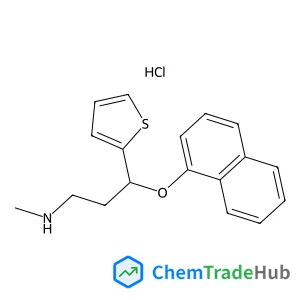
N-Methyl-3-(1-naphthyloxy)-3-(2-thienyl)-1-propanamine hydrochloride (1:1)
CAS番号:
1188266-11-6
分子式:
C18H20ClNOS
Fan Huang, Kersti Karu, Luiza C. Campos
Given detrimental impacts induced by estrogens at trace level, determination of them is significant but challenging due to their low content in environmental samples and inherent weak ionisation. A modified derivatisation-based methodology was applied for the first time to detect estrogen in free and conjugated forms including some isomers simultaneously using liquid chromatography tandem mass spectrometry (LC-MSn). Derivatisation reaction with previously used 1,2-dimethyl-1H-imidazole-5-sulphonyl chloride allowed significant increase of mass spectrometric signal of analytes and also provided distinctive fragmentation for their confirmation even in complicated matrix. Then satisfactory recovery (>75%) for the majority of analytes was achieved following optimisation of solid phase extraction (SPE) factors. The linearity was validated over a wide concentration with the correlation coefficient around 0.995. The repeatability of this methodology was also confirmed via the intra-day and inter-day precision and was less than 11.73%. Validation of method quantification limits (MQLs) for all chosen estrogens was conducted using 1000 mL surface water, ranging from 7.0 to 132.3 pg L−1. The established methodology was applied to profile presence of targeted estrogens in natural surface water samples. Out of the ten compounds of interest, three free estrogens (E1, E2, E3) and two sulphate estrogens (E1-3S and E2-3S) were found over their MQLs, being in the range of 0.05–0.32 ng L−1.
Jason A. Halfen, Victor G. Young, Jr.
DOI: 10.1039/B311520H
Hind A. Al-Abadleh, B. J. Krueger, J. L. Ross, V. H. Grassian
DOI: 10.1039/B308632A
Tara J. Burchell, Dana J. Eisler, Richard J. Puddephatt
DOI: 10.1039/B400523F
Michael Ruf, William S. Durfee, Cortlandt G. Pierpont
DOI: 10.1039/B401334D
Roger R. Hill, Sharon A. Moore, David R. Roberts
DOI: 10.1039/B308525B
Jonathan M. Stoddard, Kenneth J. Shea
DOI: 10.1039/B311292F
Arif Ali Khan, Cathleen Wismach, Peter G. Jones, Rainer Streubel
DOI: 10.1039/B309443J
Christophe Jeandon, Romain Ruppert, Henry J. Callot
DOI: 10.1039/B400812J
Lin-Ping Zhang, Thomas C. W. Mak
DOI: 10.1039/B307604K
John W. C. Cheing, William P. D. Goldring, Gerald Pattenden
DOI: 10.1039/B310753A
3-イチチルビフェニルは、ビフェニルとイチプロピオニトリルを回収率約90%で反応させて合成されます。触媒は通常、亜リチウムホウ素を用います。
8-溴-5-三氟甲基喹啉は、5-トリフルオロメチル-2-メチル-1,3-ベンゼンジオールをブロモエタノールと反応させて生成します。この反応は塩基性条件下で行われ...
ジメチル4-(4,4,5,5-テトラメチル-1,3,2-ドioxaborolan-2-基)-2,6-ピリジンジカルボイル酸フェニルアミニドの代替品としては、4-...
N-(3,5-ヘキサクロロ-4-ピリドインイル)-8-メチオキシ-5-キノリンカーボン酸の市場動向は、主に産業用途での需要により影響を受けます。研究トレンドとし...
イソステアロイルグリセリルは一般的に安全性が高いとされていますが、過度な使用や個人差により皮�owsん炎などの反応が起こる可能性があります。使用前に医師に相談す...
1-(二苯甲基)-3,3-二氟-氮杂环丁烷の市場動向は、医薬品や合成化学の研究分野で注目を集めています。新興研究は、該当化合物の合成改良と生体内での作用メカニズ...
3-チオフェンスチオールのCAS番号は7774-73-4です。結晶性の白色粉末で、分子量は122.17です。この化合物は水に微溶解し、エタノールやジクロロメタン...
2-Methyl-2-propanyl (2S)-2-(aminomethyl)-1-piperidinecarboxylateは一定の安全性基準を満たしていま...
CAS番号1316822-90-8の化合物は安全性に関しては評価が不足していますが、一般的には生物学的に活性な物質であり、取り扱いには適切な安全防護措置が必要で...
Tert-butyl 2-(2-羟基乙基)哌嗪-1-羧酸は、冷暗所で保存し、直射日光から遠ざけてください。容器は密閉し、高湿度や高温を避けて保管してください。

Analyst publishes analytical and bioanalytical research that reports premier fundamental discoveries and inventions, and the applications of those discoveries, unconfined by traditional discipline barriers.
![N-{15-[(2,5-Dioxo-1-pyrrolidinyl)oxy]-15-oxo-3,6,9,12-tetraoxapentadec-1-yl}-2-(2-propyn-1-yloxy)acetamide structure](https://static.chemtradehub.com/structs/210/2101206-92-0-2eb5.webp "N-{15-[(2,5-Dioxo-1-pyrrolidinyl)oxy]-15-oxo-3,6,9,12-tetraoxapentadec-1-yl}-2-(2-propyn-1-yloxy)acetamide structure")