












Photochemical C–H bond coupling for (hetero)aryl C(sp2)–C(sp3) bond construction
文献情報
出版日
2019-04-20
DOI
10.1039/C9OB00244H
インパクトファクター
3.876
著者
Wujiong Xia
原文を見る
要旨
Alkylated (hetero)arenes constitute one of the most fundamental skeletons in organic molecules, which prompts a growing number of research studies on the construction of (hetero)aryl C(sp2)–C(sp3) bonds especially using C–H bonds of feedstocks. With the flourishing resurgence of photoredox catalysis in organic synthesis, fruitful achievements have been witnessed in photochemical (hetero)aryl C(sp2)–C(sp3) bond formation through C–H bond coupling such as (hetero)arylation of C(sp3)–H bonds and alkylation of (hetero)aryl C(sp2)–H bonds. Photoinduced generation of alkyl radicals from various alkylating agents is the key point to the success of these reactions. This review will summarise advances in this area with emphasis on the reaction mechanisms.
おすすめジャーナル
関連文献
Modeling the impedance spectra of mixed conducting thin films with exposed and embedded current collectors
Jiapeng Liu
2017-09-18
Paper
DOI: 10.1039/C7CP03703A
Quercetin and its analogues: optical and acido–basic properties
David Biedermann, Kateřina Valentová, Vladimír Křen, Martin Kubala
2017-09-07
Paper
DOI: 10.1039/C7CP03845C
Two coexisting liquid phases in switchable ionic liquids
Juan Yao, David B. Lao, Xiao Sui, Yufan Zhou, Satish K. Nune, Xiang Ma, Tyler P. Troy, Musa Ahmed, Zihua Zhu, David J. Heldebrant, Xiao-Ying Yu
2017-06-23
Communication
DOI: 10.1039/C7CP03754F
Double salt ionic liquids based on 1-ethyl-3-methylimidazolium acetate and hydroxyl-functionalized ammonium acetates: strong effects of weak interactions
Patrick S. Barber, Paula Berton
2017-09-18
Paper
DOI: 10.1039/C7CP05710E
Theoretical study on geometric, electronic and catalytic performances of Fe dopant pairs in graphene
Yanan Tang, Huadou Chai, Weiguang Chen, Xiao Cui, Yaqiang Ma, Mingyu Zhao
2017-09-08
Paper
DOI: 10.1039/C7CP05683D
A lipophilic ionic liquid based on formamidinium cations and TFSI: the electric response and the effect of CO2 on the conductivity mechanism
Federico Bertasi, Guinevere A. Giffin, Keti Vezzù, Yaser Abu-Lebdeh, Michel Armand
2017-09-05
Paper
DOI: 10.1039/C7CP02304A
Ionic effects on the proton transfer mechanism in aqueous solutions
Joonyoung F. Joung, Sangin Kim, Sungnam Park
2017-08-25
Paper
DOI: 10.1039/C7CP04392A
DNA protection by ectoine from ionizing radiation: molecular mechanisms
Maria-Astrid Schröter, Hans-Jörg Kunte, Tihomir Solomun
2017-08-31
Paper
DOI: 10.1039/C7CP02860A
Surface chemistry and interface science
Junbai Li, Krister Holmberg
2017-07-25
Editorial
DOI: 10.1039/C7CP90152F
こちらもおすすめ
化合物よくある質問
間溴苯甲酰腈の市場動向や研究トレンドはどうですか?
間 brom 苯甲酰腈は、合成化学や薬物化学において重要な Intermediate として使用されています。市場動向としては、その合成性と機能性により、研究開...
24999-51-7(3-Bromophenyl)(oxo)...
287966-62-5Desulfo Glucoraphani...
化合物よくある質問
Methyl 2-amino-5-(trifluoromethyl)benzoateに適用される法規ガイドラインは何ですか?
CAS番号117324-58-0の塩酸メチル2アミノ-5-トリフルオロメチルベンゼートは、GHS分類により腐食性物質と判定されます。REACH規則では、製造、販...
117324-58-0Methyl 2-amino-5-(tr...
化合物よくある質問
3-ブロモ-1,3,4,5-四水化-2H-1-ベンザアゼピン-2-オンは安全ですか?
毒性があるため、適切な安全対策が必須です。皮膚や粘膜への刺激性が強く、吸入や誤飲により健康被害を引き起こす可能性があります。取扱時にはガスマスクや手袋、眼鏡を使...
86499-96-93-Bromo-1,3,4,5-tetr...
化合物よくある質問
三氟甲基ピリジン-2-甲アミン塩酸塩は安全ですか?
三氟甲基ピリジン-2-甲アミン塩酸塩は安全性に注意が必要です。毒性は低レベルですが、直接的接触や吸入は避けるべきです。適切な手袋や防塵マスクを着用し、密閉された...
871826-12-9(5-(Trifluoromethyl)...
化合物よくある質問
1-エチル-4-(4-硝基フェニル)ピペリジンは安全ですか?
1-エチル-4-(4-硝基フェニル)ピペリジンは有毒であり、取扱には注意が必要です。保管や作業中に手袋を着用し、目や皮膚に接触しないように注意する必要があります...
115619-00-61-Ethyl-4-(4-nitroph...
化合物よくある質問
1,1-ジメトキシプロパン-2-オンは安全ですか?
1,1-ジメトキシプロパン-2-オンは一般的に低毒性ですが、皮膚や目への刺激性があるため、取扱いには注意が必要です。蒸気や液体の吸入には有害な可能性があり、適切...
6342-56-91,1-dimethoxypropan-...
化合物よくある質問
コバルト(II) 3,3'-{[(1S,2S)-1,2-ジメチルフENCYCLICALE-1,2-エチエンジイル]ビス[ニトロリルメチルイリデン]}ビス[4-オキソ-2-ペンテン-2-olate]について「に適用される法規ガイドラインは何ですか?
この化合物はCAS番号259259-80-8に対応しています。GHS分類では、毒性、燃焼性、反応性、炎症性を考慮に入れ、適切な危険性分類が行われます。REACH...
259259-80-8Cobalt(2+) (2E,2'E)-...
化合物よくある質問
「カーバミル酸, N-[8-[[2-[[2-(2,6-ジオキソ-3-ピペリジニル)-2,3-ジオキソ-1,3-ジヒドロ-1H-イソイソインドール-4-イルオキシ]アセチル]アミノ]オクチル]-1,1-ジメチレチルエステル」はどのように保存すればよいですか?
この化合物は、冷却庫で-20℃の温度、乾燥した容器に保管し、直日光から保護する必要があります。湿度の高い環境や高温は避けてください。
1950635-34-32-Methyl-2-propanyl ...
1433975-21-3FMoc-D-4-Aph(tBu-CbM...
掲載誌
Organic & Biomolecular Chemistry

CiteScore:
3.4
自己引用率:
10.3%
年間論文数:
1041
Organic & Biomolecular Chemistry (OBC) publishes original and high impact research and reviews in organic chemistry. We welcome research that shows new or significantly improved protocols or methodologies in total synthesis, synthetic methodology or physical and theoretical organic chemistry as well as research that shows a significant advance in the organic chemistry or molecular design aspects of chemical biology, catalysis, supramolecular and macromolecular chemistry, theoretical chemistry, mechanism-oriented physical organic chemistry, medicinal chemistry or natural products. Articles published in the journal should report new work which makes a highly-significant impact in the field. Routine and incremental work is generally not suitable for publication in the journal. More details about key areas of our scope are below. In all cases authors should include in their article clear rationale for why their research has been carried out.
おすすめ化合物
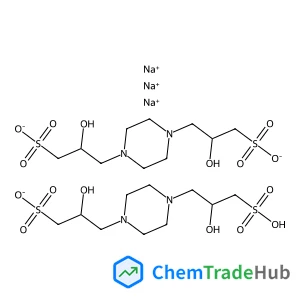
3,3'-(Piperazine-1,4-diyl)bis(2-hydroxypropane-1-sulfonic acid) Sodium Salt
CAS番号:
108321-08-0
分子式:
C20H41N4Na3O16S4
![(1R,3S,5R)-2-{[(2-Methyl-2-propanyl)oxy]carbonyl}-2-azabicyclo[3.1.0]hexane-3-carboxylic acid structure](https://static.chemtradehub.com/structs/197/197142-34-0-6a44.webp "(1R,3S,5R)-2-{[(2-Methyl-2-propanyl)oxy]carbonyl}-2-azabicyclo[3.1.0]hexane-3-carboxylic acid structure")
おすすめサプライヤー




免責事項
このページに表示される学術雑誌情報は、参考および研究目的のみを目的としています。当社は雑誌出版社とは提携しておらず、投稿の取り扱いも行っておりません。出版に関するお問い合わせは、各雑誌出版社に直接ご連絡ください。
表示されている情報に誤りがある場合は、support@chemtradehub.com までご連絡ください。迅速に確認し、対応いたします。