












A hybridization chain reaction coupled with gold nanoparticles for allergen gene detection in peanut, soybean and sesame DNAs
文献情報
出版日
2019-04-30
DOI
10.1039/C9AN00394K
インパクトファクター
4.616
著者
Dan Yuan, Yongxin Liu, Jilie Kong, Qin Chen
原文を見る
要旨
Food allergy is an abnormal immune response of the immune system to some foods, which has caused great harm to people's health. Therefore, it is particularly important to detect allergens in food. In this article, a hybridization chain reaction (HCR) was coupled with gold nanoparticles (AuNPs) to detect the allergen genes of peanut, soybean and sesame DNAs. Two hairpin probes (H1 and H2) were designed for the allergen target genes of peanut, soybean and sesame DNAs. In the presence of target DNA, the hybridization chain reaction was triggered by it producing long double-stranded DNA (dsDNA) products. In the gold nanoparticle system, long dsDNA couldn't be adsorbed on the surface of AuNPs. When the concentration of salt ions in the solution increased, gold nanoparticles accumulated and led to a decrease of ultraviolet absorption. In the absence of target DNA, no hybridization chain reaction occurred. The hairpin probes could be adsorbed on the surface of AuNPs and no accumulation happened for gold nanoparticles even if the concentration of salt ions in the solution was increased. This method required no enzymes and had a strong specificity, so it was very easy to distinguish target DNA from non-target DNA. The detection limit of three allergens detected by this method was as low as 0.5 nM. The feasibility of this method for the detection of commercial commodities had been demonstrated by the successful detection of the DNAs extracted from commercial commodities, which were treated with extreme thermostable single-stranded binding protein (ET SSB).
おすすめジャーナル
関連文献
Breaking the Hoff/Le Bel rule by an electron-compensation strategy: the global energy minimum of NGa4S4+
Xiu-dong Jia, Zhi-wei Du
2024-01-03
Paper
DOI: 10.1039/D3CP05290G
BX3-mediated borylation for the synthesis of organoboron compounds
2023-10-19
Review Article
DOI: 10.1039/D3QO01487H
Twisted organic TADF triads based on a diindolocarbazole donor for efficient photoisomerization of stilbene and photo-arylation of heteroarenes
Sushil Sharma, Sanchita Sengupta
2023-10-24
Research Article
DOI: 10.1039/D3QO01542D
Effect of polymer addition on the phase behavior of oil–water–surfactant systems of Winsor III type
Krister Holmberg
2023-10-31
Review Article
DOI: 10.1039/D3CP04730J
Chiral self-recognition in a bispericyclic cyclodimerisation reaction of 1-azadienes
Adrián López-Francés, Xabier del Corte, Zuriñe Serna-Burgos, Jesús M. de los Santos, Javier Vicario
2023-10-16
Research Article
DOI: 10.1039/D3QO01562A
N-Heterocyclic carbene catalyzed base assisted C–C bond cleavage of cyclopropenones: an approach towards diastereoselective synthesis of azetidinones and benzoxazepines
2023-10-25
Research Article
DOI: 10.1039/D3QO01328F
Asymmetric synthesis of (E)-Secobutanolides: total synthesis and structural revision of (+)-Litseakolide F and G
Dong Guk Nam, Jin Won Lee, Hyun Sil Jung, Do Hyun Ryu
2023-10-25
Research Article
DOI: 10.1039/D3QO01523H
A novel electrochemical flow-cell for operando XAS investigations in X-ray opaque supports
Guillaume Alizon, Andrea Zitolo, Andrea Di Cicco, Hélène Magnan, Emiliano Fonda
2024-01-08
Paper
DOI: 10.1039/D3CP04701F
A novel synthesis of dihydrofuranyl alcohols through cascade reactions of 1,3-diketones with α,β-unsaturated epoxides
Chengyu Yu, Penji Yan, Hai Song, Hucheng Shi, Yangfei Wei, Zhengen Song, Xin Jia
2023-10-09
Research Article
DOI: 10.1039/D3QO01309J
こちらもおすすめ
化合物よくある質問
3-イチチルビフェニルはどのように合成されますか?
3-イチチルビフェニルは、ビフェニルとイチプロピオニトリルを回収率約90%で反応させて合成されます。触媒は通常、亜リチウムホウ素を用います。
5668-93-93-Ethylbiphenyl
化合物よくある質問
8-溴-5-三氟甲基喹啉はどのように合成されますか?
8-溴-5-三氟甲基喹啉は、5-トリフルオロメチル-2-メチル-1,3-ベンゼンジオールをブロモエタノールと反応させて生成します。この反応は塩基性条件下で行われ...
917251-92-48-Bromo-5-(trifluoro...
化合物よくある質問
ジメチル4-(4,4,5,5-テトラメチル-1,3,2-ドioxaborolan-2-基)-2,6-ピリジンジカルボイル酸フェニルアミニドの代替品はありますか?
ジメチル4-(4,4,5,5-テトラメチル-1,3,2-ドioxaborolan-2-基)-2,6-ピリジンジカルボイル酸フェニルアミニドの代替品としては、4-...
741709-66-0Dimethyl 4-(4,4,5,5-...
化合物よくある質問
N-(3,5-ヘキサクロロ-4-ピリドインイル)-8-メチオキシ-5-キノリンカーボン酸の市場動向や研究トレンドはどのようなものでしょうか?
N-(3,5-ヘキサクロロ-4-ピリドインイル)-8-メチオキシ-5-キノリンカーボン酸の市場動向は、主に産業用途での需要により影響を受けます。研究トレンドとし...
199871-63-1N-(3,5-Dichloro-4-py...
化合物よくある質問
イソステアロイルグリセリルは安全ですか?
イソステアロイルグリセリルは一般的に安全性が高いとされていますが、過度な使用や個人差により皮�owsん炎などの反応が起こる可能性があります。使用前に医師に相談す...
222723-55-92-[(5Z,8Z,11Z,14Z)-5...
化合物よくある質問
1-(二苯甲基)-3,3-二氟-氮杂环丁烷の市場動向や研究トレンドはどうですか?
1-(二苯甲基)-3,3-二氟-氮杂环丁烷の市場動向は、医薬品や合成化学の研究分野で注目を集めています。新興研究は、該当化合物の合成改良と生体内での作用メカニズ...
288315-02-61-Benzhydryl-3,3-dif...
化合物よくある質問
3-チオフェンスチオールの物理化学的性質は何ですか?
3-チオフェンスチオールのCAS番号は7774-73-4です。結晶性の白色粉末で、分子量は122.17です。この化合物は水に微溶解し、エタノールやジクロロメタン...
7774-73-43-Thiophenethiol
化合物よくある質問
2-Methyl-2-propanyl (2S)-2-(aminomethyl)-1-piperidinecarboxylateは安全ですか?
2-Methyl-2-propanyl (2S)-2-(aminomethyl)-1-piperidinecarboxylateは一定の安全性基準を満たしていま...
475105-35-22-Methyl-2-propanyl ...
化合物よくある質問
CAS番号1316822-90-8の化合物は安全ですか?
CAS番号1316822-90-8の化合物は安全性に関しては評価が不足していますが、一般的には生物学的に活性な物質であり、取り扱いには適切な安全防護措置が必要で...
1316822-90-8Gal beta(1-3)[Neu5Ac...
化合物よくある質問
Tert-butyl 2-(2-羟基乙基)哌嗪-1-羧酸はどのように保存すればよいですか?
Tert-butyl 2-(2-羟基乙基)哌嗪-1-羧酸は、冷暗所で保存し、直射日光から遠ざけてください。容器は密閉し、高湿度や高温を避けて保管してください。
517866-79-4Tert-butyl 2-(2-hydr...
掲載誌
Analyst

CiteScore:
7.8
自己引用率:
5.6%
年間論文数:
653
Analyst publishes analytical and bioanalytical research that reports premier fundamental discoveries and inventions, and the applications of those discoveries, unconfined by traditional discipline barriers.
おすすめ化合物
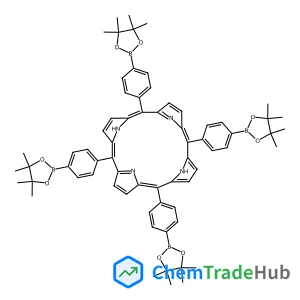
5,10,15,20-tetrakis(4-boronic acid pinacol ester phenyl) porphyrin
CAS番号:
1332748-00-1
分子式:
C68H74B4N4O8
おすすめサプライヤー





免責事項
このページに表示される学術雑誌情報は、参考および研究目的のみを目的としています。当社は雑誌出版社とは提携しておらず、投稿の取り扱いも行っておりません。出版に関するお問い合わせは、各雑誌出版社に直接ご連絡ください。
表示されている情報に誤りがある場合は、support@chemtradehub.com までご連絡ください。迅速に確認し、対応いたします。