












Twisted organic TADF triads based on a diindolocarbazole donor for efficient photoisomerization of stilbene and photo-arylation of heteroarenes
文献情報
出版日
2023-10-24
DOI
10.1039/D3QO01542D
インパクトファクター
5.281
著者
Sushil Sharma, Sanchita Sengupta
原文を見る
要旨
Herein we report the design and synthesis of twisted organic thermally activated delayed fluorescence (TADF) triads DI-PF and DI-PI based on diindolocarbazole (DI) as the donor and dibenzo[a,c]phenazine (PF) and phenanthro[9,10-d]imidazole (PI) as the acceptors. The triads DI-PF and DI-PI showed strong charge transfer bands at 590 nm with a 196 nm Stokes shift and 519 nm with a 126 nm Stokes shift, respectively. For effective TADF properties, theoretical and experimental studies revealed small to relatively modest ΔEST of 0.01 eV and 0.37 eV for DI-PF and DI-PI, respectively. Transient photoluminescence decay profiles of DI-PF and DI-PI indicated shorter prompt components of 40 ns and 13.38 ns, respectively, and longer delayed components of 6.15 μs and 2.05 μs, respectively, confirming the TADF nature for both compounds. The sufficiently long-lived lifetime components render them suitable for participation in organic photocatalysis. Furthermore, both compounds showed tunable and suitable excited state redox potentials for electron transfer photocatalysis. Accordingly, the triads DI-PF and DI-PI have been employed as photocatalysts in E to Z photoisomerization of stilbene based on their suitable triplet energy levels with reasonably good yields of up to 66% for isomerization products and in arylation of various heteroarenes with up to 86% yields for heteroarene photoarylation products.
関連文献
DMSO–KOH mediated stereoselective synthesis of Z-enamides: an expeditious route to Z-enamide bearing natural products
2023-11-22
Communication
DOI: 10.1039/D3CC04642G
Hydrogenation of levulinic acid to γ-valerolactone over hydrophobic Ru@HCP catalysts
Weiqiang Yu, Xinhong Wang, Song Shi
2023-11-13
Communication
DOI: 10.1039/D3CC04405J
C1 functionalization of imidazo heterocycles via carbon dioxide fixation
Michael Fragkiadakis, Paraskevi-Kleio Anastasiou, Ioannis Volyrakis, Apostolos Pantousas, Constantinos C. Stoumpos, Constantinos G. Neochoritis
2023-11-13
Communication
DOI: 10.1039/D3CC04597H
Assembly and optically triggered disassembly of lipid–DNA origami fibers
Sofia Julin, Eduardo Anaya-Plaza, Eeva Enlund
2023-11-09
Communication
DOI: 10.1039/D3CC04677J
Access to isoindole-derived BODIPYs by an aminopalladation cascade
Heinrich F. von Köller, Finn J. Geffers, Pedram Kalvani, Adrian Foraita, Patrick-Eric J. Loß, Burkhard Butschke, Peter G. Jones, Daniel B. Werz
2023-11-13
Communication
DOI: 10.1039/D3CC04913B
Ferrocene: an exotic building block for supramolecular assemblies
Chandrakanta Guchhait, Vembanan Suriyaa, Nihar Sahu, Sovik Dey Sarkar, Bimalendu Adhikari
2023-11-15
Highlight
DOI: 10.1039/D3CC03659F
Redox-active ligand promoted electrophile addition at cobalt
Minzhu Zou, Kate M. Waldie
2023-11-17
Communication
DOI: 10.1039/D3CC04869A
Correction: Interface-mediated protein aggregation
Fei Tao, Qian Han, Peng Yang
2023-12-05
Correction
DOI: 10.1039/D3CC90386A
こちらもおすすめ
化合物よくある質問
3-イチチルビフェニルはどのように合成されますか?
3-イチチルビフェニルは、ビフェニルとイチプロピオニトリルを回収率約90%で反応させて合成されます。触媒は通常、亜リチウムホウ素を用います。
5668-93-93-Ethylbiphenyl
化合物よくある質問
8-溴-5-三氟甲基喹啉はどのように合成されますか?
8-溴-5-三氟甲基喹啉は、5-トリフルオロメチル-2-メチル-1,3-ベンゼンジオールをブロモエタノールと反応させて生成します。この反応は塩基性条件下で行われ...
917251-92-48-Bromo-5-(trifluoro...
化合物よくある質問
ジメチル4-(4,4,5,5-テトラメチル-1,3,2-ドioxaborolan-2-基)-2,6-ピリジンジカルボイル酸フェニルアミニドの代替品はありますか?
ジメチル4-(4,4,5,5-テトラメチル-1,3,2-ドioxaborolan-2-基)-2,6-ピリジンジカルボイル酸フェニルアミニドの代替品としては、4-...
741709-66-0Dimethyl 4-(4,4,5,5-...
化合物よくある質問
N-(3,5-ヘキサクロロ-4-ピリドインイル)-8-メチオキシ-5-キノリンカーボン酸の市場動向や研究トレンドはどのようなものでしょうか?
N-(3,5-ヘキサクロロ-4-ピリドインイル)-8-メチオキシ-5-キノリンカーボン酸の市場動向は、主に産業用途での需要により影響を受けます。研究トレンドとし...
199871-63-1N-(3,5-Dichloro-4-py...
化合物よくある質問
イソステアロイルグリセリルは安全ですか?
イソステアロイルグリセリルは一般的に安全性が高いとされていますが、過度な使用や個人差により皮�owsん炎などの反応が起こる可能性があります。使用前に医師に相談す...
222723-55-92-[(5Z,8Z,11Z,14Z)-5...
化合物よくある質問
1-(二苯甲基)-3,3-二氟-氮杂环丁烷の市場動向や研究トレンドはどうですか?
1-(二苯甲基)-3,3-二氟-氮杂环丁烷の市場動向は、医薬品や合成化学の研究分野で注目を集めています。新興研究は、該当化合物の合成改良と生体内での作用メカニズ...
288315-02-61-Benzhydryl-3,3-dif...
化合物よくある質問
3-チオフェンスチオールの物理化学的性質は何ですか?
3-チオフェンスチオールのCAS番号は7774-73-4です。結晶性の白色粉末で、分子量は122.17です。この化合物は水に微溶解し、エタノールやジクロロメタン...
7774-73-43-Thiophenethiol
化合物よくある質問
2-Methyl-2-propanyl (2S)-2-(aminomethyl)-1-piperidinecarboxylateは安全ですか?
2-Methyl-2-propanyl (2S)-2-(aminomethyl)-1-piperidinecarboxylateは一定の安全性基準を満たしていま...
475105-35-22-Methyl-2-propanyl ...
化合物よくある質問
CAS番号1316822-90-8の化合物は安全ですか?
CAS番号1316822-90-8の化合物は安全性に関しては評価が不足していますが、一般的には生物学的に活性な物質であり、取り扱いには適切な安全防護措置が必要で...
1316822-90-8Gal beta(1-3)[Neu5Ac...
化合物よくある質問
Tert-butyl 2-(2-羟基乙基)哌嗪-1-羧酸はどのように保存すればよいですか?
Tert-butyl 2-(2-羟基乙基)哌嗪-1-羧酸は、冷暗所で保存し、直射日光から遠ざけてください。容器は密閉し、高湿度や高温を避けて保管してください。
517866-79-4Tert-butyl 2-(2-hydr...
掲載誌
Organic Chemistry Frontiers

CiteScore:
7.8
自己引用率:
8.7%
年間論文数:
724
Organic Chemistry Frontiers publishes high-quality research from across organic chemistry. Emphases are placed on studies that make significant contributions to the field of organic chemistry by reporting either new or significantly improved protocols or methodologies. Topics include, but are not limited to the following: Organic synthesis Development of synthetic methodologies Catalysis Natural products Functional organic materials Supramolecular and macromolecular chemistry Physical and computational organic chemistry
おすすめ化合物
![N-{3-[Benzyl(methyl)amino]propyl}-9-chloro-5,6,7,8-tetrahydro-2-acridinecarboxamide structure](https://static.chemtradehub.com/structs/142/1426944-49-1-1e4c.webp "N-{3-[Benzyl(methyl)amino]propyl}-9-chloro-5,6,7,8-tetrahydro-2-acridinecarboxamide structure")
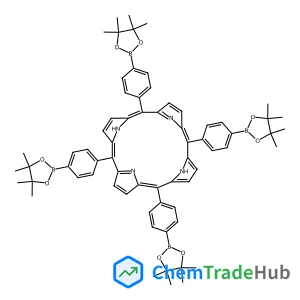
5,10,15,20-tetrakis(4-boronic acid pinacol ester phenyl) porphyrin
CAS番号:
1332748-00-1
分子式:
C68H74B4N4O8
おすすめサプライヤー





免責事項
このページに表示される学術雑誌情報は、参考および研究目的のみを目的としています。当社は雑誌出版社とは提携しておらず、投稿の取り扱いも行っておりません。出版に関するお問い合わせは、各雑誌出版社に直接ご連絡ください。
表示されている情報に誤りがある場合は、support@chemtradehub.com までご連絡ください。迅速に確認し、対応いたします。