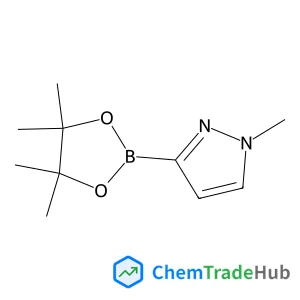
1-Methyl-3-(4,4,5,5-tetramethyl-1,3,2-dioxaborolan-2-yl)-1H-pyrazole
CAS番号:
1020174-04-2
分子式:
C10H17BN2O2
Yingying Yang, Yuelin Wang, Man Yao, Xudong Wang, Hao Huang
A series of early transition-metal carbides (TMCs) in the NaCl structure have been constructed to compare the catalytic activity in Li–O2 batteries by first-principles calculations. The reasonable interfacial models of LixO2 (x = 4, 2, and 1) molecules adsorbed on early TMCs surfaces were used to simulate oxygen reduction reaction (ORR) and oxygen evolution reaction (OER) processes. Taking overpotentials as a merit parameter of catalytic activity, more relationships between material properties relative to the adsorption/desorption behavior of active molecules and catalytic activity are constructed for early TMCs. The equilibrium and charging potentials used to calculate the OER overpotentials of early TMCs are inversely proportional to the adsorption energies of (Li2O)2 and LiO2, respectively. The ORR overpotentials are inversely proportional to the adsorption energies of (Li2O)2 and LiO2 for early TMCs, but the relationship between OER overpotentials and the adsorption energies of reactive intermediates is unclear. Additionally, the overpotentials of early TMCs for ORR and OER are proportional to the desorption energies of Li+ and O2, respectively. In general, both the adsorption energy of (Li2O)2/LiO2 and desorption energy of Li+/O2 are effective characterization parameters of catalytic activity. By providing the comprehensive valuable parameters on electrochemical performance to compare the catalytic activity of early TMCs and establishing more correlations between material properties relative to the adsorption/desorption behavior of active molecules with their catalytic activity, our investigation is helpful for knowing more about the catalytic process and beneficial to screen and design novel highly active catalysts for Li–O2 batteries.
Zhigang Cui, Hui Cao, Yi Ding, Pan Gao, Xinhua Lu, Yuanli Cai
DOI: 10.1039/C7PY00582B
Hideto Tsuji, Shotaro Sato, Noriaki Masaki, Yuki Arakawa
DOI: 10.1039/C7PY02024D
Meng-Di Lin, Jie Wei, Li-Juan Liu, Meng-Yan Yun, Lin Wu, Si-Tai Zheng, Huan-Huan Yin, Li-Chun Kong
DOI: 10.1039/C7PY01612C
Chun Man Lee, Iren Constantinescu, Lily E. Takeuchi, Sreeparna Vappala, Ravin Narain, Takao Aoyagi
DOI: 10.1039/C7PY01541K
Bo Pang, Jingzhe Zhang, Minglei Pang, Peijian Zhao, Zhen Yang, Shengyu Feng, Jie Zhang
DOI: 10.1039/C7PY01525A
Minghong Zhou, Hui Zhang, Linfeng Xiong, Zidong He, Tianqi Wang, Yang Xu, Kun Huang
DOI: 10.1039/C7PY00530J
Ana S. Sonzogni, Stefanie Wedepohl, Marcelo Calderón
DOI: 10.1039/C7PY01798G
Ben-Fa Chu, Jia-Hong Chu, Song-Qing Zhao, Na Liu, Zong-Quan Wu
DOI: 10.1039/C8PY00097B
Chao Yu, Pengfei Zhang, Fei Gao, Shaowen Zhang, Xiaofang Li
DOI: 10.1039/C7PY01915G
2-溴-9,9-二苯基芴は、医薬品、工業材料、有機合成の研究分野で応用されます。特に、レーザー材料や機能性ポリマーの合成に使用されることがあります。また、蛍光色...
四氯化铱の市場は研究開発分野で注目されており、特にナノ技術や金属有機框架(MOFs)の分野での需要が増加傾向にあります。価格は安定しており、中国や韓国での生産が...
1-(4-溴-3-氟苯基)-2-氯乙酮 (CAS番号: 1260857-14-4) の廃棄物は専門的な廃棄処理が必要です。まず、廃棄物は密閉された容器に収集し、...
苦参酚Kは、CAS番号101236-49-1を持つ化合物で、主に天然由来の生薬から抽出されます。この化合物は、抗炎症作用や抗癌作用を持つことが報告されています。
POTASSIUM (1-(TERTBUTOXYCARBONYL)AZETIDIN-3-YL)TRIFLUOROBORATE を含む廃棄物は、まず安全なエント...
4-庚基-4’-聯苯羧酸は、特殊化学品や合成化学の分野で用いられる化学物質ですが、市場動向としては、研究開発の進展とともに需要が増加しています。また、環境配慮型...
6-ブロモ-3-メトキシ-1-フェニル-1H-インドゾールを含む廃棄物は、適切な化学廃棄処理が必要です。通常、廃棄物は密閉容器に収集され、専門の廃棄処理業者に引...
4,4-二甲基-2-吡咯烷酮は医薬、ポリマー、センサー、半導体などの業界で広く使用されています。特に溶媒としての性能が高く評価されています。

Physical Chemistry Chemical Physics (PCCP) is an international journal co-owned by 19 physical chemistry and physics societies from around the world. This journal publishes original, cutting-edge research in physical chemistry, chemical physics and biophysical chemistry. To be suitable for publication in PCCP, articles must include significant innovation and/or insight into physical chemistry; this is the most important criterion that reviewers and Editors will judge against when evaluating submissions. The journal has a broad scope and welcomes contributions spanning experiment, theory, computation and data science. Topical coverage includes spectroscopy, dynamics, kinetics, statistical mechanics, thermodynamics, electrochemistry, catalysis, surface science, quantum mechanics, quantum computing and machine learning. Interdisciplinary research areas such as polymers and soft matter, materials, nanoscience, energy, surfaces/interfaces, and biophysical chemistry are welcomed if they demonstrate significant innovation and/or insight into physical chemistry. Joined experimental/theoretical studies are particularly appreciated when complementary and based on up-to-date approaches.
![[4-(Heptyloxy)phenyl]boronic acid structure](https://static.chemtradehub.com/structs/136/136370-19-9-ad33.webp "[4-(Heptyloxy)phenyl]boronic acid structure")