












Thermoresponsive nanogels with film-forming ability
文献情報
出版日
2018-01-18
DOI
10.1039/C7PY01798G
インパクトファクター
5.582
著者
Ana S. Sonzogni, Stefanie Wedepohl, Marcelo Calderón
原文を見る
要旨
Thermoresponsive nanogels (NGs) with film-forming ability could have great potential in delivery system platforms with controlled and targeted release of drugs or proteins, such as in topical treatment. This platform offers the opportunity of combining both the high loading capacity of an NG dispersion and the delivery capability from a film, which could be previously obtained or directly formed onto the surface where the release is required. Therefore, this article investigates the synthesis of NGs based on poly(N-vinylcaprolactam), a thermoresponsive polymer, and poly(butyl acrylate), which promotes particle coalescence and cohesivity (i.e., film forming). The synthesized NGs have low cytotoxicity and are able to form flexible and smooth films, conserving the thermoresponsivity of the particulated system. The obtained films loaded with a model protein show delivery profiles responsive to temperature changes.
関連文献
Quantification of protein–materials interaction by soft colloidal probe spectroscopy
Steve Martin, Hanqing Wang, Laura Hartmann, Tilo Pompe, Stephan Schmidt
2014-12-23
Communication
DOI: 10.1039/C4CP05484A
Unraveling the degradation of artificial amide bonds in nylon oligomer hydrolase: from induced-fit to acylation processes
Takeshi Baba, Mauro Boero, Katsumasa Kamiya, Hiroyuki Ando, Seiji Negoro, Masayoshi Nakano
2014-12-18
Paper
DOI: 10.1039/C4CP04419C
Stabilities and electronic properties of monolayer MoS2 with one or two sulfur line vacancy defects
Yang Han, Ting Hu, Rui Li, Jian Zhou, Jinming Dong
2014-12-12
Paper
DOI: 10.1039/C4CP04319G
Electrochemical lithiation performance and characterization of silicon–graphite composites with lithium, sodium, potassium, and ammonium polyacrylate binders
Zhen-Ji Han, Kiyofumi Yamagiwa, Naoaki Yabuuchi, Jin-Young Son, Yi-Tao Cui, Hiroshi Oji, Akinori Kogure, Takahiro Harada, Sumihisa Ishikawa, Yasuhito Aoki, Shinichi Komaba
2015-01-05
Paper
DOI: 10.1039/C4CP04939J
Rectification inversion in oxygen substituted graphyne–graphene-based heterojunctions
Wen-kai Zhao, Bin Cui, Chang-feng Fang, Guo-min Ji, Jing-fen Zhao, Xiang-ru Kong, Dong-qing Zou, Dong-mei Li
2014-12-03
Paper
DOI: 10.1039/C4CP04859H
Liquid crystal seed nucleates liquid–solid phase change in ceria nanoparticles
Thi X. T. Sayle, Lewis W. L. Sayle, Dean C. Sayle
2015-01-02
Paper
DOI: 10.1039/C4CP05499G
Carbon nanoscroll from C4H/C4F-type graphene superlattice: MD and MM simulation insights
Yehan Tao, Xiaofang Li, Tiantian Wu, Yakang Jin, Zhongyang Zhang
2014-12-04
Paper
DOI: 10.1039/C4CP04102J
A kinetic study of the CH2OO Criegee intermediate self-reaction, reaction with SO2 and unimolecular reaction using cavity ring-down spectroscopy
Rabi Chhantyal-Pun, Anthony Davey, Dudley E. Shallcross, Carl J. Percival, Andrew J. Orr-Ewing
2014-12-22
Paper
DOI: 10.1039/C4CP04198D
Role of oxygen vacancies in the surface evolution of H at CeO2(111): a charge modification effect
Guanzhong Lu
2014-12-17
Paper
DOI: 10.1039/C4CP04766D
Constrained control landscape for population transfer in a two-level system
Katharine Moore Tibbetts, Herschel Rabitz
2014-12-11
Paper
DOI: 10.1039/C4CP04792C
こちらもおすすめ
化合物よくある質問
2-ブロモ-9,9-ジフェニル-9H-フルオレンの主な用途は何ですか?
2-溴-9,9-二苯基芴は、医薬品、工業材料、有機合成の研究分野で応用されます。特に、レーザー材料や機能性ポリマーの合成に使用されることがあります。また、蛍光色...
474918-32-62-Bromo-9,9-diphenyl...
化合物よくある質問
四氯化铱の市場動向や研究トレンドはどうですか?
四氯化铱の市場は研究開発分野で注目されており、特にナノ技術や金属有機框架(MOFs)の分野での需要が増加傾向にあります。価格は安定しており、中国や韓国での生産が...
207399-11-9Tetrachloroiridium h...
882-06-44-Nitrocinnamic acid
化合物よくある質問
1-(4-溴-3-氟苯基)-2-氯乙酮を含む廃棄物はどのように処理すべきですか?
1-(4-溴-3-氟苯基)-2-氯乙酮 (CAS番号: 1260857-14-4) の廃棄物は専門的な廃棄処理が必要です。まず、廃棄物は密閉された容器に収集し、...
1260857-14-41-(4-Bromo-3-fluorop...
化合物よくある質問
苦参酚Kとは何ですか?
苦参酚Kは、CAS番号101236-49-1を持つ化合物で、主に天然由来の生薬から抽出されます。この化合物は、抗炎症作用や抗癌作用を持つことが報告されています。
101236-49-1Kushenol K
化合物よくある質問
POTASSIUM (1-(TERTBUTOXYCARBONYL)AZETIDIN-3-YL)TRIFLUOROBORATE を含む廃棄物はどのように処理すべきですか?
POTASSIUM (1-(TERTBUTOXYCARBONYL)AZETIDIN-3-YL)TRIFLUOROBORATE を含む廃棄物は、まず安全なエント...
1430219-73-0Potassium (1-(tert-b...
化合物よくある質問
4-庚基-4’-联苯羧酸の市場動向や研究トレンドはどうですか?
4-庚基-4’-聯苯羧酸は、特殊化学品や合成化学の分野で用いられる化学物質ですが、市場動向としては、研究開発の進展とともに需要が増加しています。また、環境配慮型...
58573-94-74'-Heptyl-4-biphenyl...
化合物よくある質問
6-ブロモ-3-メトキシ-1-フェニル-1H-インドゾールを含む廃棄物はどのように処理すべきですか?
6-ブロモ-3-メトキシ-1-フェニル-1H-インドゾールを含む廃棄物は、適切な化学廃棄処理が必要です。通常、廃棄物は密閉容器に収集され、専門の廃棄処理業者に引...
1332527-03-36-Bromo-3-methoxy-1-...
化合物よくある質問
4,4-二甲基-2-吡咯烷酮はどの業界で使用されていますか?
4,4-二甲基-2-吡咯烷酮は医薬、ポリマー、センサー、半導体などの業界で広く使用されています。特に溶媒としての性能が高く評価されています。
66899-02-34,4-dimethylpyrrolid...
51312-42-6Sodium Phosphotungst...
掲載誌
Polymer Chemistry

CiteScore:
8.6
自己引用率:
7.3%
年間論文数:
457
Polymer Chemistry welcomes submissions in all areas of polymer science that have a strong focus on macromolecular chemistry. Manuscripts may cover a broad range of fields, yet no direct application focus is required.
おすすめ化合物
![[4-Amino-2-(methylsulfanyl)-5-pyrimidinyl]methanol structure](https://static.chemtradehub.com/structs/588/588-36-3-fc73.webp "[4-Amino-2-(methylsulfanyl)-5-pyrimidinyl]methanol structure")
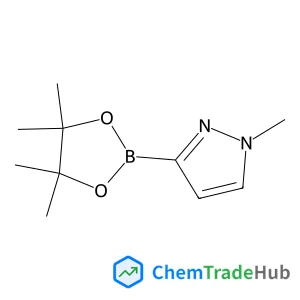
1-Methyl-3-(4,4,5,5-tetramethyl-1,3,2-dioxaborolan-2-yl)-1H-pyrazole
CAS番号:
1020174-04-2
分子式:
C10H17BN2O2
おすすめサプライヤー






免責事項
このページに表示される学術雑誌情報は、参考および研究目的のみを目的としています。当社は雑誌出版社とは提携しておらず、投稿の取り扱いも行っておりません。出版に関するお問い合わせは、各雑誌出版社に直接ご連絡ください。
表示されている情報に誤りがある場合は、support@chemtradehub.com までご連絡ください。迅速に確認し、対応いたします。