


Selective oxidation of cellulose, mediated by N-hydroxyphthalimide, under a metal-free environment
文献情報
出版日
2017-11-06
DOI
10.1039/C7PY01710C
インパクトファクター
5.582
著者
Sergiu Coseri, Gabriela Biliuta
原文を見る
要旨
Three types of cellulosic samples, including microcrystalline, never-dried sulfite pulp, and Cellets, were selected to test the oxidative capacity of a new oxidation protocol involving the redoubtable N-hydroxyphthalimide (NHPI) catalyst. All reactions were performed under mild conditions, at room temperatures and at atmospheric pressure, in the presence of sodium hypochlorite and sodium bromide. The generation of the reactive radicalic species, i.e. phthalimide N-oxyl (PINO) from its parent hydroxylamine, NHPI, in the presence of sodium hypochlorite, has been firstly proved by using the UV-Vis technique, followed next by the reaction with each cellulose type sample for a designated period of time, varying the amount of the NaClO introduced in the reaction. The main finding of this new proposed protocol resides in the elimination of any metal cocatalyst required for the generation of the non-persistent free radical PINO, as has been previously used. The obtained amounts of the carboxylic groups after oxidation, determined using potentiometric titration, are satisfactory, whereas the degree of polymerization of the resulted products has still superior values, as compared to many other methods used today. All the oxidized samples exhibited an increased crystallinity compared to the unoxidized samples as revealed by X-ray diffraction experiments. This new approach not only avoids the introduction of an additional chemical reagent, but also provides an easy and convenient alternative to those existing today for the preparation of oxidized cellulose products having high amounts of carboxylic groups and remarkably, less depolymerized.
おすすめジャーナル

Israel Journal of Chemistry

Planta Medica

Organic Preparations and Procedures International

Journal of Heterocyclic Chemistry

Pharmacological Reviews

European Journal of Wood and Wood Products

Kinetics and Catalysis

Journal of Organometallic Chemistry

Pure and Applied Chemistry

Proceedings of the National Academy of Sciences of the United States of America
関連文献
Direct visualisation of micelles of Pluronic block copolymers in aqueous solution by cryo-TEM
Paper
DOI: 10.1039/A902369K
Probing the size of Pluronic® P84 block copolymer micelles in aqueous solution by means of positron annihilation lifetime spectroscopy
Frédéric Bockstahl, Gilles Duplâtre, Maria da Graça Miguel, Hugh D. Burrows
2000-09-28
Paper
DOI: 10.1039/B002969F
n-Alkyl alcohols at the water/vapour and water/benzene interfaces: a study on phase transfer energies
Luca Frediani, Christian S. Pomelli, Jacopo Tomasi
2000-08-15
Paper
DOI: 10.1039/B004330N
Temperature-dependent self-diffusion coefficients of water and six selected molecular liquids for calibration in accurate 1H NMRPFG measurements
Manfred Holz, Stefan R. Heil, Antonio Sacco
2000-10-03
Paper
DOI: 10.1039/B005319H
こちらもおすすめ
化合物よくある質問
2-ブロモ-9,9-ジフェニル-9H-フルオレンの主な用途は何ですか?
2-溴-9,9-二苯基芴は、医薬品、工業材料、有機合成の研究分野で応用されます。特に、レーザー材料や機能性ポリマーの合成に使用されることがあります。また、蛍光色...
474918-32-62-Bromo-9,9-diphenyl...
化合物よくある質問
四氯化铱の市場動向や研究トレンドはどうですか?
四氯化铱の市場は研究開発分野で注目されており、特にナノ技術や金属有機框架(MOFs)の分野での需要が増加傾向にあります。価格は安定しており、中国や韓国での生産が...
207399-11-9Tetrachloroiridium h...
882-06-44-Nitrocinnamic acid
化合物よくある質問
1-(4-溴-3-氟苯基)-2-氯乙酮を含む廃棄物はどのように処理すべきですか?
1-(4-溴-3-氟苯基)-2-氯乙酮 (CAS番号: 1260857-14-4) の廃棄物は専門的な廃棄処理が必要です。まず、廃棄物は密閉された容器に収集し、...
1260857-14-41-(4-Bromo-3-fluorop...
化合物よくある質問
苦参酚Kとは何ですか?
苦参酚Kは、CAS番号101236-49-1を持つ化合物で、主に天然由来の生薬から抽出されます。この化合物は、抗炎症作用や抗癌作用を持つことが報告されています。
101236-49-1Kushenol K
化合物よくある質問
POTASSIUM (1-(TERTBUTOXYCARBONYL)AZETIDIN-3-YL)TRIFLUOROBORATE を含む廃棄物はどのように処理すべきですか?
POTASSIUM (1-(TERTBUTOXYCARBONYL)AZETIDIN-3-YL)TRIFLUOROBORATE を含む廃棄物は、まず安全なエント...
1430219-73-0Potassium (1-(tert-b...
化合物よくある質問
4-庚基-4’-联苯羧酸の市場動向や研究トレンドはどうですか?
4-庚基-4’-聯苯羧酸は、特殊化学品や合成化学の分野で用いられる化学物質ですが、市場動向としては、研究開発の進展とともに需要が増加しています。また、環境配慮型...
58573-94-74'-Heptyl-4-biphenyl...
化合物よくある質問
6-ブロモ-3-メトキシ-1-フェニル-1H-インドゾールを含む廃棄物はどのように処理すべきですか?
6-ブロモ-3-メトキシ-1-フェニル-1H-インドゾールを含む廃棄物は、適切な化学廃棄処理が必要です。通常、廃棄物は密閉容器に収集され、専門の廃棄処理業者に引...
1332527-03-36-Bromo-3-methoxy-1-...
化合物よくある質問
4,4-二甲基-2-吡咯烷酮はどの業界で使用されていますか?
4,4-二甲基-2-吡咯烷酮は医薬、ポリマー、センサー、半導体などの業界で広く使用されています。特に溶媒としての性能が高く評価されています。
66899-02-34,4-dimethylpyrrolid...
51312-42-6Sodium Phosphotungst...
掲載誌
Polymer Chemistry

CiteScore:
8.6
自己引用率:
7.3%
年間論文数:
457
Polymer Chemistry welcomes submissions in all areas of polymer science that have a strong focus on macromolecular chemistry. Manuscripts may cover a broad range of fields, yet no direct application focus is required.
おすすめ化合物
![N-[(Benzyloxy)carbonyl]serine structure](https://static.chemtradehub.com/structs/276/2768-56-1-77f7.webp "N-[(Benzyloxy)carbonyl]serine structure")
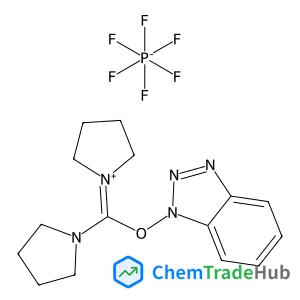
(1H-Benzotriazol-1-yloxy)(di-1-pyrrolidinyl)methylium hexafluorophosphate
CAS番号:
105379-24-6
分子式:
C15H21F6N5OP
おすすめサプライヤー



免責事項
このページに表示される学術雑誌情報は、参考および研究目的のみを目的としています。当社は雑誌出版社とは提携しておらず、投稿の取り扱いも行っておりません。出版に関するお問い合わせは、各雑誌出版社に直接ご連絡ください。
表示されている情報に誤りがある場合は、support@chemtradehub.com までご連絡ください。迅速に確認し、対応いたします。