












The UV absorption of ClO Part 2. Predissociation of the A2ΠΩstate studied by ab-initio and Fermi golden rule calculations
文献情報
出版日
DOI
10.1039/A903310F
インパクトファクター
3.676
著者
原文を見る
要旨
Ab-initio calculations at the CASSCF and MRCI level have been performed on the valence doublet and quartet electronic states of the ClO radical in order to explore the predissociation dynamics of the A2ΠΩ state (Ω=1/2 or 3/2). The ab-initio calculations neglect spin–orbit coupling. Large basis sets with diffuse orbitals were employed to ensure the calculated X2Π and A2Π potentials match closely the available experimental data. In total, the potential energies of fifteen valence states were computed at a series of internuclear separations in order to map the potential energy curves. The X2Π, A2Π and a4Σ- potentials are bound; though the latter has yet to be observed experimentally. All the other states are repulsive, and the lowest ten cross the A2Π3/2 component at energies below the v′=6 vibrational level. Using arguments based on electronic configurations, candidate states for the predissociation of the A2ΠΩ state can be selected. Simulations of the predissociation were performed by Fermi golden rule calculations for each vibrational level, using the ab-initio repulsive potentials and RKR curves for the A2Π3/2 and A2Π1/2 states. The vibrational dependence of the predissociation rate in the A2Π3/2 component was used to derive the magnitude of the individual couplings with the repulsive potentials. Comparison between the lifetimes of the vibrational levels in the A2Π3/2 and A2Π1/2 components restricts the principal players in the predissociation to three repulsive states: 14ΣΩ+, 24ΣΩ- and 32ΠΩ. The possibility of coupling between the A2Π3/2 component and the 12Δ state is also suspected. A marked similarity is revealed for the variation of predissociation rates with v′ for the A2Π3/2 and A2Π1/2 components despite a spin–orbit state dependence of the absolute rates for individual v′ levels. A repulsive 22Σ+ state is identified which is likely to be involved in the UV photodissociation of ClO. Similar ab-initio calculations on FO have revealed no bound excited valence 2Π state correlating diabatically to the Cl(2P)+O(1D) dissociation limit.
関連文献
Biocatalytic reduction of ketones by a semi-continuous flow process using supercritical carbon dioxide
Tomoko Matsuda, Kazunori Watanabe, Takashi Kamitanaka, Tadao Harada, Kaoru Nakamura
2003-04-22
Communication
DOI: 10.1039/B301452E
Transfer hydrogenation using recyclable polyurea-encapsulated palladium: efficient and chemoselective reduction of aryl ketones
Jin-Quan Yu, Hai-Chen Wu, Chandrashekar Ramarao, Jonathan B. Spencer, Steven V. Ley
2003-02-12
Communication
DOI: 10.1039/B300074P
Soluble polymer-supported convergent parallel library synthesis
Jung-Mo Ahn, Paul Wentworth Jr., Kim D. Janda
2003-01-27
Communication
DOI: 10.1039/B210696E
Controlled synthesis of homopolymers and block copolymers based on 2-(acetoacetoxy)ethyl methacrylatevia RAFT radical polymerisation
Theodora Krasia, Rémi Soula, Hans G. Börner, Helmut Schlaad
2003-01-27
Communication
DOI: 10.1039/B212634F
Asymmetric protonation of lithium enolates of α-amino acid derivatives with α-amino acid-based chiral Brønsted acids
Kentaro Futatsugi, Akira Yanagisawa, Hisashi Yamamoto
2003-01-30
Communication
DOI: 10.1039/B211523A
Zn-Proline catalyzed direct aldol reaction in aqueous media
Tamis Darbre, Miguel Machuqueiro
2003-03-31
Communication
DOI: 10.1039/B301117H
A novel bioassay for screening and quantification of taxanes
Sergi Morais, P. C. Pandey, Wilfred Chen, Ashok Mulchandani
2003-04-17
Communication
DOI: 10.1039/B302112B
High temperature synthesis of a noncentrosymmetric site-ordered cobalt aluminophosphate related to the pollucite structure
P. Bishop
2003-02-17
Communication
DOI: 10.1039/B300037K
A new organic superconductor, (DODHT)2BF4·H2O
Hiroyuki Nishikawa, Asami Machida, Takanobu Morimoto, Koichi Kikuchi, Takeshi Kodama, Isao Ikemoto, Jun-ichi Yamada, Harukazu Yoshino, Keizo Murata
2003-01-27
Communication
DOI: 10.1039/B211275B
Regiocontrolled Ru-catalyzed addition of carboxylic acids to alkynes: practical protocols for the synthesis of vinyl esters
2003-02-17
Communication
DOI: 10.1039/B211277A
こちらもおすすめ
化合物よくある質問
2-ブロモ-9,9-ジフェニル-9H-フルオレンの主な用途は何ですか?
2-溴-9,9-二苯基芴は、医薬品、工業材料、有機合成の研究分野で応用されます。特に、レーザー材料や機能性ポリマーの合成に使用されることがあります。また、蛍光色...
474918-32-62-Bromo-9,9-diphenyl...
化合物よくある質問
四氯化铱の市場動向や研究トレンドはどうですか?
四氯化铱の市場は研究開発分野で注目されており、特にナノ技術や金属有機框架(MOFs)の分野での需要が増加傾向にあります。価格は安定しており、中国や韓国での生産が...
207399-11-9Tetrachloroiridium h...
882-06-44-Nitrocinnamic acid
化合物よくある質問
1-(4-溴-3-氟苯基)-2-氯乙酮を含む廃棄物はどのように処理すべきですか?
1-(4-溴-3-氟苯基)-2-氯乙酮 (CAS番号: 1260857-14-4) の廃棄物は専門的な廃棄処理が必要です。まず、廃棄物は密閉された容器に収集し、...
1260857-14-41-(4-Bromo-3-fluorop...
化合物よくある質問
苦参酚Kとは何ですか?
苦参酚Kは、CAS番号101236-49-1を持つ化合物で、主に天然由来の生薬から抽出されます。この化合物は、抗炎症作用や抗癌作用を持つことが報告されています。
101236-49-1Kushenol K
化合物よくある質問
POTASSIUM (1-(TERTBUTOXYCARBONYL)AZETIDIN-3-YL)TRIFLUOROBORATE を含む廃棄物はどのように処理すべきですか?
POTASSIUM (1-(TERTBUTOXYCARBONYL)AZETIDIN-3-YL)TRIFLUOROBORATE を含む廃棄物は、まず安全なエント...
1430219-73-0Potassium (1-(tert-b...
化合物よくある質問
4-庚基-4’-联苯羧酸の市場動向や研究トレンドはどうですか?
4-庚基-4’-聯苯羧酸は、特殊化学品や合成化学の分野で用いられる化学物質ですが、市場動向としては、研究開発の進展とともに需要が増加しています。また、環境配慮型...
58573-94-74'-Heptyl-4-biphenyl...
化合物よくある質問
6-ブロモ-3-メトキシ-1-フェニル-1H-インドゾールを含む廃棄物はどのように処理すべきですか?
6-ブロモ-3-メトキシ-1-フェニル-1H-インドゾールを含む廃棄物は、適切な化学廃棄処理が必要です。通常、廃棄物は密閉容器に収集され、専門の廃棄処理業者に引...
1332527-03-36-Bromo-3-methoxy-1-...
化合物よくある質問
4,4-二甲基-2-吡咯烷酮はどの業界で使用されていますか?
4,4-二甲基-2-吡咯烷酮は医薬、ポリマー、センサー、半導体などの業界で広く使用されています。特に溶媒としての性能が高く評価されています。
66899-02-34,4-dimethylpyrrolid...
51312-42-6Sodium Phosphotungst...
掲載誌
Physical Chemistry Chemical Physics

CiteScore:
5.5
自己引用率:
10.3%
年間論文数:
3036
Physical Chemistry Chemical Physics (PCCP) is an international journal co-owned by 19 physical chemistry and physics societies from around the world. This journal publishes original, cutting-edge research in physical chemistry, chemical physics and biophysical chemistry. To be suitable for publication in PCCP, articles must include significant innovation and/or insight into physical chemistry; this is the most important criterion that reviewers and Editors will judge against when evaluating submissions. The journal has a broad scope and welcomes contributions spanning experiment, theory, computation and data science. Topical coverage includes spectroscopy, dynamics, kinetics, statistical mechanics, thermodynamics, electrochemistry, catalysis, surface science, quantum mechanics, quantum computing and machine learning. Interdisciplinary research areas such as polymers and soft matter, materials, nanoscience, energy, surfaces/interfaces, and biophysical chemistry are welcomed if they demonstrate significant innovation and/or insight into physical chemistry. Joined experimental/theoretical studies are particularly appreciated when complementary and based on up-to-date approaches.
おすすめ化合物
![5-Acetyl-2,3-dihydrobenzo[b]furan structure](https://static.chemtradehub.com/structs/908/90843-31-5-eea4.webp "5-Acetyl-2,3-dihydrobenzo[b]furan structure")
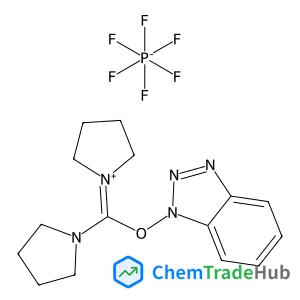
(1H-Benzotriazol-1-yloxy)(di-1-pyrrolidinyl)methylium hexafluorophosphate
CAS番号:
105379-24-6
分子式:
C15H21F6N5OP
おすすめサプライヤー



免責事項
このページに表示される学術雑誌情報は、参考および研究目的のみを目的としています。当社は雑誌出版社とは提携しておらず、投稿の取り扱いも行っておりません。出版に関するお問い合わせは、各雑誌出版社に直接ご連絡ください。
表示されている情報に誤りがある場合は、support@chemtradehub.com までご連絡ください。迅速に確認し、対応いたします。