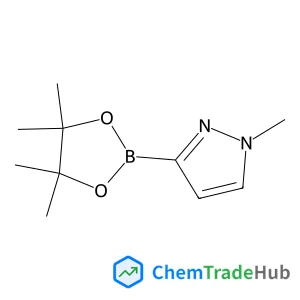
1-Methyl-3-(4,4,5,5-tetramethyl-1,3,2-dioxaborolan-2-yl)-1H-pyrazole
CAS番号:
1020174-04-2
分子式:
C10H17BN2O2
The ground-state rotational spectra of three isotopomers O12C···I35Cl, O12C···I37Cl and O13C···I35Cl of a linear (or quasi-linear) complex formed by carbon monoxide and iodine monochloride were observed by using a pulsed-nozzle, Fourier transform microwave spectrometer. The spectroscopic constants B0, DJ, χaa(I), χaa(Cl) and Mbb(I) were determined for each isotopomer. Simple models were used to interpret the spectroscopic constants to give details of the geometry, binding strength and electric charge redistribution in OC···ICl. It was concluded that the nuclei lie in the order OC···ICl with the distance r(C···I)=3.011(1) Å, that the quadratic intermolecular stretching force constant kσ=8.00(3) N m-1, and that, when CO achieves its equilibrium position in the complex, the changes in the iodine and chlorine nuclear quadrupole coupling constants of ICl are consistent with the transfer of a fraction δ1=0.025(2) of an electronic charge from C to I and an intramolecular transfer of a fraction δ2=0.048(2) from I to Cl. A comparison of the r(C···X), kσ and δ2 values for the series of complexes OC···XY, where XY=ClF, Cl2, BrCl, Br2 and ICl is presented. The order of kσ is ICl>ClF>BrCl>Br2>Cl2, while the order of δ2 is Cl2∽ClF
Franc Meyer, Peter Kircher, Hans Pritzkow
DOI: 10.1039/B211486K
Casey A. Kernag, Dominic V. McGrath
DOI: 10.1039/B301157G
Carolyn G. Leong, Okwado M. Akotsi, Michael J. Ferguson, Steven H. Bergens
DOI: 10.1039/B212544G
Joan Albert, J. Magali Cadena, Asensio González, Jaume Granell, Xavier Solans, Mercè Font-Bardia
DOI: 10.1039/B211808D
Xiuzhu Wang, Dejian Zhou, Trevor Rayment, Chris Abell
DOI: 10.1039/B211906D
Sonia M. Horvat, Sunggak Kim, Carl H. Schiesser
DOI: 10.1039/B302307A
Debasis Samanta, Nicolas Faure, Francis Rondelez, Amitabha Sarkar
DOI: 10.1039/B300833A
Jun Bao, YiLu Fu, ZhongHai Sun, Chen Gao
DOI: 10.1039/B212504H
DOI: 10.1039/B211277A
2-溴-9,9-二苯基芴は、医薬品、工業材料、有機合成の研究分野で応用されます。特に、レーザー材料や機能性ポリマーの合成に使用されることがあります。また、蛍光色...
四氯化铱の市場は研究開発分野で注目されており、特にナノ技術や金属有機框架(MOFs)の分野での需要が増加傾向にあります。価格は安定しており、中国や韓国での生産が...
1-(4-溴-3-氟苯基)-2-氯乙酮 (CAS番号: 1260857-14-4) の廃棄物は専門的な廃棄処理が必要です。まず、廃棄物は密閉された容器に収集し、...
苦参酚Kは、CAS番号101236-49-1を持つ化合物で、主に天然由来の生薬から抽出されます。この化合物は、抗炎症作用や抗癌作用を持つことが報告されています。
POTASSIUM (1-(TERTBUTOXYCARBONYL)AZETIDIN-3-YL)TRIFLUOROBORATE を含む廃棄物は、まず安全なエント...
4-庚基-4’-聯苯羧酸は、特殊化学品や合成化学の分野で用いられる化学物質ですが、市場動向としては、研究開発の進展とともに需要が増加しています。また、環境配慮型...
6-ブロモ-3-メトキシ-1-フェニル-1H-インドゾールを含む廃棄物は、適切な化学廃棄処理が必要です。通常、廃棄物は密閉容器に収集され、専門の廃棄処理業者に引...
4,4-二甲基-2-吡咯烷酮は医薬、ポリマー、センサー、半導体などの業界で広く使用されています。特に溶媒としての性能が高く評価されています。

Physical Chemistry Chemical Physics (PCCP) is an international journal co-owned by 19 physical chemistry and physics societies from around the world. This journal publishes original, cutting-edge research in physical chemistry, chemical physics and biophysical chemistry. To be suitable for publication in PCCP, articles must include significant innovation and/or insight into physical chemistry; this is the most important criterion that reviewers and Editors will judge against when evaluating submissions. The journal has a broad scope and welcomes contributions spanning experiment, theory, computation and data science. Topical coverage includes spectroscopy, dynamics, kinetics, statistical mechanics, thermodynamics, electrochemistry, catalysis, surface science, quantum mechanics, quantum computing and machine learning. Interdisciplinary research areas such as polymers and soft matter, materials, nanoscience, energy, surfaces/interfaces, and biophysical chemistry are welcomed if they demonstrate significant innovation and/or insight into physical chemistry. Joined experimental/theoretical studies are particularly appreciated when complementary and based on up-to-date approaches.