












Pentagon adjacency as a determinant of fullerene stability
文献情報
出版日
DOI
10.1039/A901600G
インパクトファクター
3.676
著者
原文を見る
要旨
Optimisation of geometries of all 40 fullerene isomers of C40, using methods from molecular mechanics and tight-binding to full abinitio SCF and DFT approaches, confirms minimisation of pentagon adjacency as a major factor in relative stability. The consensus predictions of 11 out of 12 methods are that the isomer of lowest total energy is the D2 cage with the smallest possible adjacency count, and that energies rise linearly with the number of adjacencies. Quantum mechanical methods predict a slope of 80–100 kJ mol-1 per adjacency. Molecular mechanics methods are outliers, with the Tersoff potential giving a different minimum and its Brenner modification a poor correlation and much smaller penalty.
関連文献
Synthesis and crystallographic structure of a novel photoresponsive azobenzene-containing organosilane
Nanguo Liu, Darren R. Dunphy, Mark A. Rodriguez, Sarany Singer
2003-04-10
Communication
DOI: 10.1039/B301569F
Pyridine–sugar conjugates as potent inhibitors of enzyme-catalysed glycosidehydrolysis
Peter A. Nkansah, Alan H. Haines, N. Patrick J. Stamford
2003-02-20
Communication
DOI: 10.1039/B211399F
Synthesis and characterization of hyperbranched mesoporous silica SBA-15
Ji Zhu, Agnes Szegedi, Imre Kiricsi, Paul Alivisatos, Gabor A. Somorjai
2003-01-06
Communication
DOI: 10.1039/B210053C
Non-aggregating octasubstituted dendritic phthalocyanines
Casey A. Kernag, Dominic V. McGrath
2003-04-03
Communication
DOI: 10.1039/B301157G
Synthesis, structure and reductive dechlorination of the C-centred phosphorus(iii) β-diketiminate PCl(Ph)L [L = C{C(Me)NC6H3Pri2-2,6}{C(Me)NHC6H3Pri2-2,6}]
Peter B. Hitchcock, Michael F. Lappert, Jacek E. Nycz
2003-04-16
Communication
DOI: 10.1039/B301294H
Fluoride-induced chemiluminescent decomposition of 1,2-dioxetanes bearing a phenyl moiety substituted with a methyl having an electron-withdrawing group
Masakatsu Matsumoto, Toshiyuki Mizuno, Nobuko Watanabe
2003-01-27
Communication
DOI: 10.1039/B210857G
New thermally stable cationic η3-allyl(1,4-diphospha-(1,3)-butadiene)nickel complexes for ethylene polymerization
Alex Ionkin, William Marshall
2003-02-17
Communication
DOI: 10.1039/B211252C
Effect of water on the catalytic behaviour of VPO in the selective oxidation of propane to acrylic acid
G. Landi, L. Lisi, J. C. Volta
2003-01-23
Communication
DOI: 10.1039/B211619G
A quasi-covalent metal–metal bond in an early–late heterobimetallic Ti–Pt complex stabilized by phosphinoenolate ligands‡
Pierre Braunstein, Xavier Morise, Marc Bénard, Marie-Madeleine Rohmer, Richard Welter
2003-02-03
Communication
DOI: 10.1039/B211289M
Bond energy M–C/H–C correlations: dual theoretical and experimental approach to the sensitivity of M–C bond strength to substituents
Eric Clot, Maria Besora, Feliu Maseras, Claire Mégret, Odile Eisenstein, Beatriz Oelckers, Robin N. Perutz
2003-01-24
Communication
DOI: 10.1039/B210036N
こちらもおすすめ
化合物よくある質問
2-ブロモ-9,9-ジフェニル-9H-フルオレンの主な用途は何ですか?
2-溴-9,9-二苯基芴は、医薬品、工業材料、有機合成の研究分野で応用されます。特に、レーザー材料や機能性ポリマーの合成に使用されることがあります。また、蛍光色...
474918-32-62-Bromo-9,9-diphenyl...
化合物よくある質問
四氯化铱の市場動向や研究トレンドはどうですか?
四氯化铱の市場は研究開発分野で注目されており、特にナノ技術や金属有機框架(MOFs)の分野での需要が増加傾向にあります。価格は安定しており、中国や韓国での生産が...
207399-11-9Tetrachloroiridium h...
882-06-44-Nitrocinnamic acid
化合物よくある質問
1-(4-溴-3-氟苯基)-2-氯乙酮を含む廃棄物はどのように処理すべきですか?
1-(4-溴-3-氟苯基)-2-氯乙酮 (CAS番号: 1260857-14-4) の廃棄物は専門的な廃棄処理が必要です。まず、廃棄物は密閉された容器に収集し、...
1260857-14-41-(4-Bromo-3-fluorop...
化合物よくある質問
苦参酚Kとは何ですか?
苦参酚Kは、CAS番号101236-49-1を持つ化合物で、主に天然由来の生薬から抽出されます。この化合物は、抗炎症作用や抗癌作用を持つことが報告されています。
101236-49-1Kushenol K
化合物よくある質問
POTASSIUM (1-(TERTBUTOXYCARBONYL)AZETIDIN-3-YL)TRIFLUOROBORATE を含む廃棄物はどのように処理すべきですか?
POTASSIUM (1-(TERTBUTOXYCARBONYL)AZETIDIN-3-YL)TRIFLUOROBORATE を含む廃棄物は、まず安全なエント...
1430219-73-0Potassium (1-(tert-b...
化合物よくある質問
4-庚基-4’-联苯羧酸の市場動向や研究トレンドはどうですか?
4-庚基-4’-聯苯羧酸は、特殊化学品や合成化学の分野で用いられる化学物質ですが、市場動向としては、研究開発の進展とともに需要が増加しています。また、環境配慮型...
58573-94-74'-Heptyl-4-biphenyl...
化合物よくある質問
6-ブロモ-3-メトキシ-1-フェニル-1H-インドゾールを含む廃棄物はどのように処理すべきですか?
6-ブロモ-3-メトキシ-1-フェニル-1H-インドゾールを含む廃棄物は、適切な化学廃棄処理が必要です。通常、廃棄物は密閉容器に収集され、専門の廃棄処理業者に引...
1332527-03-36-Bromo-3-methoxy-1-...
化合物よくある質問
4,4-二甲基-2-吡咯烷酮はどの業界で使用されていますか?
4,4-二甲基-2-吡咯烷酮は医薬、ポリマー、センサー、半導体などの業界で広く使用されています。特に溶媒としての性能が高く評価されています。
66899-02-34,4-dimethylpyrrolid...
51312-42-6Sodium Phosphotungst...
掲載誌
Physical Chemistry Chemical Physics

CiteScore:
5.5
自己引用率:
10.3%
年間論文数:
3036
Physical Chemistry Chemical Physics (PCCP) is an international journal co-owned by 19 physical chemistry and physics societies from around the world. This journal publishes original, cutting-edge research in physical chemistry, chemical physics and biophysical chemistry. To be suitable for publication in PCCP, articles must include significant innovation and/or insight into physical chemistry; this is the most important criterion that reviewers and Editors will judge against when evaluating submissions. The journal has a broad scope and welcomes contributions spanning experiment, theory, computation and data science. Topical coverage includes spectroscopy, dynamics, kinetics, statistical mechanics, thermodynamics, electrochemistry, catalysis, surface science, quantum mechanics, quantum computing and machine learning. Interdisciplinary research areas such as polymers and soft matter, materials, nanoscience, energy, surfaces/interfaces, and biophysical chemistry are welcomed if they demonstrate significant innovation and/or insight into physical chemistry. Joined experimental/theoretical studies are particularly appreciated when complementary and based on up-to-date approaches.
おすすめ化合物
![4-{2-[4-(2-Methyl-2-propanyl)phenyl]ethoxy}quinazoline structure](https://static.chemtradehub.com/structs/120/120928-09-8-d3db.webp "4-{2-[4-(2-Methyl-2-propanyl)phenyl]ethoxy}quinazoline structure")
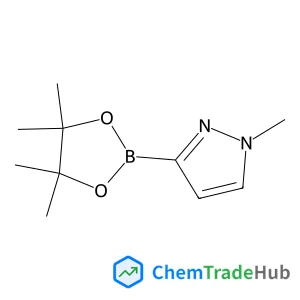
1-Methyl-3-(4,4,5,5-tetramethyl-1,3,2-dioxaborolan-2-yl)-1H-pyrazole
CAS番号:
1020174-04-2
分子式:
C10H17BN2O2
おすすめサプライヤー




免責事項
このページに表示される学術雑誌情報は、参考および研究目的のみを目的としています。当社は雑誌出版社とは提携しておらず、投稿の取り扱いも行っておりません。出版に関するお問い合わせは、各雑誌出版社に直接ご連絡ください。
表示されている情報に誤りがある場合は、support@chemtradehub.com までご連絡ください。迅速に確認し、対応いたします。