












Radiation-induced disorder in compressed lanthanide zirconates
文献情報
出版日
2018-02-12
DOI
10.1039/C7CP08664D
インパクトファクター
3.676
著者
Sulgiye Park, Cameron L. Tracy, Fuxiang Zhang, Changyong Park, Sergey N. Tkachev, Maik Lang, Rodney C. Ewing
原文を見る
要旨
The effects of swift heavy ion irradiation-induced disordering on the behavior of lanthanide zirconate compounds (Ln2Zr2O7 where Ln = Sm, Er, or Nd) at high pressures are investigated. After irradiation with 2.2 GeV 197Au ions, the initial ordered pyrochlore structure (Fdm) transformed to a defect-fluorite structure (Fmm) in Sm2Zr2O7 and Nd2Zr2O7. For irradiated Er2Zr2O7, which has a defect-fluorite structure, ion irradiation induces local disordering by introducing Frenkel defects despite retention of the initial structure. When subjected to high pressures (>29 GPa) in the absence of irradiation, all of these compounds transform to a cotunnite-like (Pnma) phase, followed by sluggish amorphization with further compression. However, if these compounds are irradiated prior to compression, the high pressure cotunnite-like phase is not formed. Rather, they transform directly from their post-irradiation defect-fluorite structure to an amorphous structure upon compression (>25 GPa). Defects and disordering induced by swift heavy ion irradiation alter the transformation pathways by raising the energetic barriers for the transformation to the high pressure cotunnite-like phase, rendering it inaccessible. As a result, the high pressure stability field of the amorphous phase is expanded to lower pressures when irradiation is coupled with compression. The responses of materials in the lanthanide zirconate system to irradiation and compression, both individually and in tandem, are strongly influenced by the specific lanthanide composition, which governs the defect energetics at extreme conditions.
関連文献
Transfer hydrogenation of levulinic acid under hydrothermal conditions catalyzed by sulfate as a temperature-switchable base
Daniel Kopetzki, Markus Antonietti
2010-02-16
Paper
DOI: 10.1039/B924648G
Nanoparticle-infused-biodegradable-microneedles as drug-delivery systems: preparation and characterisation
Rachel E. Sully, Hemda Garelick, Eriketi Z. Loizidou, Adrian G. Podoleanu, Vladimir Gubala
2021-07-08
Paper
DOI: 10.1039/D1MA00135C
Antimicrobial and surface activity of 1-alkyl-3-methylimidazolium derivatives
Justyna Łuczak, Christian Jungnickel, Izabela Łącka, Stefan Stolte, Jan Hupka
2010-03-22
Paper
DOI: 10.1039/B921805J
Self-assembled, cogged hexameric nanotubes formed from pyrogallol[4]arenes with a unique branched side chain
Oleg V. Kulikov, Megan M. Daschbach, Carl R. Yamnitz, Nigam Rath
2009-11-12
Communication
DOI: 10.1039/B917431A
What is special about silicon in functionalised organic semiconductors?
Micai Benford, Yang Song, Sean R. Parkin
2021-07-13
Paper
DOI: 10.1039/D1MA00447F
In situ trapping of bismuthine in externally heated quartz tube atomizers for atomic absorption spectrometry
Jan Kratzer, Jiří Dědina
2005-12-08
Technical Note
DOI: 10.1039/B513924D
Conductive NiMn-based bimetallic metal–organic gel nanosheets for supercapacitors
Qiankun Zhong, Wensheng Liu, Yong Yang, Wenkang Pan, Mingzai Wu, Fangcai Zheng, Xiao Lian, Helin Niu
2021-05-17
Paper
DOI: 10.1039/D1MA00390A
Novel biocompatible cholinium-based ionic liquids—toxicity and biodegradability
Marija Petkovic, Jamie L. Ferguson, H. Q. Nimal Gunaratne, Rui Ferreira, Maria C. Leitão, Luís Paulo N. Rebelo
2010-02-09
Paper
DOI: 10.1039/B922247B
In situ determination of sulfur isotopes in sulfur-rich materials by laser ablation multiple-collector inductively coupled plasma mass spectrometry (LA-MC-ICP-MS)
Paul R. D. Mason, Jan Košler, Paul J. Sylvester, Simon Meffan-Main
2005-12-20
Paper
DOI: 10.1039/B510883G
こちらもおすすめ
化合物よくある質問
4-アミノフェノール酸ナトリウム水和物とは何ですか?
4-アミノフェノール酸ナトリウム水和物は、CAS番号206557-08-6の化合物で、4-アミノフェノールとナトリウムが結合した塩と水和物です。この化合物は、白...
206557-08-64-Aminobenzoic acid ...
化合物よくある質問
Methyl 3-methyl-N-{[(2-methyl-2-propanyl)oxy]carbonyl}-L-histidinateの代替品はありますか?
この化合物は特定の合成プロセスに使用される可能性がありますが、代替品として、他の类似的な化合物、例えばMethyl 3-methyl-N-{[(2-methyl...
72212-51-2Methyl 3-methyl-N-{[...
化合物よくある質問
4-Boc-2-哌嗪甲酸の市場動向や研究トレンドはどうですか?
4-Boc-2-哌嗪甲酸は、薬品開発や合成化学分野で広く使用されており、その需要は継続的に推移しています。特に、新薬開発における合成化学分野での需要が高まってい...
192330-11-3(2R)-4-[(tert-butoxy...
化合物よくある質問
4,4'-二羟甲基联苯の物理化学的性質は何ですか?
4,4'-二羟甲基联苯のCAS番号は1667-12-5です。この化合物は白色の結晶粉末で、分子量は154.20です。水にわずかに溶けますが、アルコールや有機溶媒...
1667-12-54,4'-Biphenyldiyldim...
化合物よくある質問
5-甲硫基戊腈はどの業界で使用されていますか?
5-甲硫基戊腈は医薬品産業で使用される可能性があります。また、ポリマー合成の触媒として、センサー製造の一部として、半導体製造のプロセス改善に使用される可能性があ...
59121-25-45-(Methylsulfanyl)pe...
化合物よくある質問
CAS番号1311961-50-8の化合物はどのように合成されますか?
この化合物は、1-abieta-8,11,13-trien-19-イルと6'-メトキシシンコナナン-9-基を含有する窒素含有化合物から合成されます。一般的な合成...
1311961-50-81-Abieta-8,11,13-tri...
化合物よくある質問
6-ブロモベンジジミダゾール-2-カルビルデオキシドはどのように保存すればよいですか?
6-ブロモベンジジミダゾール-2-カルビルデオキシドは、避光・乾燥した容器(密閉容器)で-20℃~4℃の低温で保存してください。高温や直射日光、湿気は避けてくだ...
885280-26-25-Bromo-1H-benzimida...
化合物よくある質問
Boc-N-甲基氨甲环酸とは何ですか?
621-65-8のCAS番号を持つBoc-N-甲基氨甲环酸は、化学式C7H13NO5を有する化合物です。この化合物は白色の結晶性粉末で、吸湿性があります。
621-65-83-Hydroxy-1,2-propan...
化合物よくある質問
乙基三氟硼酸钾はどのように合成されますか?
乙基三氟硼酸钾は、トリフLUオール酸カリウムとエチルブロミドを反応させて合成されます。この反応は高い選択性と収率を持ち、触媒を用いることで効率的に進行します。
882871-21-8Potassium ethyltrifl...
化合物よくある質問
2-フロウロ-5-クロロ-4-アミノフェノールはどのように保存すればよいですか?
2-フロウロ-5-クロロ-4-アミノフェノールは、直射日光を避けて冷却された暗所で保存し、密閉容器に保管してください。温度は常温か低温が適しています。
847872-10-04-Amino-5-chloro-2-f...
掲載誌
Physical Chemistry Chemical Physics

CiteScore:
5.5
自己引用率:
10.3%
年間論文数:
3036
Physical Chemistry Chemical Physics (PCCP) is an international journal co-owned by 19 physical chemistry and physics societies from around the world. This journal publishes original, cutting-edge research in physical chemistry, chemical physics and biophysical chemistry. To be suitable for publication in PCCP, articles must include significant innovation and/or insight into physical chemistry; this is the most important criterion that reviewers and Editors will judge against when evaluating submissions. The journal has a broad scope and welcomes contributions spanning experiment, theory, computation and data science. Topical coverage includes spectroscopy, dynamics, kinetics, statistical mechanics, thermodynamics, electrochemistry, catalysis, surface science, quantum mechanics, quantum computing and machine learning. Interdisciplinary research areas such as polymers and soft matter, materials, nanoscience, energy, surfaces/interfaces, and biophysical chemistry are welcomed if they demonstrate significant innovation and/or insight into physical chemistry. Joined experimental/theoretical studies are particularly appreciated when complementary and based on up-to-date approaches.
おすすめ化合物
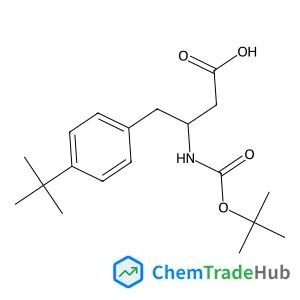
(S)-3-((tert-Butoxycarbonyl)amino)-4-(4-(tert-butyl)phenyl)butanoic acid
CAS番号:
403661-85-8
分子式:
C19H29NO4
おすすめサプライヤー




免責事項
このページに表示される学術雑誌情報は、参考および研究目的のみを目的としています。当社は雑誌出版社とは提携しておらず、投稿の取り扱いも行っておりません。出版に関するお問い合わせは、各雑誌出版社に直接ご連絡ください。
表示されている情報に誤りがある場合は、support@chemtradehub.com までご連絡ください。迅速に確認し、対応いたします。