












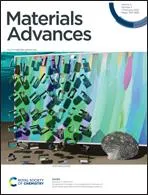
What is special about silicon in functionalised organic semiconductors?
文献情報
出版日
2021-07-13
DOI
10.1039/D1MA00447F
インパクトファクター
0
著者
Micai Benford, Yang Song, Sean R. Parkin
原文を見る
要旨
A carbon side-chain analogue to the high-performance organic semiconductor triethylsilylethynyl difluoroanthradithiophene has been synthesised and characterized. Atomic substitution of carbon for silicon results in subtle changes to opto-electronic properties, which are rationalised by density functional theory and balance of electron donating and withdrawing effects. Larger differences are observed in photostability and solid-state packing of the new material in comparison to known silicon and germanium derivatives. Comparison of the group 14 elements teaches us about the newly synthesised system, but also how the silylethynyl substituents used for the last two decades contribute to successful employment of functionalised polycyclic aromatic hydrocarbons as organic semiconductors.
関連文献
Solvation properties of protic ionic liquids and molecular solvents
Dilek Yalcin, Calum J. Drummond, Tamar L. Greaves
2019-12-02
Paper
DOI: 10.1039/C9CP05711K
Polyphosphates can stabilize but also aggregate colloids
Rayssa Jossanea Brasileiro Motta, Ana Zélia Falcão Almeida, Bruna Luiza Batista de Lima, Ricardo Schneider, Rosangela de Carvalho Balaban, Jeroen Sebastiaan van Duijneveldt, Rodrigo José de Oliveira
2019-11-29
Communication
DOI: 10.1039/C9CP05225A
Fast prediction of oxygen reduction reaction activity on carbon nanotubes with a localized geometric descriptor
Kunran Yang, Jeremie Zaffran, Bo Yang
2019-11-22
Paper
DOI: 10.1039/C9CP04885E
Spontaneous proton transfer in a series of amphoteric molecules under hydrostatic pressure
Binhong Yu, Yi Wang, Lingrui Wang, Xiao Tan, Yu-Mo Zhang, Minjie Li, Bo Zou, Sean Xiao-An Zhang
2019-07-17
Paper
DOI: 10.1039/C9CP02445J
High thermoelectric performance of Ag doped SnTe polycrystalline bulks via the synergistic manipulation of electrical and thermal transport
Jun Wang, Jichao Li, Jian Liu, Chunlei Wang, Jiyang Wang, Xiaolin Wang
2019-08-01
Paper
DOI: 10.1039/C9CP03534F
The addition of methanol to Criegee intermediates
Gustavo J. R. Aroeira, Adam S. Abbott, Sarah N. Elliott, Justin M. Turney, Henry F. Schaefer, III
2019-07-29
Paper
DOI: 10.1039/C9CP03480C
Light emission colour modulation study of oxyluciferin synthetic analogues via QM and QM/MM approaches
Madjid Zemmouche, Isabelle Navizet
2019-11-18
Paper
DOI: 10.1039/C9CP04687A
3-D bond-paths of QTAIM and the stress tensor in neutral lithium clusters, Lim (m = 2–5), presented on the Ehrenfest force molecular graph
Alireza Azizi, Roya Momen, Steven R. Kirk, Samantha Jenkins
2019-12-10
Paper
DOI: 10.1039/C9CP05066C
A combined experimental and theoretical study on the structures, interactions and volumetric properties of guanidinium-based ionic liquid mixtures
Hujun Xie, Qunfang Lei, Wenjun Fang
2019-07-23
Paper
DOI: 10.1039/C9CP02999K
こちらもおすすめ
化合物よくある質問
4-アミノフェノール酸ナトリウム水和物とは何ですか?
4-アミノフェノール酸ナトリウム水和物は、CAS番号206557-08-6の化合物で、4-アミノフェノールとナトリウムが結合した塩と水和物です。この化合物は、白...
206557-08-64-Aminobenzoic acid ...
化合物よくある質問
Methyl 3-methyl-N-{[(2-methyl-2-propanyl)oxy]carbonyl}-L-histidinateの代替品はありますか?
この化合物は特定の合成プロセスに使用される可能性がありますが、代替品として、他の类似的な化合物、例えばMethyl 3-methyl-N-{[(2-methyl...
72212-51-2Methyl 3-methyl-N-{[...
化合物よくある質問
4-Boc-2-哌嗪甲酸の市場動向や研究トレンドはどうですか?
4-Boc-2-哌嗪甲酸は、薬品開発や合成化学分野で広く使用されており、その需要は継続的に推移しています。特に、新薬開発における合成化学分野での需要が高まってい...
192330-11-3(2R)-4-[(tert-butoxy...
化合物よくある質問
4,4'-二羟甲基联苯の物理化学的性質は何ですか?
4,4'-二羟甲基联苯のCAS番号は1667-12-5です。この化合物は白色の結晶粉末で、分子量は154.20です。水にわずかに溶けますが、アルコールや有機溶媒...
1667-12-54,4'-Biphenyldiyldim...
化合物よくある質問
5-甲硫基戊腈はどの業界で使用されていますか?
5-甲硫基戊腈は医薬品産業で使用される可能性があります。また、ポリマー合成の触媒として、センサー製造の一部として、半導体製造のプロセス改善に使用される可能性があ...
59121-25-45-(Methylsulfanyl)pe...
化合物よくある質問
CAS番号1311961-50-8の化合物はどのように合成されますか?
この化合物は、1-abieta-8,11,13-trien-19-イルと6'-メトキシシンコナナン-9-基を含有する窒素含有化合物から合成されます。一般的な合成...
1311961-50-81-Abieta-8,11,13-tri...
化合物よくある質問
6-ブロモベンジジミダゾール-2-カルビルデオキシドはどのように保存すればよいですか?
6-ブロモベンジジミダゾール-2-カルビルデオキシドは、避光・乾燥した容器(密閉容器)で-20℃~4℃の低温で保存してください。高温や直射日光、湿気は避けてくだ...
885280-26-25-Bromo-1H-benzimida...
化合物よくある質問
Boc-N-甲基氨甲环酸とは何ですか?
621-65-8のCAS番号を持つBoc-N-甲基氨甲环酸は、化学式C7H13NO5を有する化合物です。この化合物は白色の結晶性粉末で、吸湿性があります。
621-65-83-Hydroxy-1,2-propan...
化合物よくある質問
乙基三氟硼酸钾はどのように合成されますか?
乙基三氟硼酸钾は、トリフLUオール酸カリウムとエチルブロミドを反応させて合成されます。この反応は高い選択性と収率を持ち、触媒を用いることで効率的に進行します。
882871-21-8Potassium ethyltrifl...
化合物よくある質問
2-フロウロ-5-クロロ-4-アミノフェノールはどのように保存すればよいですか?
2-フロウロ-5-クロロ-4-アミノフェノールは、直射日光を避けて冷却された暗所で保存し、密閉容器に保管してください。温度は常温か低温が適しています。
847872-10-04-Amino-5-chloro-2-f...
掲載誌
おすすめ化合物
![(4aR,5S,6R,8aS)-5-[2-(3-Furyl)ethyl]-8a-(hydroxymethyl)-5,6-dimethyl-3,4,4a,5,6,7,8,8a-octahydro-1-naphthalenecarboxylic acid structure](https://static.chemtradehub.com/structs/184/18411-75-1-d4cd.webp "(4aR,5S,6R,8aS)-5-[2-(3-Furyl)ethyl]-8a-(hydroxymethyl)-5,6-dimethyl-3,4,4a,5,6,7,8,8a-octahydro-1-naphthalenecarboxylic acid structure")
おすすめサプライヤー



免責事項
このページに表示される学術雑誌情報は、参考および研究目的のみを目的としています。当社は雑誌出版社とは提携しておらず、投稿の取り扱いも行っておりません。出版に関するお問い合わせは、各雑誌出版社に直接ご連絡ください。
表示されている情報に誤りがある場合は、support@chemtradehub.com までご連絡ください。迅速に確認し、対応いたします。