












Molecular stacking effect on photoluminescence quantum yield and charge mobility of organic semiconductors
文献情報
出版日
2017-10-17
DOI
10.1039/C7CP05451C
インパクトファクター
3.676
著者
Jianzhong Fan, Lili Lin, Chuan-Kui Wang
原文を見る
要旨
The photoluminescence quantum yield (PLQY) and charge transfer property of the high mobility emissive organic semiconductors, 2,6-diphenylanthracene (DPA) and 2,6-diphenyl-9,10-bis(phenylethynyl)anthracene (DP-BPEA), are theoretically investigated. A quantum mechanics/molecular mechanics (QM/MM) method is adopted to investigate the photophysical properties, the Marcus equation is used to describe hole and electron transfer rates, and kinetic Monte Carlo simulation is performed to obtain charge mobility. In both solution and solid phase, the PLQY and the charge mobility of DPA and DP-BPEA are calculated, and the molecular stacking effect is analyzed. For DPA, the rotation motions of the terminal phenyl ring are obviously restricted in the solid phase, which results in the decrease of the Huang–Rhys factor and reorganization energy. This restricted intramolecular rotation (RIR) effect suppresses dissipation pathways of the excited state energy. As a result, the aggregation induced enhancement emission (AIEE) is thus revealed for this emitter from the tetrahydrofuran (THF) solution to the solid phase. However for DP-BPEA, the geometrical variations between the ground and excited states are almost unchanged from the THF solution to the solid phase, and only a restricted intramolecular vibration (RIV) of bond length (e.g. –CC–) is displayed. As RIV is not obvious as RIR, a similar fluorescence efficiency is obtained for DP-BPEA in THF solution and the solid phase. In addition, DPA and DP-BPEA crystals are proven to be p-type semiconductors. The calculated mobility of the hole for DPA (3.39 cm2 V−1 s−1) is larger than that of DP-BPEA (1.62 cm2 V−1 s−1) because the number of effective transition pathways of DPA is more than that of DP-BPEA. Our study demonstrates that the different molecular stacking of organic semiconductors has an important effect on their photophysical and charge transfer properties.
関連文献
Approximate DFT-based methods for generating diabatic states and calculating electronic couplings: models of two and more states
ChiYung Yam
2017-12-20
Paper
DOI: 10.1039/C7CP06660K
Tunable polaron-induced coloration of tungsten oxide via a multi-step control of the physicochemical property for the detection of gaseous F
Sang Yeon Lee, Gowoon Shim, Jucheol Park
2018-04-04
Paper
DOI: 10.1039/C8CP00158H
Revealing at the molecular level the role of the surfactant in the enhancement of the thermal properties of the gold nanofluid system used for concentrating solar power
Elisa I. Martín, Antonio Sánchez-Coronilla, Javier Navas, Roberto Gómez-Villarejo, Paloma Martínez-Merino, Rodrigo Alcántara, Concha Fernández-Lorenzo
2017-12-18
Paper
DOI: 10.1039/C7CP05384C
Ethanol synthesis from syngas over Cu(Pd)-doped Fe(100): a systematic theoretical investigation
Wei Wang, Ye Wang
2017-11-13
Paper
DOI: 10.1039/C7CP06693G
Analyses of trajectory on-the-fly based on the global reaction route map
Takuro Tsutsumi, Yuriko Ono, Satoshi Maeda, Tetsuya Taketsugu
2017-12-08
Paper
DOI: 10.1039/C7CP06528K
Protonation state and fine structure of the active site determine the reactivity of dehydratase: hydration and isomerization of β-myrcene catalyzed by linalool dehydratase/isomerase from Castellaniella defragrans
Xiya Wang, Hao Su, Rutao Liu, Yongjun Liu
2018-06-01
Paper
DOI: 10.1039/C8CP02362J
Solvation of alcohols in ionic liquids – understanding the effect of the anion and cation
Inês C. M. Vaz, Margarida Bastos, Carlos E. S. Bernardes, José N. Canongia Lopes, Luís M. N. B. F. Santos
2017-12-20
Paper
DOI: 10.1039/C7CP07525A
Comparing alchemical and physical pathway methods for computing the absolute binding free energy of charged ligands
Nanjie Deng, Di Cui, Bin W. Zhang, Junchao Xia, Jeffrey Cruz, Ronald Levy
2018-05-24
Paper
DOI: 10.1039/C8CP01524D
Model of protocell compartments – dodecyl hydrogen sulfate vesicles
Bin Liu, Meihua Gao, Haiping Li, Jianqiang Liu, Shiling Yuan, Na Du
2017-12-15
Communication
DOI: 10.1039/C7CP06379B
Multifunctional nanostructured Co-doped ZnO: Co spatial distribution and correlated magnetic properties
Rafael T. da Silva, Alexandre Mesquita, Thalita Chiaramonte, Xavier Gratens, Valmir A. Chitta, Gul Rahman, Antonio C. Doriguetto, Maria I. B. Bernardi, Hugo B. de Carvalho
2018-07-09
Paper
DOI: 10.1039/C8CP02870B
こちらもおすすめ
化合物よくある質問
環戊烷-1,3-二甲酸甲酯はどのように合成されますか?
環戊烷-1,3-二甲酸甲酯は、環戊烷と塩酸によるヒンデンブルク反応を経由して合成されます。この反応では、環戊烷が塩酸と作用し、1,3-ジカルボキシ基が導入されま...
2435-36-1Dimethyl 1,3-cyclope...
化合物よくある質問
4-メトキシ-1,2,3-スチアゼ-3,5-ジオンとは何ですか?
4-メトキシ-1,2,3-スチアゼ-3,5-ジオンは、CAS番号107843-77-6の化合物で、(E)-ベンジル3-(3,4-ジヒドロキシフェニル) acry...
107843-77-6(E)-Benzyl 3-(3,4-di...
化合物よくある質問
プロスタグランジンA2について「に適用される法規ガイドラインは何ですか?'
プロスタグランジンA2 (CAS番号: 41691-92-3) は、化学物質の安全管理に関する規制として、GHS (危険物質の国際的ハザード分類・ラベル付けシス...
41691-92-316,16-DIMETHYL PROST...
化合物よくある質問
4-アミノ-1-ナフタレン sulfonic 酸についての物理化学的性質は何ですか?
4-アミノ-1-ナフタレン sulfonic 酸のCAS番号は84-86-6です。この化合物は結晶性で、分子量は212.15 g/molです。アルコールや水など...
84-86-64-Amino-1-naphthalen...
化合物よくある質問
N-GlcNAc-生物素を取り扱う際の実験室安全事項は何ですか?
N-GlcNAc-生物素は吸収性があり、皮膚や目への接触を避けることが重要です。PPE(個体保護具)は使用し、ドラフトチャンバーは必要に応じて使用します。漏洩時...
1272755-69-72-Acetamido-2-deoxy-...
化合物よくある質問
3-アミノメチルフローラノピペリジン-1-カルボニル酸テルブチルエステルとは何ですか?
CAS番号1209781-11-2の3-アミノメチルフローラノピペリジン-1-カルボニル酸テルブチルエステルは、有機化合物の一種で、化学式はC10H17FNO3...
1209781-11-22-Methyl-2-propanyl ...
化合物よくある質問
6-溴-1-甲基-1H-ベンゾ[d][1,2,3]三氮唑はどのように合成されますか?
6- bromo-1-methyl-1H-benzotriazoleは、ブロモフリオリンと1-メチル-1H-ベンゾ[d][1,2,3]三氮唑の反応により合成され...
944718-32-56-Bromo-1-methyl-1H-...
化合物よくある質問
4-硫代尿苷はどのように合成されますか?
4-硫代尿苷は、尿素とD-リボシルヒドロキシアルデヒドを用いてスルホン化反応を経て合成されます。通常は塩酸ヒドロキシチオニルスルホン酸などの触媒を使用し、選択性...
6741-73-71-(4-thio-beta-D-rib...
化合物よくある質問
ブレインナトリユリックペプチド32ラットとは何ですか?
ブレインナトリユリックペプチド32ラット(CAS番号: 133448-20-1)は、心臓で作られるホルモンの一つで、心不全の診断や予後評価に使用されます。
133448-20-1Brain Natriuretic Pe...
化合物よくある質問
1-(3-氮杂啶)-4-羟基哌啶双盐酸盐の物理化学的性質は何ですか?
CAS番号810680-60-5の1-(3-氮杂啶)-4-羟基哌啶双盐酸盐は、白色の結晶性粉末である。分子量は360.84 g/molで、水に溶けやすい。反応活...
810680-60-51-(3-Azetidinyl)-4-p...
掲載誌
Physical Chemistry Chemical Physics

CiteScore:
5.5
自己引用率:
10.3%
年間論文数:
3036
Physical Chemistry Chemical Physics (PCCP) is an international journal co-owned by 19 physical chemistry and physics societies from around the world. This journal publishes original, cutting-edge research in physical chemistry, chemical physics and biophysical chemistry. To be suitable for publication in PCCP, articles must include significant innovation and/or insight into physical chemistry; this is the most important criterion that reviewers and Editors will judge against when evaluating submissions. The journal has a broad scope and welcomes contributions spanning experiment, theory, computation and data science. Topical coverage includes spectroscopy, dynamics, kinetics, statistical mechanics, thermodynamics, electrochemistry, catalysis, surface science, quantum mechanics, quantum computing and machine learning. Interdisciplinary research areas such as polymers and soft matter, materials, nanoscience, energy, surfaces/interfaces, and biophysical chemistry are welcomed if they demonstrate significant innovation and/or insight into physical chemistry. Joined experimental/theoretical studies are particularly appreciated when complementary and based on up-to-date approaches.
おすすめ化合物
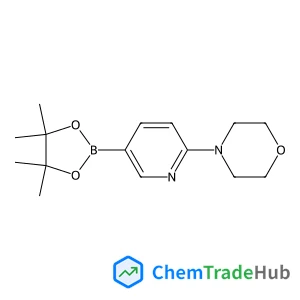
4-(5-(4,4,5,5-tetramethyl-1,3,2-dioxaborolan-2-yl)pyridin-2-yl)morpholine
CAS番号:
485799-04-0
分子式:
C15H23BN2O3
おすすめサプライヤー



免責事項
このページに表示される学術雑誌情報は、参考および研究目的のみを目的としています。当社は雑誌出版社とは提携しておらず、投稿の取り扱いも行っておりません。出版に関するお問い合わせは、各雑誌出版社に直接ご連絡ください。
表示されている情報に誤りがある場合は、support@chemtradehub.com までご連絡ください。迅速に確認し、対応いたします。