












![Ethyl 3-((6-(4,5-dihydro-1H-benzo[d]azepin-3(2H)-yl)-2-(pyridin-2-yl)pyrimidin-4-yl)amino)propanoate structure](https://static.chemtradehub.com/structs/137/1373423-53-0-496a.webp "Ethyl 3-((6-(4,5-dihydro-1H-benzo[d]azepin-3(2H)-yl)-2-(pyridin-2-yl)pyrimidin-4-yl)amino)propanoate structure")
Competing pathways in the near-UV photochemistry of acetaldehyde
文献情報
出版日
2017-05-24
DOI
10.1039/C7CP02573D
インパクトファクター
3.676
著者
Benjamin W. Toulson, Kara M. Kapnas, Dmitry A. Fishman, Craig Murray
原文を見る
要旨
Time-resolved ion imaging measurements have been performed to explore the photochemistry of acetaldehyde at photolysis wavelengths spanning the range 265–328 nm. Ion images recorded probing CH3 radicals with single-photon VUV ionization show different dissociation dynamics in three distinct wavelength regions. At the longest photolysis wavelengths, λ > 318 nm, CH3 radicals are formed over tens of nanoseconds with a speed distribution that is consistent with statistical unimolecular dissociation on the S0 surface following internal conversion. In the range 292 nm ≤ λ ≤ 318 nm, dissociation occurs almost exclusively on the T1 surface following intersystem crossing and passage over a barrier, leading to the available energy being partitioned primarily into photofragment recoil. The CH3 speed distributions become bimodal at λ < 292 nm. In addition to the translationally fast T1 products, a new translationally slow, but non-statistical, component appears and grows in importance as the photolysis wavelength is decreased. Photofragment excitation (PHOFEX) spectra of CH3CHO obtained probing CH3 and HCO products are identical across the absorption band, indicating that three-body fragmentation is not responsible for the non-statistical slow component. Rather, translationally slow products are attributed to dissociation on S0, accessed via a conical intersection between the S1 and S0 surfaces at extended C–C distances. Time-resolved ion images of CH3 radicals measured using a picosecond laser operating at a photolysis wavelength of 266 nm show that product formation on T1 and S0via the conical intersection occurs with time constants of 240 ps and 560 ps, respectively.
関連文献
Fissisternoids A and B, two 2′,5′-quinodihydrochalcone-based meroterpenoid enantiomers with unusual carbon skeletons from Fissistigma bracteolatum
Gui-Min Xue, Chen-Guang Zhao, Jin-Feng Xue, Hui Chen, Zhen-Zhu Zhao, Ying-Ying Si, Kun Du, Yan-Le Zhi, Wei-Sheng Feng
2021-11-19
Research Article
DOI: 10.1039/D1QO01404H
Acetylation of alcohols and amines under visible light irradiation: diacetyl as an acylation reagent and photosensitizer
Pengcheng Lian, Ruyi Li, Xiao Wan, Zixin Xiang, Hang Liu, Zhiyu Cao, Xiaobing Wan
2021-11-19
Research Article
DOI: 10.1039/D1QO01613J
A transition-metal-free, base-promoted annulation/ring-cleavage/ring-reconstruction cascade reaction: a facile access to N-protection free indole-indenones
Na Luo, Zhen-Wei Sun, Xing-Xin Xu, Xiao-Qiang Hu, Feng-Cheng Jia
2021-10-05
Research Article
DOI: 10.1039/D1QO01280K
Nickel-catalyzed electrochemical reductive relay cross-coupling of alkyl halides with alkyl carboxylic acids
Cong Ma, Dong Liu, Hui Qiu, Bin Cheng, Tian-Sheng Mei
2021-10-07
Research Article
DOI: 10.1039/D1QO01219C
Regioselective synthesis and biological evaluation of N-substituted 2-aminoquinazolin-4-ones
Zhen-Yuan Liao, Wen-Hsiung Yeh, Pen-Yuan Liao, Yu-Ting Liu, Ying-Cheng Chen, Yi-Hung Chen, Tsung-Han Hsieh, Chia-Chi Lin, Ming-Hsuan Lu, Yi-Song Chen, Ming-Chih Hsu, Tsai-Kun Li, Tun-Cheng Chien
2018-04-27
Paper
DOI: 10.1039/C8OB00624E
Insight into the mechanism of the arylation of arenes via norbornene relay palladation through meta- to para-selectivity
Shengnan Liu, Qiong Wang, Fang Huang, Wenjuan Wang, Chong Yang, Jianbiao Liu, Dezhan Chen
2021-11-09
Research Article
DOI: 10.1039/D1QO01500A
Gold-catalyzed C5-alkylation of indolines and sequential oxidative aromatization: access to C5-functionalized indoles
Wenzheng Zhang, Guangyang Xu, Lin Qiu, Jiangtao Sun
2018-05-02
Communication
DOI: 10.1039/C8OB00826D
Tetra-substituted furans by a gold-catalysed tandem C(sp3)–H alkynylation/oxy-alkynylation reaction
Chunyu Han, Xianhai Tian, Lina Song, Yaowen Liu
2021-10-05
Research Article
DOI: 10.1039/D1QO01401C
In situ phosphonium-containing Lewis base-catalyzed 1,6-cyanation reaction: a facile way to obtain α-diaryl and α-triaryl acetonitriles
Yuan Chen, Xiaoyu Ren, Yumeng Guo, Bing Yi, Hongkui Zhang, Guowei Gao, Tianli Wang
2021-11-11
Research Article
DOI: 10.1039/D1QO01501J
Nickel catalyzed site selective C–H functionalization of α-aryl-thioamides
Debashruti Bandyopadhyay, Annaram Thirupathi, Nagsen Munjaji Dhage, Nirmala Mohanta, S. Peruncheralathan
2018-08-23
Communication
DOI: 10.1039/C8OB01712C
こちらもおすすめ
化合物よくある質問
環戊烷-1,3-二甲酸甲酯はどのように合成されますか?
環戊烷-1,3-二甲酸甲酯は、環戊烷と塩酸によるヒンデンブルク反応を経由して合成されます。この反応では、環戊烷が塩酸と作用し、1,3-ジカルボキシ基が導入されま...
2435-36-1Dimethyl 1,3-cyclope...
化合物よくある質問
4-メトキシ-1,2,3-スチアゼ-3,5-ジオンとは何ですか?
4-メトキシ-1,2,3-スチアゼ-3,5-ジオンは、CAS番号107843-77-6の化合物で、(E)-ベンジル3-(3,4-ジヒドロキシフェニル) acry...
107843-77-6(E)-Benzyl 3-(3,4-di...
化合物よくある質問
プロスタグランジンA2について「に適用される法規ガイドラインは何ですか?'
プロスタグランジンA2 (CAS番号: 41691-92-3) は、化学物質の安全管理に関する規制として、GHS (危険物質の国際的ハザード分類・ラベル付けシス...
41691-92-316,16-DIMETHYL PROST...
化合物よくある質問
4-アミノ-1-ナフタレン sulfonic 酸についての物理化学的性質は何ですか?
4-アミノ-1-ナフタレン sulfonic 酸のCAS番号は84-86-6です。この化合物は結晶性で、分子量は212.15 g/molです。アルコールや水など...
84-86-64-Amino-1-naphthalen...
化合物よくある質問
N-GlcNAc-生物素を取り扱う際の実験室安全事項は何ですか?
N-GlcNAc-生物素は吸収性があり、皮膚や目への接触を避けることが重要です。PPE(個体保護具)は使用し、ドラフトチャンバーは必要に応じて使用します。漏洩時...
1272755-69-72-Acetamido-2-deoxy-...
化合物よくある質問
3-アミノメチルフローラノピペリジン-1-カルボニル酸テルブチルエステルとは何ですか?
CAS番号1209781-11-2の3-アミノメチルフローラノピペリジン-1-カルボニル酸テルブチルエステルは、有機化合物の一種で、化学式はC10H17FNO3...
1209781-11-22-Methyl-2-propanyl ...
化合物よくある質問
6-溴-1-甲基-1H-ベンゾ[d][1,2,3]三氮唑はどのように合成されますか?
6- bromo-1-methyl-1H-benzotriazoleは、ブロモフリオリンと1-メチル-1H-ベンゾ[d][1,2,3]三氮唑の反応により合成され...
944718-32-56-Bromo-1-methyl-1H-...
化合物よくある質問
4-硫代尿苷はどのように合成されますか?
4-硫代尿苷は、尿素とD-リボシルヒドロキシアルデヒドを用いてスルホン化反応を経て合成されます。通常は塩酸ヒドロキシチオニルスルホン酸などの触媒を使用し、選択性...
6741-73-71-(4-thio-beta-D-rib...
化合物よくある質問
ブレインナトリユリックペプチド32ラットとは何ですか?
ブレインナトリユリックペプチド32ラット(CAS番号: 133448-20-1)は、心臓で作られるホルモンの一つで、心不全の診断や予後評価に使用されます。
133448-20-1Brain Natriuretic Pe...
化合物よくある質問
1-(3-氮杂啶)-4-羟基哌啶双盐酸盐の物理化学的性質は何ですか?
CAS番号810680-60-5の1-(3-氮杂啶)-4-羟基哌啶双盐酸盐は、白色の結晶性粉末である。分子量は360.84 g/molで、水に溶けやすい。反応活...
810680-60-51-(3-Azetidinyl)-4-p...
掲載誌
Physical Chemistry Chemical Physics

CiteScore:
5.5
自己引用率:
10.3%
年間論文数:
3036
Physical Chemistry Chemical Physics (PCCP) is an international journal co-owned by 19 physical chemistry and physics societies from around the world. This journal publishes original, cutting-edge research in physical chemistry, chemical physics and biophysical chemistry. To be suitable for publication in PCCP, articles must include significant innovation and/or insight into physical chemistry; this is the most important criterion that reviewers and Editors will judge against when evaluating submissions. The journal has a broad scope and welcomes contributions spanning experiment, theory, computation and data science. Topical coverage includes spectroscopy, dynamics, kinetics, statistical mechanics, thermodynamics, electrochemistry, catalysis, surface science, quantum mechanics, quantum computing and machine learning. Interdisciplinary research areas such as polymers and soft matter, materials, nanoscience, energy, surfaces/interfaces, and biophysical chemistry are welcomed if they demonstrate significant innovation and/or insight into physical chemistry. Joined experimental/theoretical studies are particularly appreciated when complementary and based on up-to-date approaches.
おすすめ化合物
![N-[(1S,2R,4S)-2-Amino-4-(dimethylcarbamoyl)cyclohexyl]-N'-(5-chloro-2-pyridinyl)ethanediamide structure](https://static.chemtradehub.com/structs/480/480452-37-7-0898.webp "N-[(1S,2R,4S)-2-Amino-4-(dimethylcarbamoyl)cyclohexyl]-N'-(5-chloro-2-pyridinyl)ethanediamide structure")
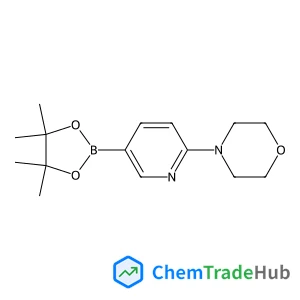
4-(5-(4,4,5,5-tetramethyl-1,3,2-dioxaborolan-2-yl)pyridin-2-yl)morpholine
CAS番号:
485799-04-0
分子式:
C15H23BN2O3
おすすめサプライヤー


免責事項
このページに表示される学術雑誌情報は、参考および研究目的のみを目的としています。当社は雑誌出版社とは提携しておらず、投稿の取り扱いも行っておりません。出版に関するお問い合わせは、各雑誌出版社に直接ご連絡ください。
表示されている情報に誤りがある場合は、support@chemtradehub.com までご連絡ください。迅速に確認し、対応いたします。