












Early diagnosis of Alzheimer's disease using infrared spectroscopy of isolated blood samples followed by multivariate analyses
文献情報
出版日
2016-11-09
DOI
10.1039/C6AN01580H
インパクトファクター
4.616
著者
S. Mordechai, E. Shufan, B. S. Porat Katz, A. Salman
原文を見る
要旨
Alzheimer's disease (AD) is the most common cause of dementia, particularly in the elderly. The disease is characterized by cognitive decline that typically starts with insidious memory loss and progresses relentlessly to produce global impairment of all higher cortical functions. Due to better living conditions and health facilities in developed countries, which result in higher overall life spans, these countries report upward trends of AD among their populations. There are, however, no specific diagnostic tests for AD and clinical diagnosis is especially difficult in the earliest stages of the disease. Early diagnosis of AD is frequently subjective and is determined by physicians (generally neurologists, geriatricians, and psychiatrists) depending on their experience. Diagnosing AD requires both medical history and mental status testing. Having trouble with memory does not mean you have AD. AD has no current cure, but treatments for symptoms are available and research continues. In this study, we investigated the potential of infrared microscopy to differentiate between AD patients and controls, using Fourier transform infrared (FTIR) spectroscopy of isolated blood components. FTIR is known as a quick, safe, and minimally invasive method to investigate biological samples. For this goal, we measured infrared spectra from white blood cells (WBCs) and plasma taken from AD patients and controls, with the consent of the patients or their guardians. Applying multivariate analysis, principal component analysis (PCA) followed by linear discriminant analysis (LDA), it was possible to differentiate among the different types of mild, moderate, and severe AD, and the controls, with 85% accuracy when using the WBC spectra and about 77% when using the plasma spectra. When only the moderate and severe stages were included, an 83% accuracy was obtained using the WBC spectra and about 89% when using the plasma spectra.
関連文献
Effective bulk and surface temperatures of the catalyst bed of FT-IR cells used for in situ and operando studies
Haoguang Li, Mickael Rivallan, Frederic Thibault-Starzyk, Arnaud Travert
2013-03-22
Paper
DOI: 10.1039/C3CP50442E
Switching kinetics of electrochemical metallization memory cells
Stephan Menzel, Stefan Tappertzhofen, Ilia Valov
2013-03-14
Paper
DOI: 10.1039/C3CP50738F
The reaction force constant as an indicator of synchronicity/nonsynchronicity in [4+2] cycloaddition processes
Diana Yepes, Oscar Donoso-Tauda, Patricia Pérez, Pablo Jaque
2013-01-18
Paper
DOI: 10.1039/C3CP44197K
Temperature and time dependence on ZnS microstructure and phases obtained through hydrothermal decomposition of diethyldithiocarbamate complexes
Guilherme Oliveira Siqueira, Tulio Matencio, Herculano Vieira da Silva, Yara Gonçalves de Souza, José Domingos Ardisson, Geraldo Magela de Lima, Arilza de Oliveira Porto
2013-03-04
Paper
DOI: 10.1039/C3CP50549A
Manipulating dynamics with chemical structure: probing vibrationally-enhanced tunnelling in photoexcited catechol
Jamie D. Young, Dave Townsend, Justyna M. Żurek, Martin J. Paterson, Gareth M. Roberts, Vasilios G. Stavros
2013-03-22
Paper
DOI: 10.1039/C3CP51108A
Low temperature synthesis of wurtzite zinc sulfide (ZnS) thin films by chemical spray pyrolysis
Xin Zeng, Stevin S. Pramana, Sudip K. Batabyal, Xiaodong Chen, K. B. Jinesh
2013-01-17
Communication
DOI: 10.1039/C3CP43470B
Low-lying excited-states of 5-benzyluracil
Marco Micciarelli, Carlo Altucci, Bartolomeo Della Ventura, Raffaele Velotta, Valer Toşa, Adán B. Gónzalez Pérez, Martin Pérez Rodríguez, Ángel R. de Lera, Attila Bende
2013-03-19
Paper
DOI: 10.1039/C3CP50343G
Chelating ionic liquids for reversible zinc electrochemistry
Mega Kar, Bjorn Winther-Jensen, Maria Forsyth, Douglas R. MacFarlane
2013-03-22
Paper
DOI: 10.1039/C3CP51102B
Investigation of the nanomechanical properties of β-Si3N4nanowires under three-point bending via molecular dynamics simulation
Xuefeng Lu, Hongjie Wang, Meng Chen, Lei Fan, Chao Wang, Shuhai Jia
2013-02-27
Communication
DOI: 10.1039/C3CP50372K
こちらもおすすめ
化合物よくある質問
3-イチチルビフェニルはどのように合成されますか?
3-イチチルビフェニルは、ビフェニルとイチプロピオニトリルを回収率約90%で反応させて合成されます。触媒は通常、亜リチウムホウ素を用います。
5668-93-93-Ethylbiphenyl
化合物よくある質問
8-溴-5-三氟甲基喹啉はどのように合成されますか?
8-溴-5-三氟甲基喹啉は、5-トリフルオロメチル-2-メチル-1,3-ベンゼンジオールをブロモエタノールと反応させて生成します。この反応は塩基性条件下で行われ...
917251-92-48-Bromo-5-(trifluoro...
化合物よくある質問
ジメチル4-(4,4,5,5-テトラメチル-1,3,2-ドioxaborolan-2-基)-2,6-ピリジンジカルボイル酸フェニルアミニドの代替品はありますか?
ジメチル4-(4,4,5,5-テトラメチル-1,3,2-ドioxaborolan-2-基)-2,6-ピリジンジカルボイル酸フェニルアミニドの代替品としては、4-...
741709-66-0Dimethyl 4-(4,4,5,5-...
化合物よくある質問
N-(3,5-ヘキサクロロ-4-ピリドインイル)-8-メチオキシ-5-キノリンカーボン酸の市場動向や研究トレンドはどのようなものでしょうか?
N-(3,5-ヘキサクロロ-4-ピリドインイル)-8-メチオキシ-5-キノリンカーボン酸の市場動向は、主に産業用途での需要により影響を受けます。研究トレンドとし...
199871-63-1N-(3,5-Dichloro-4-py...
化合物よくある質問
イソステアロイルグリセリルは安全ですか?
イソステアロイルグリセリルは一般的に安全性が高いとされていますが、過度な使用や個人差により皮�owsん炎などの反応が起こる可能性があります。使用前に医師に相談す...
222723-55-92-[(5Z,8Z,11Z,14Z)-5...
化合物よくある質問
1-(二苯甲基)-3,3-二氟-氮杂环丁烷の市場動向や研究トレンドはどうですか?
1-(二苯甲基)-3,3-二氟-氮杂环丁烷の市場動向は、医薬品や合成化学の研究分野で注目を集めています。新興研究は、該当化合物の合成改良と生体内での作用メカニズ...
288315-02-61-Benzhydryl-3,3-dif...
化合物よくある質問
3-チオフェンスチオールの物理化学的性質は何ですか?
3-チオフェンスチオールのCAS番号は7774-73-4です。結晶性の白色粉末で、分子量は122.17です。この化合物は水に微溶解し、エタノールやジクロロメタン...
7774-73-43-Thiophenethiol
化合物よくある質問
2-Methyl-2-propanyl (2S)-2-(aminomethyl)-1-piperidinecarboxylateは安全ですか?
2-Methyl-2-propanyl (2S)-2-(aminomethyl)-1-piperidinecarboxylateは一定の安全性基準を満たしていま...
475105-35-22-Methyl-2-propanyl ...
化合物よくある質問
CAS番号1316822-90-8の化合物は安全ですか?
CAS番号1316822-90-8の化合物は安全性に関しては評価が不足していますが、一般的には生物学的に活性な物質であり、取り扱いには適切な安全防護措置が必要で...
1316822-90-8Gal beta(1-3)[Neu5Ac...
化合物よくある質問
Tert-butyl 2-(2-羟基乙基)哌嗪-1-羧酸はどのように保存すればよいですか?
Tert-butyl 2-(2-羟基乙基)哌嗪-1-羧酸は、冷暗所で保存し、直射日光から遠ざけてください。容器は密閉し、高湿度や高温を避けて保管してください。
517866-79-4Tert-butyl 2-(2-hydr...
掲載誌
Analyst

CiteScore:
7.8
自己引用率:
5.6%
年間論文数:
653
Analyst publishes analytical and bioanalytical research that reports premier fundamental discoveries and inventions, and the applications of those discoveries, unconfined by traditional discipline barriers.
おすすめ化合物
![N-{15-[(2,5-Dioxo-1-pyrrolidinyl)oxy]-15-oxo-3,6,9,12-tetraoxapentadec-1-yl}-2-(2-propyn-1-yloxy)acetamide structure](https://static.chemtradehub.com/structs/210/2101206-92-0-2eb5.webp "N-{15-[(2,5-Dioxo-1-pyrrolidinyl)oxy]-15-oxo-3,6,9,12-tetraoxapentadec-1-yl}-2-(2-propyn-1-yloxy)acetamide structure")
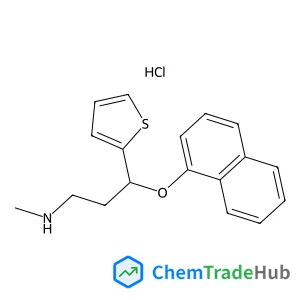
N-Methyl-3-(1-naphthyloxy)-3-(2-thienyl)-1-propanamine hydrochloride (1:1)
CAS番号:
1188266-11-6
分子式:
C18H20ClNOS
おすすめサプライヤー



免責事項
このページに表示される学術雑誌情報は、参考および研究目的のみを目的としています。当社は雑誌出版社とは提携しておらず、投稿の取り扱いも行っておりません。出版に関するお問い合わせは、各雑誌出版社に直接ご連絡ください。
表示されている情報に誤りがある場合は、support@chemtradehub.com までご連絡ください。迅速に確認し、対応いたします。