


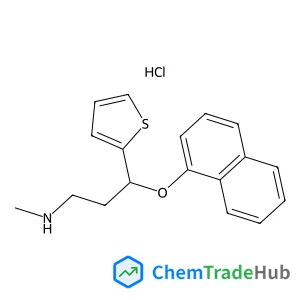
N-Methyl-3-(1-naphthyloxy)-3-(2-thienyl)-1-propanamine hydrochloride (1:1)
CAS番号:
1188266-11-6
分子式:
C18H20ClNOS
Jamie D. Young, Dave Townsend, Justyna M. Żurek, Martin J. Paterson, Gareth M. Roberts, Vasilios G. Stavros
Ultrafast time-resolved velocity map ion imaging (TR-VMI) and time-resolved ion-yield (TR-IY) methods are utilised to reveal a comprehensive picture of the electronic state relaxation dynamics in photoexcited catechol (1,2-dihydroxybenzene). After excitation to the S1 (1ππ*) state between 280.5 (the S1 origin band, S1(v = 0)) to 243 nm, the population in this state is observed to decay through coupling onto the S2 (1πσ*) state, which is dissociative with respect to the non-hydrogen bonded ‘free’ O–H bond (labelled O1–H). This process occurs via tunnelling under an S1/S2 conical intersection (CI) on a timeframe of 5–11 ps, resulting in O1–H bond fission along S2. Concomitant formation of ground state catechoxyl radicals (C6H5O2(X)), in coincidence with translationally excited H-atoms, occurs over the same timescale as the S1 state population decays. Between 254–237 nm, direct excitation to the S2 state is also observed, manifesting in the ultrafast (∼100 fs) formation of H-atoms with high kinetic energy release. From these measurements we determine that the S1/S2 CI lies ∼3700–5500 cm−1 above the S1(v = 0) level, indicating that the barrier height to tunnelling from S1(v = 0) → S2 is comparable to that observed in the related ‘benchmark’ species phenol (hydroxybenzene). We discuss how a highly ‘vibrationally-enhanced’ tunnelling mechanism is responsible for the two orders of magnitude enhancement to the tunnelling rate in catechol, relative to that previously determined in phenol (>1.2 ns), despite similar barrier heights. This phenomenon is a direct consequence of the non-planar S1 excited state minimum structure (C1 symmetry) in catechol, which in turn yields relaxed symmetry constraints for vibronic coupling from S1(v = 0) → S2 – a scenario which does not exist for phenol. These findings offer an elegant example of how even simple chemical modifications (ortho-hydroxy substitution) to a fundamental, biologically relevant, UV chromophore, such as phenol, can have profound effects on the ensuing excited state dynamics.

Kinetics and Catalysis

Fibre Chemistry

Organic Preparations and Procedures International

Pure and Applied Chemistry

Pharmacological Reviews

Israel Journal of Chemistry

Proceedings of the National Academy of Sciences of the United States of America

Helvetica Chimica Acta

Russian Chemical Reviews

Journal of Physics and Chemistry of Solids
DOI: 10.1039/C3CP44283G
Vicky FitzGerald, Veijo Honkimaki, Mark A. Roberts, Tessa Brennan, Richard A. Martin, George A. Saunders, Robert J. Newport
DOI: 10.1039/C3CP44298E
Jan Rongé, Dorien Nijs, Stef Kerkhofs, Kasper Masschaele, Johan A. Martens
DOI: 10.1039/C3CP50890K
Sergey Sirotin, Philippe Bazin, Françoise Maugé, Arnaud Travert
DOI: 10.1039/C3CP51146D
Sirous Asgari, Doretta Capsoni, Piercarlo Mustarelli
DOI: 10.1039/C3CP51481A
U. Hoppe, L. Delevoye, L. Montagne, M. v. Zimmermann, A. C. Hannon
DOI: 10.1039/C2CP42772A
Jean-François Greisch, Michael E. Harding, Mattias Kordel
DOI: 10.1039/C3CP44362K
Anna Kubacka, Ana Iglesias-Juez, M. Di Michiel, Mark A. Newton, Marcos Fernández-García
DOI: 10.1039/C3CP44293D
Joseph Mason, Christopher Batchelor-McAuley, Richard G. Compton
DOI: 10.1039/C3CP50607J
Kiichi Fukuhara, Masaaki Kitano, Shigenobu Hayashi, Michikazu Hara
DOI: 10.1039/C3CP43853H
3-イチチルビフェニルは、ビフェニルとイチプロピオニトリルを回収率約90%で反応させて合成されます。触媒は通常、亜リチウムホウ素を用います。
8-溴-5-三氟甲基喹啉は、5-トリフルオロメチル-2-メチル-1,3-ベンゼンジオールをブロモエタノールと反応させて生成します。この反応は塩基性条件下で行われ...
ジメチル4-(4,4,5,5-テトラメチル-1,3,2-ドioxaborolan-2-基)-2,6-ピリジンジカルボイル酸フェニルアミニドの代替品としては、4-...
N-(3,5-ヘキサクロロ-4-ピリドインイル)-8-メチオキシ-5-キノリンカーボン酸の市場動向は、主に産業用途での需要により影響を受けます。研究トレンドとし...
イソステアロイルグリセリルは一般的に安全性が高いとされていますが、過度な使用や個人差により皮�owsん炎などの反応が起こる可能性があります。使用前に医師に相談す...
1-(二苯甲基)-3,3-二氟-氮杂环丁烷の市場動向は、医薬品や合成化学の研究分野で注目を集めています。新興研究は、該当化合物の合成改良と生体内での作用メカニズ...
3-チオフェンスチオールのCAS番号は7774-73-4です。結晶性の白色粉末で、分子量は122.17です。この化合物は水に微溶解し、エタノールやジクロロメタン...
2-Methyl-2-propanyl (2S)-2-(aminomethyl)-1-piperidinecarboxylateは一定の安全性基準を満たしていま...
CAS番号1316822-90-8の化合物は安全性に関しては評価が不足していますが、一般的には生物学的に活性な物質であり、取り扱いには適切な安全防護措置が必要で...
Tert-butyl 2-(2-羟基乙基)哌嗪-1-羧酸は、冷暗所で保存し、直射日光から遠ざけてください。容器は密閉し、高湿度や高温を避けて保管してください。

Physical Chemistry Chemical Physics (PCCP) is an international journal co-owned by 19 physical chemistry and physics societies from around the world. This journal publishes original, cutting-edge research in physical chemistry, chemical physics and biophysical chemistry. To be suitable for publication in PCCP, articles must include significant innovation and/or insight into physical chemistry; this is the most important criterion that reviewers and Editors will judge against when evaluating submissions. The journal has a broad scope and welcomes contributions spanning experiment, theory, computation and data science. Topical coverage includes spectroscopy, dynamics, kinetics, statistical mechanics, thermodynamics, electrochemistry, catalysis, surface science, quantum mechanics, quantum computing and machine learning. Interdisciplinary research areas such as polymers and soft matter, materials, nanoscience, energy, surfaces/interfaces, and biophysical chemistry are welcomed if they demonstrate significant innovation and/or insight into physical chemistry. Joined experimental/theoretical studies are particularly appreciated when complementary and based on up-to-date approaches.
![1,10-bis(3,5-dimethylphenyl)-12-hydroxy-4,5,6,7-tetrahydroiindeno[7,1-de:1',7'-fg][1,3,2]dioxaphosphocine 12-oxide structure](https://static.chemtradehub.com/structs/141/1412439-82-7-b9a9.webp "1,10-bis(3,5-dimethylphenyl)-12-hydroxy-4,5,6,7-tetrahydroiindeno[7,1-de:1',7'-fg][1,3,2]dioxaphosphocine 12-oxide structure")
![N-{15-[(2,5-Dioxo-1-pyrrolidinyl)oxy]-15-oxo-3,6,9,12-tetraoxapentadec-1-yl}-2-(2-propyn-1-yloxy)acetamide structure](https://static.chemtradehub.com/structs/210/2101206-92-0-2eb5.webp "N-{15-[(2,5-Dioxo-1-pyrrolidinyl)oxy]-15-oxo-3,6,9,12-tetraoxapentadec-1-yl}-2-(2-propyn-1-yloxy)acetamide structure")





