












Chemical selectivity in structure determination by the time dependent analysis of in situ XRPD data: a clear view of Xe thermal behavior inside a MFI zeolite
文献情報
出版日
2015-05-28
DOI
10.1039/C5CP02522B
インパクトファクター
3.676
著者
Rocco Caliandro, Davide Viterbo, Marco Milanesio
原文を見る
要旨
X-ray diffraction methods in general provide a representation of the average structure, thus allowing only limited chemical selectivity. As recently shown [D. Chernyshov, et al., Acta Crystallogr., Sect. A: Found. Crystallogr., 2011, 67, 327], some structural information on a subset of atoms can be obtained using the modulation enhanced diffraction (MED), thus providing a new tool that is able to enhance selectivity in diffraction. MED uses a periodic stimulus supplied in situ on a crystal while diffraction data are collected continuously during one or more stimulation periods. Such large data sets can then be treated by different methods. Herein, we present and compare phase sensitive detection (PSD) and principal component analysis (PCA) for in situ X-ray powder diffraction (XRPD) data treatment. The application of PCA to MED data is described for the first time in the present paper. Simulated and experimental MED powder data were produced using an MFI zeolite as a static spectator in which Xe, acting as the active species, is adsorbed and desorbed in a periodic manner. By demodulating the simulated and experimental data, MED allowed the powder diffraction pattern of the responding scattering density to be obtained and enabled the selective extraction of crystallographic information on Xe by solving the crystal structure of the active species independently of the static zeolite framework. The “real world” experiments indicated that the PSD-MED approach has some limitations related to the degree of fulfilment of some theoretical assumptions. When applied to in situ XRPD data, PCA, despite being based on blind statistical analysis, gave results similar to those obtained by PSD (based on Fourier analysis) for simulated data. Moreover, PCA is complementary to PSD thanks to its capability of gathering information on the Xe substructure even in the presence of a non-periodic stimulus, i.e. using the most simple stimulus shape as a single temperature ramp. In particular, PC1 results are able to perfectly reproduce the corresponding 1Ω signal from a traditional PSD analysis. Moreover PCA can be applied directly to raw non periodic XRPD data, opening the possibility of using it during an “in situ” experiment. PCA can thus be envisaged as a very useful, fast and efficient tool to improve data collection and maximize data quality. To date, however, PSD remains superior for substructure solution from the analysis of 2Ω demodulated data.
関連文献
From poly(vinylimidazole) to cationic glycopolymers and glyco-particles: effective antibacterial agents with enhanced biocompatibility and selectivity
Jing Chen, Chunyang Bao, Rui Han, Guang-Zhao Li, Zhaoquan Zheng, Yan Wang, Qiang Zhang
2022-03-23
Paper
DOI: 10.1039/D1PY01711J
Functional pH-responsive polymers containing dynamic enaminone linkages for the release of active organic amines
Spyridon Efstathiou, Congkai Ma, Despina Coursari, Georgios Patias, Lucas Al-Shok, David M. Haddleton
2022-03-18
Paper
DOI: 10.1039/D2PY00167E
LCST and UCST-type thermoresponsive behavior in dendronized gelatins
Xiacong Zhang, Biyi Xu, Wen Li
2022-04-11
Paper
DOI: 10.1039/D2PY00118G
Synthesis and characterisation of polyamides based on 2,5-furandicarboxylic acid as a sustainable building block for engineering plastics
Sicco de Vos, Vasilios Tsanaktsis, Bahar Yeniad
2022-05-16
Paper
DOI: 10.1039/D2PY00189F
Optically reconfigurable shape memory metallo-polymer mediated by a carbolong complex and radically exchangeable covalent bond
Liulin Yang, Haibo Zhao, Yulin Xie, Pufan Ouyang, Yonghong Ruan, Jiangxi Chen, Wengui Weng, Xumin He, Haiping Xia
2022-03-03
Paper
DOI: 10.1039/D2PY00192F
Design of selective divalent chain transfer agents for coordinative chain transfer polymerization of ethylene and its copolymerization with butadiene
Julien Thuilliez
2022-03-10
Paper
DOI: 10.1039/D2PY00155A
Chromium complexes supported by NNO-tridentate ligands: an unprecedented activity with the requirement of a small amount of MAO
Jiliang Tian, Xingwang Zhang, Shaofeng Liu
2022-03-04
Paper
DOI: 10.1039/D2PY00125J
こちらもおすすめ
化合物よくある質問
2-ヒドロキシ-5-ニトロベンジンブロモイドの代替品はありますか?
2-ヒドロキシ-5-ニトロベンジンブロモイドは特定の化学反応に適しているため、代替品は限られています。しかし、同様の構造を持つ2-ヒドロキシ-4-ニトロベンジン...
772-33-82-(Bromomethyl)-4-ni...
化合物よくある質問
N-(2-ブロモフェニル)-1-チロール-3-オキソ-3-(ピペリジニル)プロペン-2-イル)ベンゼンアミドを取り扱う際の実験室安全事項は何ですか?
N-(2-ブロモフェニル)-1-チロール-3-オキソ-3-(ピペリジニル)プロペン-2-イル)ベンゼンアミドは有毒で、皮膚や粘膜に刺激を与える可能性があります。...
1800044-77-2N-[(1Z)-1-(2-Bromoph...
化合物よくある質問
1,3プロパンジオール,2-[2-(2アミノ-6クロロ-9Hピリミジン-9-イル)エチル-1,1,2,2-D4]-2,3-ジアセタートの市場動向や研究トレンドはどうですか?
この化合物は、新規治療薬の開発に注目されています。市場では、その有効性と安全性が評価され、研究分野では、分子生物学と医薬化学の新たな発見が期待されています。
1020718-81-31,3-Propanediol, 2-[...
579-44-2Ethanone, 2-hydroxy-...
化合物よくある質問
Succinimidyl-alanyl-phenylalanyl-prolyl-phenylalanine 4-nitroanilide はどの業界で使用されていますか?
Succinimidyl-alanyl-phenylalanyl-prolyl-phenylalanine 4-nitroanilide は主に医薬品開発やポ...
128802-73-3succinimidyl-alanyl-...
化合物よくある質問
メチル6-アミノ-5-クロロピリジン-2-カーボイル酸について、適用される法規ガイドラインは何ですか?
メチル6-アミノ-5-クロロピリジン-2-カーボイル酸(CAS番号: 1256794-05-4)の使用には、GHS( Globally Harmonized S...
1256794-05-4Methyl 6-amino-5-chl...
化合物よくある質問
エチル4-(シクロ Pentagonyl)アミノ-2-メチル硫化基ピリミジン-5-カルボキシレートを取り扱う際の実験室安全事項は何ですか?
取り扱いには、耐薬品性の容器を使用し、通気性の良い場所で操作することを推奨します。漏れ時は、SDS(安全データシート)を参照して適切な措置を取ること。手洗いと洗...
211245-62-4ethyl 4-(cyclopentyl...
化合物よくある質問
(S)-3-ベンZYルピペリジン塩酸塩とは何ですか?
(S)-3-ベンZYルピペリジン塩酸塩は、CAS番号1258940-00-9で表される化合物です。これは、(S)-3-苯基哌啶的盐酸盐であり、主に医薬品の原料と...
1258940-00-9(S)-3-Phenylpiperidi...
化合物よくある質問
3,5-二甲基金剛胺の主な用途は何ですか?
3,5-二甲基金剛胺は、主に医薬品の原料として使用され、また抗うつ薬や抗アルツハイマー薬の開発に利用されます。さらに、化粧品や食品添加物の製造でも重要な役割を果...
19988-45-52-(2,3-Dihydroxyphen...
化合物よくある質問
ビス(4-メチル-2-ペンチル)フェニルカルボン酸エステルの代替品はありますか?
ビス(4-メチル-2-ペンチル)フェニルカルボン酸エステル (CAS番号: 1398066-13-1) の代替品には、ビス(2-エチルヘキシル)フェノールカルボ...
1398066-13-1Bis(4-methyl-2-penty...
掲載誌
Physical Chemistry Chemical Physics

CiteScore:
5.5
自己引用率:
10.3%
年間論文数:
3036
Physical Chemistry Chemical Physics (PCCP) is an international journal co-owned by 19 physical chemistry and physics societies from around the world. This journal publishes original, cutting-edge research in physical chemistry, chemical physics and biophysical chemistry. To be suitable for publication in PCCP, articles must include significant innovation and/or insight into physical chemistry; this is the most important criterion that reviewers and Editors will judge against when evaluating submissions. The journal has a broad scope and welcomes contributions spanning experiment, theory, computation and data science. Topical coverage includes spectroscopy, dynamics, kinetics, statistical mechanics, thermodynamics, electrochemistry, catalysis, surface science, quantum mechanics, quantum computing and machine learning. Interdisciplinary research areas such as polymers and soft matter, materials, nanoscience, energy, surfaces/interfaces, and biophysical chemistry are welcomed if they demonstrate significant innovation and/or insight into physical chemistry. Joined experimental/theoretical studies are particularly appreciated when complementary and based on up-to-date approaches.
おすすめ化合物
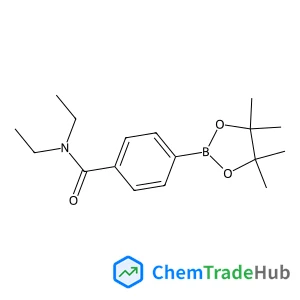
N,N-Diethyl-4-(4,4,5,5-tetramethyl-1,3,2-dioxaborolan-2-yl)benzamide
CAS番号:
325142-99-2
分子式:
C17H26BNO3
![tert-Butyl N-[(2-chloropyridin-4-yl)methyl]carbamate structure](https://static.chemtradehub.com/structs/916/916210-27-0-9f95.webp "tert-Butyl N-[(2-chloropyridin-4-yl)methyl]carbamate structure")
おすすめサプライヤー





免責事項
このページに表示される学術雑誌情報は、参考および研究目的のみを目的としています。当社は雑誌出版社とは提携しておらず、投稿の取り扱いも行っておりません。出版に関するお問い合わせは、各雑誌出版社に直接ご連絡ください。
表示されている情報に誤りがある場合は、support@chemtradehub.com までご連絡ください。迅速に確認し、対応いたします。