


LCST and UCST-type thermoresponsive behavior in dendronized gelatins
文献情報
出版日
2022-04-11
DOI
10.1039/D2PY00118G
インパクトファクター
5.582
著者
Xiacong Zhang, Biyi Xu, Wen Li
原文を見る
要旨
Modification of natural polymers with stimuli-responsive synthetic moieties is beneficial because of the convergence of superior properties from natural polymers and stimuli-responsiveness to generate new intelligent materials. This usually has been performed using synthetic polymers with long chains, resulting in modified natural polymers with diminished properties due to the predominant portion of synthetic moieties. In the present work, instead of long-chain polymers, we utilized threefold dendritic oligoethylene glycols (OEGs) for modification of gelatin, which is an important biomacromolecule with excellent biocompatibility and bioactivity, to generate dendronized gelatins (GelG1s) with radial amphiphilic features. The formed GelG1s can exhibit lower critical solution temperature (LCST)-type and upper critical solution temperature (UCST)-type thermoresponsive behavior, depending on the grafting ratio of the dendritic OEGs. The thermoresponsive behavior of GelG1s can further be tuned by the addition of salts. The introduction of dendritic OEGs results in only a minor influence on the secondary structure of the gelatins, and GelG1s retain the temperature-controlled sol–gel transitions that occur with the naked gelatin. In addition, the mechanical strength of the hydrogels formed from GelG1s at low temperatures can be modulated by either polymer concentration or grafting ratios of OEG dendrons. Overall, we provide a new strategy for the development of gelatin-based smart materials.
おすすめジャーナル

Chemistry Education Research and Practice

Acta Materialia

Saudi Pharmaceutical Journal

Russian Journal of Organic Chemistry

Russian Journal of Applied Chemistry

Drug Discovery Today

Organic Process Research & Development

Russian Journal of Coordination Chemistry

Journal of Peptide Science

Current Opinion in Colloid & Interface Science
関連文献
Homogeneous and heterogeneous dynamics in native and denatured bovine serum albumin
Felix Ameseder, Aurel Radulescu, Marina Khaneft, Wiebke Lohstroh, Andreas M. Stadler
2018-01-26
Paper
DOI: 10.1039/C7CP08292D
Photoelectron spectroscopy and thermochemistry of o-, m-, and p-methylenephenoxide anions
Daniel J. Nelson, Wilson K. Gichuhi, Charles M. Nichols, Veronica M. Bierbaum, W. Carl Lineberger
2018-09-20
Paper
DOI: 10.1039/C8CP05403G
Bound and continuum-embedded states of cyanopolyyne anions
Wojciech Skomorowski, Sahil Gulania, Anna I. Krylov
2018-01-15
Paper
DOI: 10.1039/C7CP08227D
Photoprotection or photodamage: a direct observation of nonradiative dynamics from 2-ethylhexyl 4-dimethylaminobenzoate sunscreen agent
Chensheng Ma, Chris Tsz-Leung Chan, Ruth Chau-Ting Chan, Allen Ka-Wa Wong, Bowie Po-Yee Chung, Wai-Ming Kwok
2018-09-05
Paper
DOI: 10.1039/C8CP04447C
The interfacial electrostatic potential modulates the insertion of cell-penetrating peptides into lipid bilayers
Natalia Wilke, Luis S. Mayorga
2018-01-26
Paper
DOI: 10.1039/C7CP07243K
Entropy drives the insertion of ibuprofen into model membranes
Natalia Rojas-Valencia, Marcela Manrique-Moreno, C. Z. Hadad, Albeiro Restrepo
2018-09-05
Paper
DOI: 10.1039/C8CP04674C
Carbon-contacted single molecule electrical junctions
Cezhou Zhao, Chun Zhao, Weitao Su, Yannick J. Dappe, Richard J. Nichols
2018-06-21
Paper
DOI: 10.1039/C8CP02877J
Structural transformations of carbon and boron nitride nanoscrolls at high impact collisions
C. F. Woellner, L. D. Machado, P. A. S. Autreto, D. S. Galvao
2018-01-16
Paper
DOI: 10.1039/C7CP07402F
Comment on “Spectroscopic properties and location of the Ce3+ energy levels in Y3Al2Ga3O12 and Y3Ga5O12 at ambient and high hydrostatic pressure” by S. Mahlik, A. Lazarowska, J. Ueda, S. Tanabe and M. Grinberg, Phys. Chem. Chem. Phys., 2016, 18, 6683
Yongjie Wang, M. Głowacki, M. Berkowski, A. Kamińska
2018-12-14
Comment
DOI: 10.1039/C8CP06154H
Polarization propagator theory and the entanglement between MO excitations
2018-09-15
Paper
DOI: 10.1039/C8CP03480J
こちらもおすすめ
化合物よくある質問
2-ヒドロキシ-5-ニトロベンジンブロモイドの代替品はありますか?
2-ヒドロキシ-5-ニトロベンジンブロモイドは特定の化学反応に適しているため、代替品は限られています。しかし、同様の構造を持つ2-ヒドロキシ-4-ニトロベンジン...
772-33-82-(Bromomethyl)-4-ni...
化合物よくある質問
N-(2-ブロモフェニル)-1-チロール-3-オキソ-3-(ピペリジニル)プロペン-2-イル)ベンゼンアミドを取り扱う際の実験室安全事項は何ですか?
N-(2-ブロモフェニル)-1-チロール-3-オキソ-3-(ピペリジニル)プロペン-2-イル)ベンゼンアミドは有毒で、皮膚や粘膜に刺激を与える可能性があります。...
1800044-77-2N-[(1Z)-1-(2-Bromoph...
化合物よくある質問
1,3プロパンジオール,2-[2-(2アミノ-6クロロ-9Hピリミジン-9-イル)エチル-1,1,2,2-D4]-2,3-ジアセタートの市場動向や研究トレンドはどうですか?
この化合物は、新規治療薬の開発に注目されています。市場では、その有効性と安全性が評価され、研究分野では、分子生物学と医薬化学の新たな発見が期待されています。
1020718-81-31,3-Propanediol, 2-[...
579-44-2Ethanone, 2-hydroxy-...
化合物よくある質問
Succinimidyl-alanyl-phenylalanyl-prolyl-phenylalanine 4-nitroanilide はどの業界で使用されていますか?
Succinimidyl-alanyl-phenylalanyl-prolyl-phenylalanine 4-nitroanilide は主に医薬品開発やポ...
128802-73-3succinimidyl-alanyl-...
化合物よくある質問
メチル6-アミノ-5-クロロピリジン-2-カーボイル酸について、適用される法規ガイドラインは何ですか?
メチル6-アミノ-5-クロロピリジン-2-カーボイル酸(CAS番号: 1256794-05-4)の使用には、GHS( Globally Harmonized S...
1256794-05-4Methyl 6-amino-5-chl...
化合物よくある質問
エチル4-(シクロ Pentagonyl)アミノ-2-メチル硫化基ピリミジン-5-カルボキシレートを取り扱う際の実験室安全事項は何ですか?
取り扱いには、耐薬品性の容器を使用し、通気性の良い場所で操作することを推奨します。漏れ時は、SDS(安全データシート)を参照して適切な措置を取ること。手洗いと洗...
211245-62-4ethyl 4-(cyclopentyl...
化合物よくある質問
(S)-3-ベンZYルピペリジン塩酸塩とは何ですか?
(S)-3-ベンZYルピペリジン塩酸塩は、CAS番号1258940-00-9で表される化合物です。これは、(S)-3-苯基哌啶的盐酸盐であり、主に医薬品の原料と...
1258940-00-9(S)-3-Phenylpiperidi...
化合物よくある質問
3,5-二甲基金剛胺の主な用途は何ですか?
3,5-二甲基金剛胺は、主に医薬品の原料として使用され、また抗うつ薬や抗アルツハイマー薬の開発に利用されます。さらに、化粧品や食品添加物の製造でも重要な役割を果...
19988-45-52-(2,3-Dihydroxyphen...
化合物よくある質問
ビス(4-メチル-2-ペンチル)フェニルカルボン酸エステルの代替品はありますか?
ビス(4-メチル-2-ペンチル)フェニルカルボン酸エステル (CAS番号: 1398066-13-1) の代替品には、ビス(2-エチルヘキシル)フェノールカルボ...
1398066-13-1Bis(4-methyl-2-penty...
掲載誌
Polymer Chemistry

CiteScore:
8.6
自己引用率:
7.3%
年間論文数:
457
Polymer Chemistry welcomes submissions in all areas of polymer science that have a strong focus on macromolecular chemistry. Manuscripts may cover a broad range of fields, yet no direct application focus is required.
おすすめ化合物
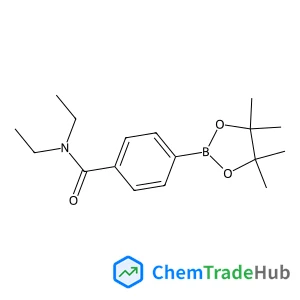
N,N-Diethyl-4-(4,4,5,5-tetramethyl-1,3,2-dioxaborolan-2-yl)benzamide
CAS番号:
325142-99-2
分子式:
C17H26BNO3
おすすめサプライヤー




免責事項
このページに表示される学術雑誌情報は、参考および研究目的のみを目的としています。当社は雑誌出版社とは提携しておらず、投稿の取り扱いも行っておりません。出版に関するお問い合わせは、各雑誌出版社に直接ご連絡ください。
表示されている情報に誤りがある場合は、support@chemtradehub.com までご連絡ください。迅速に確認し、対応いたします。