













Optically reconfigurable shape memory metallo-polymer mediated by a carbolong complex and radically exchangeable covalent bond
文献情報
出版日
2022-03-03
DOI
10.1039/D2PY00192F
インパクトファクター
5.582
著者
Liulin Yang, Haibo Zhao, Yulin Xie, Pufan Ouyang, Yonghong Ruan, Jiangxi Chen, Wengui Weng, Xumin He, Haiping Xia
原文を見る
要旨
Conventional shape memory polymers (SMPs) are restricted to predetermined permanent shapes and therefore cannot be reconfigured arbitrarily to adapt to variant application scenarios. Meanwhile, shape memory behaviour is mostly thermally active and is often induced by direct heating and lacks spatial or remote control. Herein, we report a novel SMP with a reconfigurable network containing a semi-crystalline polymer chain, radically exchangeable covalent bond and photothermoresponsive carbolong complex moiety. The photothermal effect of the carbolong complex and the thermal responsiveness of the semi-crystalline polymer chain and radically exchangeable covalent bond lead to shape memory behaviour and network topological rearrangement using near-infrared light irradiation. Such a strategy offers an opportunity for building reconfigurable shape memory polymers that can be manipulated by either direct heating or remote light irradiation.
関連文献
Double layer capacitance of anode/solid-electrolyte interfaces
2011-07-25
Paper
DOI: 10.1039/C1CP20508K
Kinetics of the C–C bond beta scission reactions in alkyl radicals
Artur Ratkiewicz
2011-07-22
Paper
DOI: 10.1039/C1CP21229J
Voltammetry and in situscanning tunnelling spectroscopy of osmium, iron, and ruthenium complexes of 2,2′:6′,2′′-terpyridine covalently linked to Au(111)-electrodes
Princia Salvatore, Allan Glargaard Hansen, Thomas Bjørnholm, Richard John Nichols, Jens Ulstrup
2011-06-23
Paper
DOI: 10.1039/C1CP21197H
Diffusional effects on the reversible excited-state proton transfer. From experiments to Brownian dynamics simulations‡
Alexander V. Popov, Elizabeth-Ann Gould, Michael A. Salvitti, Rigoberto Hernandez, Kyril M. Solntsev
2011-07-14
Paper
DOI: 10.1039/C1CP20952C
Excitons in semiconducting carbon nanotubes: diameter-dependent photoluminescence spectra
Yoshihiko Kanemitsu
2011-07-07
Perspective
DOI: 10.1039/C1CP21235D
Temperature dependent structured absorption spectra of molecular chlorine
I. A. K. Young, C. Murray, C. M. Blaum, R. A. Cox, R. L. Jones, F. D. Pope
2011-07-26
Paper
DOI: 10.1039/C1CP21337G
Photo-deactivation pathways of a double H-bonded photochromic Schiff base investigated by combined theoretical calculations and experimental time-resolved studies
Carlos Randino, Marcin Ziółek, Ricard Gelabert, Juan Angel Organero, Michal Gil, Miquel Moreno, José M. Lluch, Abderrazzak Douhal
2011-07-14
Paper
DOI: 10.1039/C1CP21039D
こちらもおすすめ
化合物よくある質問
2-ヒドロキシ-5-ニトロベンジンブロモイドの代替品はありますか?
2-ヒドロキシ-5-ニトロベンジンブロモイドは特定の化学反応に適しているため、代替品は限られています。しかし、同様の構造を持つ2-ヒドロキシ-4-ニトロベンジン...
772-33-82-(Bromomethyl)-4-ni...
化合物よくある質問
N-(2-ブロモフェニル)-1-チロール-3-オキソ-3-(ピペリジニル)プロペン-2-イル)ベンゼンアミドを取り扱う際の実験室安全事項は何ですか?
N-(2-ブロモフェニル)-1-チロール-3-オキソ-3-(ピペリジニル)プロペン-2-イル)ベンゼンアミドは有毒で、皮膚や粘膜に刺激を与える可能性があります。...
1800044-77-2N-[(1Z)-1-(2-Bromoph...
化合物よくある質問
1,3プロパンジオール,2-[2-(2アミノ-6クロロ-9Hピリミジン-9-イル)エチル-1,1,2,2-D4]-2,3-ジアセタートの市場動向や研究トレンドはどうですか?
この化合物は、新規治療薬の開発に注目されています。市場では、その有効性と安全性が評価され、研究分野では、分子生物学と医薬化学の新たな発見が期待されています。
1020718-81-31,3-Propanediol, 2-[...
579-44-2Ethanone, 2-hydroxy-...
化合物よくある質問
Succinimidyl-alanyl-phenylalanyl-prolyl-phenylalanine 4-nitroanilide はどの業界で使用されていますか?
Succinimidyl-alanyl-phenylalanyl-prolyl-phenylalanine 4-nitroanilide は主に医薬品開発やポ...
128802-73-3succinimidyl-alanyl-...
化合物よくある質問
メチル6-アミノ-5-クロロピリジン-2-カーボイル酸について、適用される法規ガイドラインは何ですか?
メチル6-アミノ-5-クロロピリジン-2-カーボイル酸(CAS番号: 1256794-05-4)の使用には、GHS( Globally Harmonized S...
1256794-05-4Methyl 6-amino-5-chl...
化合物よくある質問
エチル4-(シクロ Pentagonyl)アミノ-2-メチル硫化基ピリミジン-5-カルボキシレートを取り扱う際の実験室安全事項は何ですか?
取り扱いには、耐薬品性の容器を使用し、通気性の良い場所で操作することを推奨します。漏れ時は、SDS(安全データシート)を参照して適切な措置を取ること。手洗いと洗...
211245-62-4ethyl 4-(cyclopentyl...
化合物よくある質問
(S)-3-ベンZYルピペリジン塩酸塩とは何ですか?
(S)-3-ベンZYルピペリジン塩酸塩は、CAS番号1258940-00-9で表される化合物です。これは、(S)-3-苯基哌啶的盐酸盐であり、主に医薬品の原料と...
1258940-00-9(S)-3-Phenylpiperidi...
化合物よくある質問
3,5-二甲基金剛胺の主な用途は何ですか?
3,5-二甲基金剛胺は、主に医薬品の原料として使用され、また抗うつ薬や抗アルツハイマー薬の開発に利用されます。さらに、化粧品や食品添加物の製造でも重要な役割を果...
19988-45-52-(2,3-Dihydroxyphen...
化合物よくある質問
ビス(4-メチル-2-ペンチル)フェニルカルボン酸エステルの代替品はありますか?
ビス(4-メチル-2-ペンチル)フェニルカルボン酸エステル (CAS番号: 1398066-13-1) の代替品には、ビス(2-エチルヘキシル)フェノールカルボ...
1398066-13-1Bis(4-methyl-2-penty...
掲載誌
Polymer Chemistry

CiteScore:
8.6
自己引用率:
7.3%
年間論文数:
457
Polymer Chemistry welcomes submissions in all areas of polymer science that have a strong focus on macromolecular chemistry. Manuscripts may cover a broad range of fields, yet no direct application focus is required.
おすすめ化合物
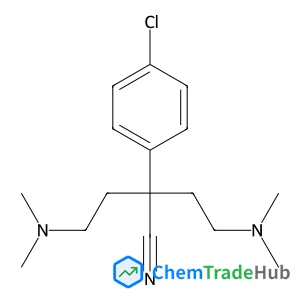
2-(4-Chlorophenyl)-4-(dimethylamino)-2-(2-(dimethylamino)ethyl)butanenitrile
CAS番号:
1246816-57-8
分子式:
C16H24ClN3
おすすめサプライヤー




免責事項
このページに表示される学術雑誌情報は、参考および研究目的のみを目的としています。当社は雑誌出版社とは提携しておらず、投稿の取り扱いも行っておりません。出版に関するお問い合わせは、各雑誌出版社に直接ご連絡ください。
表示されている情報に誤りがある場合は、support@chemtradehub.com までご連絡ください。迅速に確認し、対応いたします。