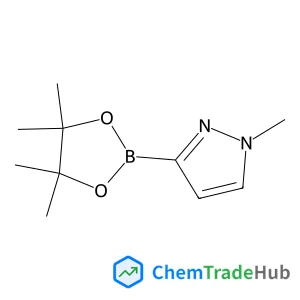
1-Methyl-3-(4,4,5,5-tetramethyl-1,3,2-dioxaborolan-2-yl)-1H-pyrazole
CAS番号:
1020174-04-2
分子式:
C10H17BN2O2
This work aims to extend the study of the formation of the electric double layer at the interface defined by a solution and an ion-exchange membrane on the basis of the Nernst–Planck and Poisson equations, including different values of the counter-ion diffusion coefficient and the dielectric constant in the solution and membrane phases. The network simulation method is used to obtain the time evolution of the electric potential, the displacement electric vector, the electric charge density and the ionic concentrations at the interface between a binary electrolyte solution and a cation-exchange membrane with total co-ion exclusion. The numerical results for the temporal evolution of the interfacial electric potential and the surface electric charge are compared with analytical solutions derived in the limit of the shortest times by considering the Poisson equation for a simple cationic diffusion process. The steady-state results are justified from the Gouy–Chapman theory for the diffuse double layer in the limits of similar and high bathing ionic concentrations with respect to the fixed-charge concentration inside the membrane. Interesting new physical insights arise from the interpretation of the process of the formation of the electric double layer at the ion exchange membrane–solution interface on the basis of a membrane model with total co-ion exclusion.
Meng-En Chen, Xiao-Wei Chen, Yue-Hong Hu, Rui Ye, Jian-Wei Lv, Baosheng Li, Fu-Min Zhang
DOI: 10.1039/D1QO00496D
DOI: 10.1039/D1QO00461A
Stephy Elza John, Shivani Gulati, Nagula Shankaraiah
DOI: 10.1039/D0QO01480J
DOI: 10.1039/C8OB00469B
Qun-yan Wu, Shuai Wang, Zhi-wei Huang, Kong-qiu Hu, Ji-pan Yu, Lei Mei, Meng Zhang
DOI: 10.1039/D1QO00536G
V. Vongsutilers, P. M. Gannett
DOI: 10.1039/C8OB00030A
Ming Bao, Wei Lu, Han Su, Lihua Qiu
DOI: 10.1039/C8OB00735G
Maria Zablocka, Karol Ciepluch, Katarzyna Milowska, Maria Bryszewska, Dzmitry Shcharbin, Nadia Katir, Abdelkrim El Kadib
DOI: 10.1039/D1QO00511A
Masaki Fujie, Junki Hara
DOI: 10.1039/D1QO00523E
Marcel Ritter, Sandesh Neupane, Christoph Steinbeck
DOI: 10.1039/C8OB00164B
2-メトキシ-4-(メチルスルフィニル)アミンは、主に医薬品および農薬の製造に使用されます。また、合成化学の一部として研究用材料としても利用されます。
代替品としては、4,6-二クロロピラミジンアミンや他のピラミジン系化合物が考えられます。ただし、目的と用途によって最適な代替品は異なります。
6-氯-4-甲基-1H-吲哚の廃棄物は、適切な容器に収集し、密閉して保管します。温度は常温、湿度は低く、直射日光を避けて保管することを推奨します。廃棄処理は専門...
2-フローユロ-4-(トリフルオロメチル)ベンゾイドのCAS番号は207974-08-1です。この化合物はGHS分類で毒性物質と有害な反応物質として分類されます...
4-ニトロフェニルN-[(ベンゼルオキシルカーボンイル]グリシングリシングリシン酸は、室温で暗所に保管し、乾燥した環境で保存することを推奨します。容器は密閉性の...
イソデスロラタドリンの代替品としては、デスロラタドリンや他の抗ヒスタミン薬が挙げられます。具体的には、デスロラタドリン、ラセカミド、フェルタドリンなどが、症状や...
5-甲氧基-1,2,3,4-四氢异喹啉盐酸盐の一般的な合成方法は、メタノール中で5-メトキシ-1,2,3,4-四ヒュドロイソキシンを塩酸で塩化します。この反応で...
CAS番号6471-78-9の4-アミノ-5-メトキシ-2-トルエンサルホニック酸は、GHS分類では corrosive(腐食性)と識別されます。EUのREAC...
甲基孕酮の取り扱いは、PPE(個人保護具)の使用が必要な重要な安全事項を伴います。防塵マスク、ゴーグル、手袋を着用することが推奨されます。ドラフトチャンバーを使...

Physical Chemistry Chemical Physics (PCCP) is an international journal co-owned by 19 physical chemistry and physics societies from around the world. This journal publishes original, cutting-edge research in physical chemistry, chemical physics and biophysical chemistry. To be suitable for publication in PCCP, articles must include significant innovation and/or insight into physical chemistry; this is the most important criterion that reviewers and Editors will judge against when evaluating submissions. The journal has a broad scope and welcomes contributions spanning experiment, theory, computation and data science. Topical coverage includes spectroscopy, dynamics, kinetics, statistical mechanics, thermodynamics, electrochemistry, catalysis, surface science, quantum mechanics, quantum computing and machine learning. Interdisciplinary research areas such as polymers and soft matter, materials, nanoscience, energy, surfaces/interfaces, and biophysical chemistry are welcomed if they demonstrate significant innovation and/or insight into physical chemistry. Joined experimental/theoretical studies are particularly appreciated when complementary and based on up-to-date approaches.