












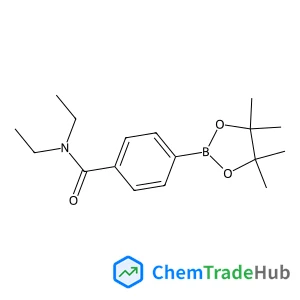
N,N-Diethyl-4-(4,4,5,5-tetramethyl-1,3,2-dioxaborolan-2-yl)benzamide
CAS番号:
325142-99-2
分子式:
C17H26BNO3
Svilen P. Simeonov, José M. S. S. Esperança, Luís Paulo N. Rebelo, Carlos A. M. Afonso
An efficient, simple, scalable and atom efficient method for the synthesis of 2,5-dihydroxymethylfuran (DHMF) and 5-hydroxymethylfuranoic acid, as sodium salt (HMFA), in 80% yield from 5-hydroxymethylfurfural (HMF) in water using NaOH (0.9 eq.) via a Cannizzaro reaction is described. Both the building blocks DHMF and HMFA were successfully isolated merely using selective crystallisation.
Yu Zhang, Tao Li, Dongshuai Hou, Jinglin Zhang, Jinyang Jiang
DOI: 10.1039/C8CP02469C
Takuya Uto, Satoshi Idenoue, Kazuya Yamamoto, Jun-ichi Kadokawa
DOI: 10.1039/C8CP02749H
Jianghao Li, Yihang Fan, Xiaotian Xue, Lingwei Ma, Sumeng Zou, Zhu Fei, Zheng Xie
DOI: 10.1039/C8CP05533E
Michael Barclay, Ragnar Bjornsson, Maicol Cipriani, Andreas Terfort, D. Howard Fairbrother, Oddur Ingólfsson
DOI: 10.1039/C8CP07785A
Lemos P. S., Silva G. S., Roca R. A., Assis M., Torres-Mendieta R., Beltrán-Mir H., Mínguez-Vega G., Cordoncillo E., Andrés J., Longo E.
DOI: 10.1039/C8CP07263A
Promit Ray, Barbara Kirchner
DOI: 10.1039/C8CP07683A
Sílvia Illa-Tuset, David C. Malaspina, Jordi Faraudo
DOI: 10.1039/C8CP04505D
Maria Morga, Małgorzata Nattich-Rak, Magdalena Oćwieja, Zbigniew Adamczyk
DOI: 10.1039/C9CP00440H
DOI: 10.1039/C8CP07241H
2-溴-9,9-二苯基芴は、医薬品、工業材料、有機合成の研究分野で応用されます。特に、レーザー材料や機能性ポリマーの合成に使用されることがあります。また、蛍光色...
四氯化铱の市場は研究開発分野で注目されており、特にナノ技術や金属有機框架(MOFs)の分野での需要が増加傾向にあります。価格は安定しており、中国や韓国での生産が...
1-(4-溴-3-氟苯基)-2-氯乙酮 (CAS番号: 1260857-14-4) の廃棄物は専門的な廃棄処理が必要です。まず、廃棄物は密閉された容器に収集し、...
苦参酚Kは、CAS番号101236-49-1を持つ化合物で、主に天然由来の生薬から抽出されます。この化合物は、抗炎症作用や抗癌作用を持つことが報告されています。
POTASSIUM (1-(TERTBUTOXYCARBONYL)AZETIDIN-3-YL)TRIFLUOROBORATE を含む廃棄物は、まず安全なエント...
4-庚基-4’-聯苯羧酸は、特殊化学品や合成化学の分野で用いられる化学物質ですが、市場動向としては、研究開発の進展とともに需要が増加しています。また、環境配慮型...
6-ブロモ-3-メトキシ-1-フェニル-1H-インドゾールを含む廃棄物は、適切な化学廃棄処理が必要です。通常、廃棄物は密閉容器に収集され、専門の廃棄処理業者に引...
4,4-二甲基-2-吡咯烷酮は医薬、ポリマー、センサー、半導体などの業界で広く使用されています。特に溶媒としての性能が高く評価されています。

Green Chemistry provides a unique forum for the publication of innovative research on the development of alternative green and sustainable technologies. The scope of Green Chemistry is based on, but not limited to, the definition proposed by Anastas and Warner (Green Chemistry: Theory and Practice, P T Anastas and J C Warner, Oxford University Press, Oxford, 1998). Green chemistry is the utilisation of a set of principles that reduces or eliminates the use or generation of hazardous substances in the design, manufacture and application of chemical products. Green Chemistry is at the frontiers of this continuously-evolving interdisciplinary science and publishes research that attempts to reduce the environmental impact of the chemical enterprise by developing a technology base that is inherently non-toxic to living things and the environment. Submissions on all aspects of research relating to the endeavour are welcome. The journal publishes original and significant cutting-edge research that is likely to be of wide general appeal. To be published, work must present a significant advance in green chemistry. Papers must contain a comparison with existing methods and demonstrate advantages over those methods before publication can be considered. For more information please see this Editorial. Coverage includes the following, but is not limited to: Design (e.g. biomimicry, design for degradation/recycling/reduced toxicity…) Reagents & Feedstocks (e.g. renewables, CO2, solvents, auxiliary agents, waste utilization…) Synthesis (e.g. organic, inorganic, synthetic biology…) Catalysis (e.g. homogeneous, heterogeneous, enzyme, whole cell…) Process (e.g. process design, intensification, separations, recycling, efficiency…) Energy (e.g. renewable energy, fuels, photovoltaics, fuel cells, energy storage, energy carriers…) Applications (e.g. electronics, dyes, consumer products, coatings, pharmaceuticals, preservatives, building materials, chemicals for industry/agriculture/mining…) Impact (e.g. safety, metrics, LCA, sustainability, (eco)toxicology…) Green chemistry is, by definition, a continuously-evolving frontier. Therefore, the inclusion of a particular material or technology does not, of itself, guarantee that a paper is suitable for the journal. To be suitable, the novel advance should have the potential for reduced environmental impact relative to the state of the art. Green Chemistry does not normally deal with research associated with 'end-of-pipe' or remediation issues.
![Pyrazolo[1,5-a]pyridine-3-carbothioamide structure](https://static.chemtradehub.com/structs/885/885275-44-5-aae0.webp "Pyrazolo[1,5-a]pyridine-3-carbothioamide structure")
![1-[3-(4-Morpholinylsulfonyl)phenyl]methanamine structure](https://static.chemtradehub.com/structs/933/933989-32-3-51af.webp "1-[3-(4-Morpholinylsulfonyl)phenyl]methanamine structure")




