











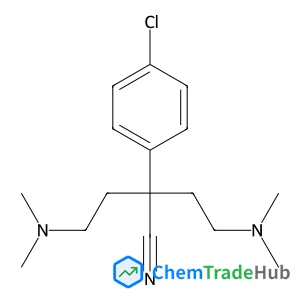
2-(4-Chlorophenyl)-4-(dimethylamino)-2-(2-(dimethylamino)ethyl)butanenitrile
CAS番号:
1246816-57-8
分子式:
C16H24ClN3
Promit Ray, Barbara Kirchner
Four different ionic liquids (ILs) consisting of the bis(trifluoromethanesulfonyl)imide ([NTf2]−) anion, with structurally similar systematically varying cations, are investigated herein through classical molecular dynamics. The following cations were examined: pyrrolidinium ([pyrHH]+), piperidinium ([pipHH]+), N-butyl-pyrrolidinium ([pyrH4]+) and N-butyl-N-methyl-pyrrolidinium ([pyr14]+). The focus herein is on understanding the effect of increased ring size and alkyl chain addition, resulting in three protic ILs and one aprotic IL ([pyr14][NTf2]), on the physicochemical properties of the liquids studied herein. Addition of alkyl groups to the cation appears to cause a distinct weakening of inter-ionic interactions and ordering in comparison to increasing the ring size. The influence of these structural changes, however, is clearer on the ordering of like ions than oppositely charged ions. The protic ILs exhibit important similarities in the spatial arrangement of ions on account of their strong and directed H-bonding interactions. The cation is seen to influence particular conformations of the anion which further explains the more selective ordering in the protic ILs. However, the aggregation of the butyl side chain is also seen to be an important structural determinant in [pyrH4][NTf2] and [pyr14][NTf2]. We analyze the formation of domains in order to quantitatively evaluate the microheterogeneity arising in these systems from the separation of phases according to polarities. Velocity autocorrelation functions are studied in order to characterize the stronger caging effect in the protic ILs and the weakening of the caging effect upon addition of alkyl groups to the cation, these are consistent with the coordination environment within the respective liquids. In conclusion, significant correlations between the structure and properties of these ILs are observed and quantified within this contribution.
Manuel Weh, Olga Anhalt
DOI: 10.1039/D3SC05341E
Rajib Dey, Sudip Mukherjee, Riya Mukherjee
DOI: 10.1039/D3SC05124B
Bartłomiej Sadowski, Daniel T. Gryko
DOI: 10.1039/D3SC05272A
Tuan D. Samdin, Chelsea R. Jones, Gretchen Guaglianone, Adam G. Kreutzer, J. Alfredo Freites, Michał Wierzbicki
DOI: 10.1039/D3SC05185D
Ran Liu, Zheng Liu, Mohan Chen, Hang Xing, Penghui Zhang, Jingjing Zhang
DOI: 10.1039/D3SC04249A
Pedro Zuazua-Villar, Oliwia Koczy, Andrew J. Counsell, Stephen J. Walsh, Naomi S. Robertson, David R. Spring, Jessica A. Downs, Marko Hyvönen
DOI: 10.1039/D3SC03331G
Ilia B. Moroz, Yishay Feldman, Raanan Carmieli, Xinyu Liu, Michal Leskes
DOI: 10.1039/D3SC03456A
David Specklin, Marie-Christine Boegli, Anaïs Coffinet, Léon Escomel, Laure Vendier, Mary Grellier, Antoine Simonneau
DOI: 10.1039/D3SC04390H
Deepamali Dissanayake, Alysia Draper, Neelofur Jaunnoo, Joris J. Haven, Craig Forsyth, Alasdair I. McKay, Tanja Junkers, Dragoslav Vidović
DOI: 10.1039/D3SC05186B
Abhijit Chatterjee, Joy Chatterjee, Subrahmanyam Sappati, Riteeka Tanwar, Madan D. Ambhore, Habibul Arfin, Rintu M. Umesh, Mayurika Lahiri, Pankaj Mandal, Partha Hazra
DOI: 10.1039/D3SC04280D
2-溴-9,9-二苯基芴は、医薬品、工業材料、有機合成の研究分野で応用されます。特に、レーザー材料や機能性ポリマーの合成に使用されることがあります。また、蛍光色...
四氯化铱の市場は研究開発分野で注目されており、特にナノ技術や金属有機框架(MOFs)の分野での需要が増加傾向にあります。価格は安定しており、中国や韓国での生産が...
1-(4-溴-3-氟苯基)-2-氯乙酮 (CAS番号: 1260857-14-4) の廃棄物は専門的な廃棄処理が必要です。まず、廃棄物は密閉された容器に収集し、...
苦参酚Kは、CAS番号101236-49-1を持つ化合物で、主に天然由来の生薬から抽出されます。この化合物は、抗炎症作用や抗癌作用を持つことが報告されています。
POTASSIUM (1-(TERTBUTOXYCARBONYL)AZETIDIN-3-YL)TRIFLUOROBORATE を含む廃棄物は、まず安全なエント...
4-庚基-4’-聯苯羧酸は、特殊化学品や合成化学の分野で用いられる化学物質ですが、市場動向としては、研究開発の進展とともに需要が増加しています。また、環境配慮型...
6-ブロモ-3-メトキシ-1-フェニル-1H-インドゾールを含む廃棄物は、適切な化学廃棄処理が必要です。通常、廃棄物は密閉容器に収集され、専門の廃棄処理業者に引...
4,4-二甲基-2-吡咯烷酮は医薬、ポリマー、センサー、半導体などの業界で広く使用されています。特に溶媒としての性能が高く評価されています。

Physical Chemistry Chemical Physics (PCCP) is an international journal co-owned by 19 physical chemistry and physics societies from around the world. This journal publishes original, cutting-edge research in physical chemistry, chemical physics and biophysical chemistry. To be suitable for publication in PCCP, articles must include significant innovation and/or insight into physical chemistry; this is the most important criterion that reviewers and Editors will judge against when evaluating submissions. The journal has a broad scope and welcomes contributions spanning experiment, theory, computation and data science. Topical coverage includes spectroscopy, dynamics, kinetics, statistical mechanics, thermodynamics, electrochemistry, catalysis, surface science, quantum mechanics, quantum computing and machine learning. Interdisciplinary research areas such as polymers and soft matter, materials, nanoscience, energy, surfaces/interfaces, and biophysical chemistry are welcomed if they demonstrate significant innovation and/or insight into physical chemistry. Joined experimental/theoretical studies are particularly appreciated when complementary and based on up-to-date approaches.
![Pyrazolo[1,5-a]pyridine-3-carbothioamide structure](https://static.chemtradehub.com/structs/885/885275-44-5-aae0.webp "Pyrazolo[1,5-a]pyridine-3-carbothioamide structure")
![2,6-Di(thiophen-2-yl)dithieno[3,2-b:2',3'-d]thiophene structure](https://static.chemtradehub.com/structs/910/910788-24-8-5b70.webp "2,6-Di(thiophen-2-yl)dithieno[3,2-b:2',3'-d]thiophene structure")
![6-Benzyl-4,5,6,7-tetrahydro-1H-pyrazolo[3,4-c]pyridin-3(2H)-one structure](https://static.chemtradehub.com/structs/909/909187-64-0-f54f.webp "6-Benzyl-4,5,6,7-tetrahydro-1H-pyrazolo[3,4-c]pyridin-3(2H)-one structure")




