












Synthesis of amphiphilic poly(cyclooctene)-graft-poly(ethylene glycol) copolymersviaROMP and its surface properties
文献情報
出版日
2010-12-14
DOI
10.1039/C0PY00353K
インパクトファクター
5.582
著者
Hengchong Shi, Dean Shi, Zhanhai Yao, Shifang Luan, Jing Jin, Jie Zhao, Huawei Yang, Paola Stagnaro, Jinghua Yin
原文を見る
要旨
Macromonomer cyclooctene-poly(ethylene glycol) (cyclooctene-PEG) was first synthesized before being copolymerized with cyclooctene by ring opening metathesis polymerization (ROMP) to obtain an amphiphilic graft copolymer (poly(cyclooctene)-g-PEG) with polycyclooctene as the hydrophobic trunk chain and PEG as hydrophilic side chains. The structure of poly(cyclooctene)-g-PEG copolymer was characterized by FTIR and 1H-NMR. The surface properties of poly(cyclooctene)-g-PEG film were evaluated through water contact angle and X-ray photoelectron spectroscopy (XPS). Water contact angle decreased from 87.7째 to 65.8째 along with increasing the content of PEG. Protein adsorption results showed that poly(cyclooctene)-g-PEG copolymers had significant effect on preventing bovine serum albumin (BSA) from absorbing onto the polymer surface.
関連文献
Properties of perhalogenated {closo-B10} and {closo-B11} multiply charged anions and a critical comparison with {closo-B12} in the gas and the condensed phase
Jonas Warneke, Szymon Z. Konieczka, Gao-Lei Hou, Edoardo Aprà, Christoph Kerpen, Fabian Keppner, Thomas C. Schäfer, Michael Deckert, Zheng Yang, Eric J. Bylaska, Grant E. Johnson, Julia Laskin, Xue-Bin Wang, Maik Finze
2018-11-07
Paper
DOI: 10.1039/C8CP05313H
Thermoelectric properties of the tetrahedrite–tennantite solid solutions Cu12Sb4−xAsxS13 and Cu10Co2Sb4−yAsyS13 (0 ≤ x, y ≤ 4)
Christophe Candolfi, Anne Dauscher, Janusz Tobola, Jiří Hejtmánek, Bertrand Lenoir
2019-01-31
Paper
DOI: 10.1039/C9CP00213H
Molecular and dissociative O2 adsorption on the Cu2O(111) surface
Xiaohu Yu, Caibin Zhao, Tianlei Zhang, Zhong Liu
2018-05-23
Paper
DOI: 10.1039/C8CP03035A
Tuning the magnetic properties of beryllium chains
Noelia Faginas-Lago, Thierry Leininger, Stefano Evangelisti
2019-02-27
Paper
DOI: 10.1039/C8CP07159D
Deep core photoionization of iodine in CH3I and CF3I molecules: how deep down does the chemical shift reach?
Nacer Boudjemia, Kari Jänkälä, Kenji Tamasaku, Marko Huttula, Masaki Oura
2019-02-11
Paper
DOI: 10.1039/C8CP07307D
Neural network force fields for simple metals and semiconductors: construction and application to the calculation of phonons and melting temperatures
Mário R. G. Marques, Jakob Wolff, Conrad Steigemann, Miguel A. L. Marques
2019-03-07
Paper
DOI: 10.1039/C8CP05771K
Electronic and magnetic properties of CoPc and FePc molecules on graphene: the substrate, defect, and hydrogen adsorption effects
Xiaoguang Li, Jinlong Yang
2019-02-12
Paper
DOI: 10.1039/C8CP07091A
Transition metal cations on the move: simultaneous operando X-ray absorption spectroscopy and X-ray diffraction investigations during Li uptake and release of a NiFe2O4/CNT composite
Stefan Permien, Tobias Neumann, Sylvio Indris, Gero Neubüser, Lorenz Kienle, Andy Fiedler, Anna-Lena Hansen, Diego Gianolio, Thomas Bredow, Wolfgang Bensch
2018-06-27
Paper
DOI: 10.1039/C8CP02919A
Quantitative analysis of 14N quadrupolar coupling using 1H detected 14N solid-state NMR
James A. Jarvis, Maria Concistre, Richard W. Bounds, Ilya Kuprov, Marina Carravetta, Philip T. F. Williamson
2019-02-27
Paper
DOI: 10.1039/C8CP06276E
こちらもおすすめ
化合物よくある質問
3-(2-オキサプロピル)ベンzoic酸はどのように合成されますか?
3-(2-オキサプロピル)ベンzoic酸は、ベンzoic酸とプロパノ酸をヒドロキシム化合物として反応させて生成します。具体的には、ベンzoic酸とプロパノ酸を反...
205927-63-53-(2-Oxopropyl)benzo...
114873-01-73-Fluoro-N-{[(2-meth...
化合物よくある質問
4-メチル-4-ピペリジニル-1-ピロリドイン甲酸の主な用途は何ですか?
4-メチル-4-ピペリジニル-1-ピロリドイン甲酸は、主に医薬品の合成材料や研究用物質として使用されます。さらに、一部の薬理学的研究にも応用されています。
885523-47-7(4-Methyl-4-piperidi...
化合物よくある質問
Biotin-PEG3-oxyamine HCl塩について、適切な化合物名称に適用される法規ガイドラインは何ですか?
Biotin-PEG3-oxyamine HCl塩は、GHS( Globally Harmonized System of Classification and...
1786206-22-1Biotin-PEG3-oxyamine...
化合物よくある質問
N-(4-イソチオシアネートフェニル)-2-メトキシアリニンはどのように合成されますか?
N-(4-イソチオシアネートフェニル)-2-メトキシアリニンは、4-イソチオシアノフェノールと2-メトキシアリニルアミンのアミニド反応を用いて合成されます。この...
915919-57-2N-(4-Isothiocyanatop...
化合物よくある質問
金粉蕨亭2'-O-葡萄糖甙の主な用途は何ですか?
金粉蕨亭2'-O-葡萄糖甙は主に薬理研究や医薬品製造に使用され、抗炎症作用や抗がん作用などがあります。また、その構造や性質から、合成化学や化学生理学の研究にも用...
76947-60-92-(7-Hydroxy-2,2,4,6...
化合物よくある質問
2-(2-ニトロフェニル)酢酸ヒドライドの物理化学的性質は何ですか?
2-(2-ニトロフェニル)酢酸ヒドライドのCAS番号は114953-81-0です。この化合物は白色結晶性粉末で、分子量は244.12です。水溶性は限られており、...
114953-81-02-(2-Nitrophenyl)ace...
化合物よくある質問
5-(ヒドロキシメチル)-2-チオキソ-2,3-ジヒドロピリミジン-4(1H)-オンを取り扱う際の実験室安全事項は何ですか?
この化合物は高活性のため、取り扱いには注意が必要です。PPE(個人保護具)としてゴーグル、ガントリー、および防滴シールドを着用することが推奨されます。ドラフトチ...
93185-31-05-(Hydroxymethyl)-2-...
化合物よくある質問
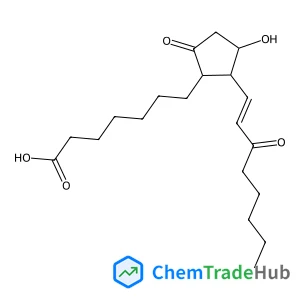
11-脱氢血栓烷 b2の市場動向や研究トレンドはどうですか?
11-脱氢血栓烷 b2は、血栓溶解・抗凝固作用に関する研究で注目を集めています。特に心血管疾患の治療法開発において、市場の需要が高まっています。研究トレンドとし...
67910-12-77-{(2R,3S,4S)-4-Hydr...
化合物よくある質問
3,3-二甲基哌啶-4-酮はどのように保存すればよいですか?
3,3-二甲基哌啶-4-酮は避光、常温、乾燥した場所で保存してください。容器は密閉し、遠くから火源を離して保管することを確認してください。
150668-82-93,3-Dimethyl-4-piper...
掲載誌
Polymer Chemistry

CiteScore:
8.6
自己引用率:
7.3%
年間論文数:
457
Polymer Chemistry welcomes submissions in all areas of polymer science that have a strong focus on macromolecular chemistry. Manuscripts may cover a broad range of fields, yet no direct application focus is required.
おすすめ化合物
![4-[(2,4-Dihydroxyphenyl)diazenyl]-5-hydroxy-2,7-naphthalenedisulfonic acid structure](https://static.chemtradehub.com/structs/362/3627-01-8-79ac.webp "4-[(2,4-Dihydroxyphenyl)diazenyl]-5-hydroxy-2,7-naphthalenedisulfonic acid structure")
4-[(2,4-Dihydroxyphenyl)diazenyl]-5-hydroxy-2,7-naphthalenedisulfonic acid
CAS番号:
3627-01-8
分子式:
C16H12N2O9S2
おすすめサプライヤー



免責事項
このページに表示される学術雑誌情報は、参考および研究目的のみを目的としています。当社は雑誌出版社とは提携しておらず、投稿の取り扱いも行っておりません。出版に関するお問い合わせは、各雑誌出版社に直接ご連絡ください。
表示されている情報に誤りがある場合は、support@chemtradehub.com までご連絡ください。迅速に確認し、対応いたします。