


![6-Benzyl-4,5,6,7-tetrahydro-1H-pyrazolo[3,4-c]pyridin-3(2H)-one structure](https://static.chemtradehub.com/structs/909/909187-64-0-f54f.webp "6-Benzyl-4,5,6,7-tetrahydro-1H-pyrazolo[3,4-c]pyridin-3(2H)-one structure")
Molecular and dissociative O2 adsorption on the Cu2O(111) surface
文献情報
出版日
2018-05-23
DOI
10.1039/C8CP03035A
インパクトファクター
3.676
著者
Xiaohu Yu, Caibin Zhao, Tianlei Zhang, Zhong Liu
原文を見る
要旨
The adsorption of O2 on the Cu2O(111) surface at different coverages has been studied by spin-polarized density functional theory (DFT+U) calculations and atomic thermodynamics. It has been found that the dissociative O2 prefers to adsorb on the reconstructed Cu2O(111) surface at low coverages (1/4 to 1 monolayer), while totally dissociative and mixed molecular and dissociative O2 prefers to adsorb on the reconstructed Cu2O(111) surface thermodynamically at higher coverages (5/4 to 7/4 monolayers). More interesting is that the CuO film can be automatically formed on the Cu2O(111) surface that was induced by the surface reconstruction of the Cu2O(111) surface and adsorption of four dissociative O2 molecules (1 monolayer), which agrees well with the recent experimental results. Along higher coverages of O2 adsorption (5/4 to 7/4 monolayers), much stronger surface reconstruction and relaxation was found. The probability distribution of different single-O2 adsorbed states on the Cu2O(111) surface as a function of temperature was analyzed using a Boltzmann model. The adsorption mechanism of O2 on the Cu2O(111) surface was analyzed using the phase diagram and compared with other metal oxides.
おすすめジャーナル

Nature Reviews Drug Discovery

Advanced Engineering Materials

Environmental Toxicology and Pharmacology

European Journal of Organic Chemistry

Molecules

Contact Lens & Anterior Eye

Photochemical & Photobiological Sciences

Journal of Medical Biochemistry

Angewandte Chemie International Edition

Mini-Reviews in Medicinal Chemistry
関連文献
Hydrogen spillover and substrate–support hydrogen bonding mediate hydrogenation of phenol catalyzed by palladium on reducible metal oxides
Yeongseo An, Sayak Banerjee
2023-11-24
Edge Article
DOI: 10.1039/D3SC02913A
Hydrogen spillover enhances alkaline hydrogen electrocatalysis on interface-rich metallic Pt-supported MoO3
2023-12-08
Edge Article
DOI: 10.1039/D3SC04126C
A universal orthogonal imaging platform for living-cell RNA detection using fluorogenic RNA aptamers
Peng Yin, Mingmin Ge, Shiyi Xie, Li Zhang, Shi Kuang, Zhou Nie
2023-12-02
Edge Article
DOI: 10.1039/D3SC04957D
An erythrocyte membrane-camouflaged fluorescent covalent organic framework for starving/nitric oxide/immunotherapy of triple-negative breast cancer
Fang Yuan, Cuiling Zhang, Xianzhu Luo, Shasha Cheng, Yingxin Zhu, Yuezhong Xian
2023-07-28
Edge Article
DOI: 10.1039/D3SC02022C
Ultrasensitive detection of aromatic water pollutants through protein immobilization driven organic electrochemical transistors
Subhankar Sahu, Lokesh Kumar, Sumita Das, Dipti Gupta, Ruchi Anand
2023-12-13
Edge Article
DOI: 10.1039/D3SC03509C
Artificial cells with viscoadaptive behavior based on hydrogel-loaded giant unilamellar vesicles
2023-12-04
Edge Article
DOI: 10.1039/D3SC04687G
Engineering TADF, mechanochromism, and second harmonic up-conversion properties in regioisomeric substitution space
Abhijit Chatterjee, Joy Chatterjee, Subrahmanyam Sappati, Riteeka Tanwar, Madan D. Ambhore, Habibul Arfin, Rintu M. Umesh, Mayurika Lahiri, Pankaj Mandal, Partha Hazra
2023-11-08
Edge Article
DOI: 10.1039/D3SC04280D
Photoredox-catalyzed stereo- and regioselective vicinal fluorosulfonyl-borylation of unsaturated hydrocarbons
Heyin Li, Mengjun Huang, Zhenlei Zou, Zhen Wang, Yifan Li, Chao Sun, Wangzhe Chen, Yi Pan, Weigang Zhang, Yi Wang
2023-11-13
Edge Article
DOI: 10.1039/D3SC03101B
Critical assessment of selenourea as an efficient small molecule fluorescence quenching probe to monitor protein dynamics
2023-09-26
Edge Article
DOI: 10.1039/D3SC04287A
Quantitative detection of microRNA-21 in vivo using in situ assembled photoacoustic and SERS nanoprobes
Liting Zheng, Qingqing Li, Ying Wu, Lichao Su, Wei Du, Jibin Song, Lanlan Chen, Huanghao Yang
2023-11-21
Edge Article
DOI: 10.1039/D3SC04371A
こちらもおすすめ
化合物よくある質問
2-ブロモ-9,9-ジフェニル-9H-フルオレンの主な用途は何ですか?
2-溴-9,9-二苯基芴は、医薬品、工業材料、有機合成の研究分野で応用されます。特に、レーザー材料や機能性ポリマーの合成に使用されることがあります。また、蛍光色...
474918-32-62-Bromo-9,9-diphenyl...
化合物よくある質問
四氯化铱の市場動向や研究トレンドはどうですか?
四氯化铱の市場は研究開発分野で注目されており、特にナノ技術や金属有機框架(MOFs)の分野での需要が増加傾向にあります。価格は安定しており、中国や韓国での生産が...
207399-11-9Tetrachloroiridium h...
882-06-44-Nitrocinnamic acid
化合物よくある質問
1-(4-溴-3-氟苯基)-2-氯乙酮を含む廃棄物はどのように処理すべきですか?
1-(4-溴-3-氟苯基)-2-氯乙酮 (CAS番号: 1260857-14-4) の廃棄物は専門的な廃棄処理が必要です。まず、廃棄物は密閉された容器に収集し、...
1260857-14-41-(4-Bromo-3-fluorop...
化合物よくある質問
苦参酚Kとは何ですか?
苦参酚Kは、CAS番号101236-49-1を持つ化合物で、主に天然由来の生薬から抽出されます。この化合物は、抗炎症作用や抗癌作用を持つことが報告されています。
101236-49-1Kushenol K
化合物よくある質問
POTASSIUM (1-(TERTBUTOXYCARBONYL)AZETIDIN-3-YL)TRIFLUOROBORATE を含む廃棄物はどのように処理すべきですか?
POTASSIUM (1-(TERTBUTOXYCARBONYL)AZETIDIN-3-YL)TRIFLUOROBORATE を含む廃棄物は、まず安全なエント...
1430219-73-0Potassium (1-(tert-b...
化合物よくある質問
4-庚基-4’-联苯羧酸の市場動向や研究トレンドはどうですか?
4-庚基-4’-聯苯羧酸は、特殊化学品や合成化学の分野で用いられる化学物質ですが、市場動向としては、研究開発の進展とともに需要が増加しています。また、環境配慮型...
58573-94-74'-Heptyl-4-biphenyl...
化合物よくある質問
6-ブロモ-3-メトキシ-1-フェニル-1H-インドゾールを含む廃棄物はどのように処理すべきですか?
6-ブロモ-3-メトキシ-1-フェニル-1H-インドゾールを含む廃棄物は、適切な化学廃棄処理が必要です。通常、廃棄物は密閉容器に収集され、専門の廃棄処理業者に引...
1332527-03-36-Bromo-3-methoxy-1-...
化合物よくある質問
4,4-二甲基-2-吡咯烷酮はどの業界で使用されていますか?
4,4-二甲基-2-吡咯烷酮は医薬、ポリマー、センサー、半導体などの業界で広く使用されています。特に溶媒としての性能が高く評価されています。
66899-02-34,4-dimethylpyrrolid...
51312-42-6Sodium Phosphotungst...
掲載誌
Physical Chemistry Chemical Physics

CiteScore:
5.5
自己引用率:
10.3%
年間論文数:
3036
Physical Chemistry Chemical Physics (PCCP) is an international journal co-owned by 19 physical chemistry and physics societies from around the world. This journal publishes original, cutting-edge research in physical chemistry, chemical physics and biophysical chemistry. To be suitable for publication in PCCP, articles must include significant innovation and/or insight into physical chemistry; this is the most important criterion that reviewers and Editors will judge against when evaluating submissions. The journal has a broad scope and welcomes contributions spanning experiment, theory, computation and data science. Topical coverage includes spectroscopy, dynamics, kinetics, statistical mechanics, thermodynamics, electrochemistry, catalysis, surface science, quantum mechanics, quantum computing and machine learning. Interdisciplinary research areas such as polymers and soft matter, materials, nanoscience, energy, surfaces/interfaces, and biophysical chemistry are welcomed if they demonstrate significant innovation and/or insight into physical chemistry. Joined experimental/theoretical studies are particularly appreciated when complementary and based on up-to-date approaches.
おすすめ化合物
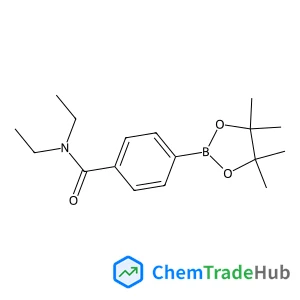
N,N-Diethyl-4-(4,4,5,5-tetramethyl-1,3,2-dioxaborolan-2-yl)benzamide
CAS番号:
325142-99-2
分子式:
C17H26BNO3
おすすめサプライヤー






免責事項
このページに表示される学術雑誌情報は、参考および研究目的のみを目的としています。当社は雑誌出版社とは提携しておらず、投稿の取り扱いも行っておりません。出版に関するお問い合わせは、各雑誌出版社に直接ご連絡ください。
表示されている情報に誤りがある場合は、support@chemtradehub.com までご連絡ください。迅速に確認し、対応いたします。