












Empirical modelling as an experimental approach to optimize lactone production
文献情報
出版日
2011-02-04
DOI
10.1039/C0CY00017E
インパクトファクター
6.119
著者
Nelma Gomes, José A. Teixeira, Isabel Belo
原文を見る
要旨
The biotransformation of ricinoleic acid, carried out by Yarrowia lipolytica, leads to the formation of γ-decalactone, a well-known peach-like aroma compound, interesting to produce and to use in the flavouring industry, reason why it is imperative to define the most appropriate conditions for its production. Thus, the aim of this work is the optimization of operating conditions for this lactone. However, as the accumulation of another compound, namely 3-hydroxy-γ-decalactone (the precursor of two other aromatic compounds, dec-2-enolide and dec-3-enolide), may also occur simultaneously in the biotransformation medium, and since this compound may as well be of interest for the flavouring industry, the operating conditions for its production were also a focus of attention. Therefore, a 32 level full-factorial design was used to determine the effect of pH and dissolved oxygen concentration (DO) on the production of γ-decalactone and 3-hydroxy-γ-decalactone. Since both factors were found to influence the two lactones production, a response surface methodology (RSM) analysis was also applied to identify the optimal conditions for the production of those two compounds. The statistical model pointed out pH = 6.17 and DO = 44.4% as the best conditions optimizing γ-decalactone production. Using these optimal conditions, the maximal γ-decalactone concentration achieved was 680.9 mg L−1, which was quite similar to the predicted value of 718.7 mg γ-decalactone L−1. Among the range of operating conditions tested, no optimization was possible for 3-hydroxy-γ-decalactone production, since all possible solutions corresponded to operating conditions not analyzed.
関連文献
High-performance ultrathin perfluorinated sulfonic acid membranes with thermo-morphology control for a vanadium redox flow battery
Yecheol Rho, Soonyong So
2023-10-23
Paper
DOI: 10.1039/D3TA04760A
Ultrahigh-quality graphene resonators by liquid-based strain-engineering
Mario Hofmann, Chi-Te Liang, Ya-Ping Hsieh
2023-11-02
Communication
DOI: 10.1039/D3NH00420A
A single-phase gadolinium-doped ceria cathode for highly efficient CO2 electrolysis
Ahmad Shaur, Michel Drazkowski, Shaochen Zhu, Bernard Boukamp
2023-11-03
Paper
DOI: 10.1039/D3TA03977C
A new class of organic–inorganic single and double hybrid perovskites with a diammonium-halide-diammonium spacer layer
Walter P. D. Wong, Xinyun Wang
2023-10-30
Paper
DOI: 10.1039/D3TA04568D
Stability and synthesis across barium tin sulfide material space
Andriy Zakutayev
2023-11-10
Paper
DOI: 10.1039/D3TA04431A
High-throughput design of energetic molecules
Jian Liu, Shicao Zhao, Bowen Duan, Xudong He, Chunming Yang, Xuemei Pu, Xinben Zhang, Yonghao Xiao, Fude Nie, Wen Qian, Geng Li
2023-11-02
Paper
DOI: 10.1039/D3TA05002E
Solar light selective-harvesting eco-friendly colloidal quantum dots for transparent luminescent solar concentrators
Ehsan Hamzehpoor, Jiabin Liu, Xin Liu, Gurpreet Singh Selopal, Dmytro F. Perepichka, Zhiming M. Wang
2023-10-13
Paper
DOI: 10.1039/D3TA05351B
こちらもおすすめ
化合物よくある質問
環戊烷-1,3-二甲酸甲酯はどのように合成されますか?
環戊烷-1,3-二甲酸甲酯は、環戊烷と塩酸によるヒンデンブルク反応を経由して合成されます。この反応では、環戊烷が塩酸と作用し、1,3-ジカルボキシ基が導入されま...
2435-36-1Dimethyl 1,3-cyclope...
化合物よくある質問
4-メトキシ-1,2,3-スチアゼ-3,5-ジオンとは何ですか?
4-メトキシ-1,2,3-スチアゼ-3,5-ジオンは、CAS番号107843-77-6の化合物で、(E)-ベンジル3-(3,4-ジヒドロキシフェニル) acry...
107843-77-6(E)-Benzyl 3-(3,4-di...
化合物よくある質問
プロスタグランジンA2について「に適用される法規ガイドラインは何ですか?'
プロスタグランジンA2 (CAS番号: 41691-92-3) は、化学物質の安全管理に関する規制として、GHS (危険物質の国際的ハザード分類・ラベル付けシス...
41691-92-316,16-DIMETHYL PROST...
化合物よくある質問
4-アミノ-1-ナフタレン sulfonic 酸についての物理化学的性質は何ですか?
4-アミノ-1-ナフタレン sulfonic 酸のCAS番号は84-86-6です。この化合物は結晶性で、分子量は212.15 g/molです。アルコールや水など...
84-86-64-Amino-1-naphthalen...
化合物よくある質問
N-GlcNAc-生物素を取り扱う際の実験室安全事項は何ですか?
N-GlcNAc-生物素は吸収性があり、皮膚や目への接触を避けることが重要です。PPE(個体保護具)は使用し、ドラフトチャンバーは必要に応じて使用します。漏洩時...
1272755-69-72-Acetamido-2-deoxy-...
化合物よくある質問
3-アミノメチルフローラノピペリジン-1-カルボニル酸テルブチルエステルとは何ですか?
CAS番号1209781-11-2の3-アミノメチルフローラノピペリジン-1-カルボニル酸テルブチルエステルは、有機化合物の一種で、化学式はC10H17FNO3...
1209781-11-22-Methyl-2-propanyl ...
化合物よくある質問
6-溴-1-甲基-1H-ベンゾ[d][1,2,3]三氮唑はどのように合成されますか?
6- bromo-1-methyl-1H-benzotriazoleは、ブロモフリオリンと1-メチル-1H-ベンゾ[d][1,2,3]三氮唑の反応により合成され...
944718-32-56-Bromo-1-methyl-1H-...
化合物よくある質問
4-硫代尿苷はどのように合成されますか?
4-硫代尿苷は、尿素とD-リボシルヒドロキシアルデヒドを用いてスルホン化反応を経て合成されます。通常は塩酸ヒドロキシチオニルスルホン酸などの触媒を使用し、選択性...
6741-73-71-(4-thio-beta-D-rib...
化合物よくある質問
ブレインナトリユリックペプチド32ラットとは何ですか?
ブレインナトリユリックペプチド32ラット(CAS番号: 133448-20-1)は、心臓で作られるホルモンの一つで、心不全の診断や予後評価に使用されます。
133448-20-1Brain Natriuretic Pe...
化合物よくある質問
1-(3-氮杂啶)-4-羟基哌啶双盐酸盐の物理化学的性質は何ですか?
CAS番号810680-60-5の1-(3-氮杂啶)-4-羟基哌啶双盐酸盐は、白色の結晶性粉末である。分子量は360.84 g/molで、水に溶けやすい。反応活...
810680-60-51-(3-Azetidinyl)-4-p...
掲載誌
Catalysis Science & Technology
CiteScore:
5.91
自己引用率:
4.5%
年間論文数:
600
Catalysis Science & Technology is committed to publishing research reporting high-quality, cutting-edge developments across the catalysis community at large. The journal places equal focus on publications from the heterogeneous, homogeneous, thermo-, electro-, photo-, organo- and biocatalysis communities. Works published in the journal feature a balanced mix of fundamental, technology-oriented, experimental, computational, digital and data-driven original research, thus appealing to catalysis practitioners in both academic and industrial environments. Original research articles published in the journal must demonstrate new catalytic discoveries and/or methodological advances that represent a significant advance on previously published work, from the molecular to the process scales. We welcome rigorous research in a wide range of timely or emerging applications related to the environment, health, energy and materials. Catalysis Science & Technology publishes Communications, Articles, Reviews and Perspectives. More details regarding manuscript types may be found in the Information for Authors section.
おすすめ化合物
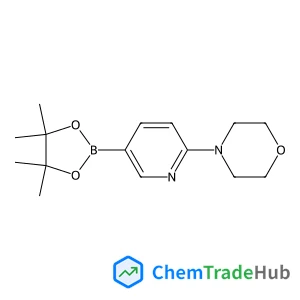
4-(5-(4,4,5,5-tetramethyl-1,3,2-dioxaborolan-2-yl)pyridin-2-yl)morpholine
CAS番号:
485799-04-0
分子式:
C15H23BN2O3
おすすめサプライヤー






免責事項
このページに表示される学術雑誌情報は、参考および研究目的のみを目的としています。当社は雑誌出版社とは提携しておらず、投稿の取り扱いも行っておりません。出版に関するお問い合わせは、各雑誌出版社に直接ご連絡ください。
表示されている情報に誤りがある場合は、support@chemtradehub.com までご連絡ください。迅速に確認し、対応いたします。