












Solar light selective-harvesting eco-friendly colloidal quantum dots for transparent luminescent solar concentrators
文献情報
出版日
2023-10-13
DOI
10.1039/D3TA05351B
インパクトファクター
12.732
著者
Ehsan Hamzehpoor, Jiabin Liu, Xin Liu, Gurpreet Singh Selopal, Dmytro F. Perepichka, Zhiming M. Wang
原文を見る
要旨
Luminescent solar concentrators (LSCs) constructed using colloidal quantum dots (QDs) have emerged as a promising and cost-effective solution for transparent photovoltaics. However, the efficiency of these LSCs in converting sunlight to electricity often remains low due to limited quantum efficiency and significant reabsorption losses associated with the QDs. Furthermore, the majority of high-efficiency LSCs incorporate QDs containing heavy metals, curtailing their potential for widespread commercialization. Here, we have developed white-emitting CuGaS2/ZnS and its optical characteristics are adeptly tailored through manipulation of the ZnS shell. The optimal configuration of CuGaS2/ZnS demonstrates an impressive photoluminescence quantum yield of 80% and an extensive Stokes shift of ∼190 nm. These QDs are integrated in a polymer matrix to produce LSCs with dimensions of 5 × 5 × 0.2 cm3. Under standard illumination conditions of one sun AM 1.5G (100 mW cm−2), these LSCs exhibit an optical efficiency of 1.7%, average visible transmittance of ∼75% and color rendering index of 91.6. To improve the solar light harvesting, we constructed a tandem LSC, with CuGaS2/ZnS QD-LSC as the top layer and near-infrared-active AgInS2/ZnS QD-LSC was developed as the bottom layer. The optical efficiency could reach 4.4%, which underscores the potential of these environmentally friendly core/shell QDs for cost-effective transparent solar conversion applications.
関連文献
Phase change materials of n-alkane-containing microcapsules: observation of coexistence of ordered and rotator phases
Yunlan Su, Baoquan Xie, Haijin Zhu, Dujin Wang
2011-01-11
Paper
DOI: 10.1039/C0CP01173H
Preparation and photocatalytic activity of eccentric Au–titania core–shell nanoparticles by block copolymer templates
Xue Li, Xiaoning Fu, Hui Yang
2010-12-14
Paper
DOI: 10.1039/C0CP01353F
Temperature-cycle single-molecule FRET microscopy on polyprolines
Haifeng Yuan, Ted Xia, Benjamin Schuler, Michel Orrit
2010-12-10
Paper
DOI: 10.1039/C0CP01772H
Optical imaging of excited-state tautomerization in single molecules
Anna M. Chizhik, Regina Jäger, Alexey I. Chizhik, Sebastian Bär, Hans-Georg Mack, Marcus Sackrow, Catrinel Stanciu, Alexey Lyubimtsev, Michael Hanack, Alfred J. Meixner
2011-01-14
Perspective
DOI: 10.1039/C0CP02228D
Electronic coherences and vibrational wave-packets in single molecules studied with femtosecond phase-controlled spectroscopy
Richard Hildner, Daan Brinks, Fernando D. Stefani
2011-01-14
Paper
DOI: 10.1039/C0CP02231D
Interactions of TRIS [tris(hydroxymethyl)aminomethane] and related buffers with peptide backbone: Thermodynamic characterization
Mohamed Taha, Ming-Jer Lee
2010-08-27
Paper
DOI: 10.1039/C0CP00253D
Amorphization and recrystallization study of lithium insertion into manganese dioxide
Rapela R. Maphanga, Dean C. Sayle, Thi X. T. Sayle, Phuti E. Ngoepe
2010-11-29
Paper
DOI: 10.1039/C0CP00274G
Interstitialcy diffusion of oxygen in tetragonal La2CoO4+δ
Akihiro Kushima, David Parfitt, Alexander Chroneos, Bilge Yildiz, John A. Kilner, Robin W. Grimes
2010-12-06
Paper
DOI: 10.1039/C0CP01603A
Step-wise proton-coupled electron transfer extended to aminobenzoquinone modified monolayers
Wenbin Zhang, Ian J. Burgess
2010-11-24
Paper
DOI: 10.1039/C0CP01251C
こちらもおすすめ
化合物よくある質問
2,3-スチオエポキシマドルを取り扱う際の実験室安全事項は何ですか?
取り扱いにはPPE(プロテクティブ・パーソナル・エイド)が必要で、防ぐ手袋と保護眼鏡を着用してください。ドラフトチャンバーの使用を推奨します。漏洩した場合は、適...
4267-80-52,3-Thioepoxy Madol
53981-25-22-Amino-6-fluorophen...
化合物よくある質問
BOC-S-3-アミニ-4-(4-メチオキシベンチル)-ブタン酸の代替品はありますか?
この化合物の代替品としては、BOC保護基を有さないアミノ酸やその他の保護基化合物が考えられます。また、メチオキシ基を有しない他の芳香族アミノ酸も代替品として挙げ...
126800-59-7(3S)-4-(4-Methoxyphe...
化合物よくある質問
Methyl 2-(chloromethyl)-3-nitrobenzoate(1218910-61-2)の代替品はありますか?
Methyl 2-(chloromethyl)-3-nitrobenzoate(1218910-61-2)の代替品としては、化学組成を変えることで効果を達成する...
1218910-61-2Methyl 2-(chlorometh...
化合物よくある質問
(2R)-2-アミノ-N-ベンジル-3-ヒドロキシプロパナミドを含む廃棄物はどのように処理すべきですか?
(2R)-2-アミノ-N-ベンジル-3-ヒドロキシプロパナミドを含む廃棄物は、適切な廃棄物管理ガイドラインに基づき処理する必要があります。まず、廃棄物を適切に収...
175481-39-7(2R)-2-amino-N-benzy...
化合物よくある質問
6,7-二氢-咪唑並[1,2-a]ピリドイン-8(5h)-酮はどのように合成されますか?
6,7-二氢-咪唑並[1,2-a]ピリドイン-8(5h)-酮は、2-ブロモフェニルアセトインとリン酸ハロゲン化物を反応させることで合成できます。この反応は高温で...
457949-09-66,7-Dihydroimidazo[1...
化合物よくある質問
エチル(3R)-3-ピロリジニル酢酸水和塩とは何ですか?
エチル(3R)-3-ピロリジニル酢酸水和塩は、CAS番号1332459-32-1の化合物で、(R)-乙基2-(ピロリジン-3-基)酢酸塩水和塩と呼ばれます。この...
1332459-32-1Ethyl (3R)-3-pyrroli...
化合物よくある質問
(2S)-{[(2-メチルエチルオキシ]カルボニル}アミノ)[2-(トリアフルオロメチルフェニル]エチカシック酸の物理化学的性質は何ですか?
(2S)-{[(2-メチルエチルオキシ]カルボニル}アミノ)[2-(トリアフルオロメチルフェニル]エチカシック酸のCAS番号は1203454-45-8です。この...
1203454-45-8(2S)-({[(2-Methyl-2-...
化合物よくある質問
2-ブロモ-1-(2-メチル-2-プロパニル)-4-ニトロベンゼンはどのように保存すればよいですか?
2-ブロモ-1-(2-メチル-2-プロパニル)-4-ニトロベンゼンは、直射日光を避けて暗所で、室温(約15℃〜25℃)、乾燥した場所に保存する必要があります。ま...
6310-17-42-Bromo-1-(2-methyl-...
化合物よくある質問
1-[(4-硝基フェニル)スルホニル]-1H-1,2,4-三唑の市場動向や研究トレンドはどうですか?
市場動向としては、1-[(4-硝基フェニル)スルホニル]-1H-1,2,4-三唑は主に農業用除草剤や合成化学製品の原料として利用されています。研究トレンドとして...
57777-84-11-[(4-Nitrophenyl)su...
掲載誌
Journal of Materials Chemistry A

CiteScore:
19.5
自己引用率:
4.7%
年間論文数:
2211
Journal of Materials Chemistry A, B & C cover high quality studies across all fields of materials chemistry. The journals focus on those theoretical or experimental studies that report new understanding, applications, properties and synthesis of materials. The journals have a strong history of publishing quality reports of interest to interdisciplinary communities and providing an efficient and rigorous service through peer review and publication. The journals are led by an international team of Editors-in-Chief and Associate Editors who are all active researchers in their fields. Journal of Materials Chemistry A, B & C are separated by the intended application of the material studied. Broadly, applications in energy and sustainability are of interest to Journal of Materials Chemistry A, applications in biology and medicine are of interest to Journal of Materials Chemistry B, and applications in optical, magnetic and electronic devices are of interest to Journal of Materials Chemistry C. More than one Journal of Materials Chemistry journal may be suitable for certain fields and researchers are encouraged to submit their paper to the journal that they feel best fits for their particular article. Example topic areas within the scope of Journal of Materials Chemistry A are listed below. This list is neither exhaustive nor exclusive. Artificial photosynthesis Batteries Carbon dioxide conversion Catalysis Fuel cells Gas capture/separation/storage Green/sustainable materials Hydrogen generation Hydrogen storage Photocatalysis Photovoltaics Self-cleaning materials Self-healing materials Sensors Supercapacitors Thermoelectrics Water splitting Water treatment
おすすめ化合物
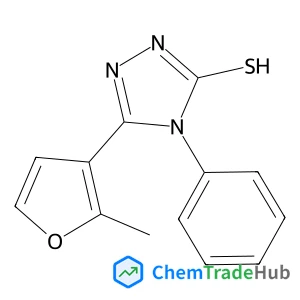
5-(2-Methyl-3-furyl)-4-phenyl-2,4-dihydro-3H-1,2,4-triazole-3-thione
CAS番号:
346464-59-3
分子式:
C13H11N3OS
![(1R,5R)-3-{[(2-Methyl-2-propanyl)oxy]carbonyl}-3-azabicyclo[3.1.0]hexane-1-carboxylic acid structure](https://static.chemtradehub.com/structs/116/1165450-63-4-bfe1.webp "(1R,5R)-3-{[(2-Methyl-2-propanyl)oxy]carbonyl}-3-azabicyclo[3.1.0]hexane-1-carboxylic acid structure")
おすすめサプライヤー



免責事項
このページに表示される学術雑誌情報は、参考および研究目的のみを目的としています。当社は雑誌出版社とは提携しておらず、投稿の取り扱いも行っておりません。出版に関するお問い合わせは、各雑誌出版社に直接ご連絡ください。
表示されている情報に誤りがある場合は、support@chemtradehub.com までご連絡ください。迅速に確認し、対応いたします。