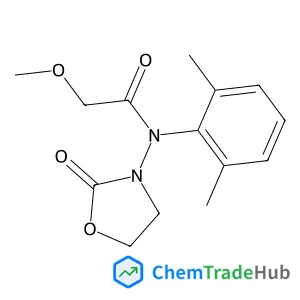
N-(2,6-Dimethylphenyl)-2-methoxy-N-(2-oxo-1,3-oxazolidin-3-yl)acetamide
CAS番号:
77732-09-3
分子式:
C14H18N2O4
Pitamber Mahanandia, Jörg J. Schneider, Marina Khaneft, Bernd Stühn, Tiago P. Peixoto, Barbara Drossel
We present experimental and theoretical studies on the infiltration of polymers (polystyrene (PS), polymethylmethacrylate (PMMA)) into the free interstices of 3D aligned carbon nanotube arrays. The 3D aligned CNT structures were prepared by a template assisted non catalytic CVD approach. The infiltrated CNT/polymer composites were characterized by microscopic techniques such as infra-red and Raman spectroscopy. Small angle X-ray scattering (SAXS) has been employed to study the structural evolution and polymer confinement after the polymers are infiltrated in the aligned arrays of CNTs. A theoretical model has been used to understand and predict possible confinement effects of these polymers within the aligned CNT arrays, using self-consistent field theory (SCFT) and Monte-Carlo simulations based on the bond-fluctuation model.

Polycyclic Aromatic Compounds

Critical Reviews in Solid State and Materials Sciences

Heteroatom Chemistry

Medicinal Chemistry Research

Journal of Chemical Sciences

Chinese Journal of Chemistry

Biocatalysis and Biotransformation

Journal of the Indian Institute of Science

Journal of Asian Natural Products Research

Colloid Journal
Suresh Rayavarapu, Sanjeev Kheria, Dinesh R. Shinde, Rajesh G. Gonnade, Gangadhar J. Sanjayan
DOI: 10.1039/C7OB02358H
S. B. Yeldell, B. K. Ruble, I. J. Dmochowski
DOI: 10.1039/C7OB02353G
Morteza Shiri, Maryam Ranjbar, Zahra Yasaei, Fatemeh Zamanian, Behrouz Notash
DOI: 10.1039/C7OB02043K
Y. Yi, H. Gholami, M. G. Morrow, B. Borhan
DOI: 10.1039/C7OB02283B
Jiang Nan, Qiong Ma, Jiacheng Yin, Chengyuan Liang, Lei Tian, Yangmin Ma
DOI: 10.1039/D1QO00040C
Ankush Banerjee, Samrat Kundu, Arya Bhattacharyya, Samrat Sahu, Modhu Sudan Maji
DOI: 10.1039/D1QO00092F
Namit Dey, Sabyasachi Chattopadhyay
DOI: 10.1039/C7OB02552A
Antony Wing Hung Ng, Yu Hin Leung
DOI: 10.1039/D0QO01658F
Gauravi Yashwantrao, Satyajit Saha
DOI: 10.1039/D0QO01575J
2-氟-4-イオドベンzo酸エチルエステルは有機溶媒を用いた反応であり、ドラフトチャンバーでの操作が必要です。漏洩時にはSDS参照の安全措置を講じ、PPE(防護...
血根碱は主に医薬分野で利用され、抗炎症や抗がん剤としての潜在的な効果が研究されています。また、化学研究や薬物開発において、新しい薬剤設計の参考となる化合物として...
Methyl 3-メトキシスチフェン-2-カルボン酸メチルエステルは、薬品合成、染料製造、以及合成中間体としての用途が広がっています。
丹磺酰-L-亮氨酸は乾燥した場所で、直射日光から保護し、低温(室温以下)で保存してください。密閉容器に入れて保管することをおすすめします。
5-(苄氧基)ピラミジン-4-アミンの代替品として、6-メトキシピラミジンや5-フェニルピラミジンなどが挙げられます。これらの化合物は、5-(苄氧基)ピラミジン...
8-ヒドロキシノルデコペントアセートはCAS番号84807-87-4の化合物で、分子量は750.02 uです。これは油溶性で、水に溶けにくい特徴があります。反応...
tert-ブチル(エス)-1-ヒドロキシペンタ-4-エン-2-イルカルバamateは主に医薬品の合成材料や分析化学の試薬として使用されます。
ブコール-L-2-フローヨルブリン(CAS番号: 1196107-73-9)は、GHS(グローバルハザードアサessmentシステム)に基づく危害分類と表示が求...
6-ブロモ-N-環丙基-2-ピリジニニメタンは、薬理学研究や合成化学に使用される化合物であり、特に抗ウイルス薬や抗がん薬の開発に注目されています。市場では、薬物...
RS-AMPÀは、遮光容器に保存し、室温(15〜25℃)で保管することが推奨されます。高湿や熱は物質を劣化させるため、湿度は50%以下に保つことが重要です。また...

Physical Chemistry Chemical Physics (PCCP) is an international journal co-owned by 19 physical chemistry and physics societies from around the world. This journal publishes original, cutting-edge research in physical chemistry, chemical physics and biophysical chemistry. To be suitable for publication in PCCP, articles must include significant innovation and/or insight into physical chemistry; this is the most important criterion that reviewers and Editors will judge against when evaluating submissions. The journal has a broad scope and welcomes contributions spanning experiment, theory, computation and data science. Topical coverage includes spectroscopy, dynamics, kinetics, statistical mechanics, thermodynamics, electrochemistry, catalysis, surface science, quantum mechanics, quantum computing and machine learning. Interdisciplinary research areas such as polymers and soft matter, materials, nanoscience, energy, surfaces/interfaces, and biophysical chemistry are welcomed if they demonstrate significant innovation and/or insight into physical chemistry. Joined experimental/theoretical studies are particularly appreciated when complementary and based on up-to-date approaches.