












RhIII-Catalyzed formal [5 + 1] cyclization of 2-pyrrolyl/indolylanilines using vinylene carbonate as a C1 synthon
文献情報
出版日
2021-02-08
DOI
10.1039/D1QO00040C
インパクトファクター
5.281
著者
Jiang Nan, Qiong Ma, Jiacheng Yin, Chengyuan Liang, Lei Tian, Yangmin Ma
原文を見る
要旨
A rhodium(III)-catalyzed formal C–H [5 + 1] cyclization of 2-pyrrolyl/indolylanilines with vinylene carbonate has been explored towards the potent assembly of diverse 4-methylpyrrolo[1,2-a]quinoxalines. This established protocol is characterized by an exceedingly simple reaction system, and excellent functional group toleration and yields. Most importantly, entirely distinct from documented [4 + 2] cyclization conversions, herein, the emerging vinylene carbonate firstly presents as a C1 synthon to realize [5 + 1] annulation and shows new chemical reactivity. Biological studies indicate that these prepared products are promising candidates in terms of their antibacterial activity.
おすすめジャーナル
関連文献
A new interpretation of SAXS peaks in sulfonated poly(ether ether ketone) (sPEEK) membranes for fuel cells
H. Mendil-Jakani, I. Zamanillo Lopez, P. M. Legrand, V. H. Mareau, L. Gonon
2014-04-08
Paper
DOI: 10.1039/C4CP00710G
Carbon dioxide reduction via light activation of a ruthenium–Ni(cyclam) complex
Christian Herrero, Annamaria Quaranta, Sanae El Ghachtouli, Winfried Leibl
2014-02-11
Paper
DOI: 10.1039/C3CP54946A
Enhancing photo-induced ultrafast charge transfer across heterojunctions of CdS and laser-sintered TiO2 nanocrystals
Bryan T. Spann, S. Venkataprasad Bhat, Qiong Nian, Kelly M. Rickey, Gary J. Cheng, Xiulin Ruan, Xianfan Xu
2014-04-14
Paper
DOI: 10.1039/C4CP01298D
An acetate bound cobalt oxide catalyst for water oxidation: role of monovalent anions and cations in lowering overpotential
Subal Dey, Biswajit Mondal, Abhishek Dey
2014-04-11
Paper
DOI: 10.1039/C4CP01205D
Electrochemical CO2 reduction on Cu2O-derived copper nanoparticles: controlling the catalytic selectivity of hydrocarbons
Recep Kas, Ruud Kortlever, Alexander Milbrat, Marc T. M. Koper, Guido Mul, Jonas Baltrusaitis
2014-04-29
Paper
DOI: 10.1039/C4CP01520G
Development of high power and energy density microsphere silicon carbide–MnO2 nanoneedles and thermally oxidized activated carbon asymmetric electrochemical supercapacitors
Myeongjin Kim, Jooheon Kim
2014-04-30
Paper
DOI: 10.1039/C4CP01141D
Reaction rate constants of H-abstraction by OH from large ketones: measurements and site-specific rate rules
Ahmed E. Elwardany, Aamir Farooq
2014-04-29
Paper
DOI: 10.1039/C4CP01253D
Dynamic control of Förster energy transfer in a photonic environment
Frank Schleifenbaum, Andreas M. Kern, Alexander Konrad, Alfred J. Meixner
2014-05-01
Paper
DOI: 10.1039/C4CP01306A
Direct CO oxidation by lattice oxygen on the SnO2(110) surface: a DFT study
Zhansheng Lu, Dongwei Ma, Lin Yang, Xiaobing Wang, Guoliang Xu, Zongxian Yang
2014-04-28
Paper
DOI: 10.1039/C4CP00540F
Photophysical properties of open-framework germanates templated by nickel complexes
M. V. Peskov, U. Schwingenschlögl
2014-04-24
Paper
DOI: 10.1039/C4CP00836G
こちらもおすすめ
化合物よくある質問
2-氟-4-イオドベンzo酸エチルエステルを取り扱う際の実験室安全事項は何ですか?
2-氟-4-イオドベンzo酸エチルエステルは有機溶媒を用いた反応であり、ドラフトチャンバーでの操作が必要です。漏洩時にはSDS参照の安全措置を講じ、PPE(防護...
205750-82-9Benzoic acid, 2-fluo...
化合物よくある質問
血根碱の主な用途は何ですか?
血根碱は主に医薬分野で利用され、抗炎症や抗がん剤としての潜在的な効果が研究されています。また、化学研究や薬物開発において、新しい薬剤設計の参考となる化合物として...
2447-54-313-Methyl[1,3]benzod...
化合物よくある質問
Methyl 3-methoxythiophene-2-carboxylateの主な用途は何ですか?
Methyl 3-メトキシスチフェン-2-カルボン酸メチルエステルは、薬品合成、染料製造、以及合成中間体としての用途が広がっています。
62353-75-7Methyl 3-methoxythio...
化合物よくある質問
丹磺酰-L-亮氨酸はどのように保存すればよいですか?
丹磺酰-L-亮氨酸は乾燥した場所で、直射日光から保護し、低温(室温以下)で保存してください。密閉容器に入れて保管することをおすすめします。
1100-22-7N-{[5-(Dimethylamino...
化合物よくある質問
5-(苄氧基)ピラミジン-4-アミンの代替品はありますか?
5-(苄氧基)ピラミジン-4-アミンの代替品として、6-メトキシピラミジンや5-フェニルピラミジンなどが挙げられます。これらの化合物は、5-(苄氧基)ピラミジン...
92289-50-45-benzyloxypyrimidin...
化合物よくある質問
8-ヒドロキシノルデコペントアセートの物理化学的性質は何ですか?
8-ヒドロキシノルデコペントアセートはCAS番号84807-87-4の化合物で、分子量は750.02 uです。これは油溶性で、水に溶けにくい特徴があります。反応...
84807-87-4(5Z,8Z,11Z,13E,15S)-...
化合物よくある質問
tert-ブチル(エス)-1-ヒドロキシペンタ-4-エン-2-イルカルバamateの主な用途は何ですか?
tert-ブチル(エス)-1-ヒドロキシペンタ-4-エン-2-イルカルバamateは主に医薬品の合成材料や分析化学の試薬として使用されます。
116613-81-12-Methyl-2-propanyl ...
化合物よくある質問
ブコール-L-2-フローヨルブリンについて適切な法規ガイドラインは何ですか?
ブコール-L-2-フローヨルブリン(CAS番号: 1196107-73-9)は、GHS(グローバルハザードアサessmentシステム)に基づく危害分類と表示が求...
1196107-73-92-Bromo-13,13-dimeth...
化合物よくある質問
6-ブロモ-N-環丙基-2-ピリジニニメタンの市場動向や研究トレンドはどうですか
6-ブロモ-N-環丙基-2-ピリジニニメタンは、薬理学研究や合成化学に使用される化合物であり、特に抗ウイルス薬や抗がん薬の開発に注目されています。市場では、薬物...
959237-20-86-Bromo-N-cyclopropy...
化合物よくある質問
RS-AMPÀはどのように保存すればよいですか?
RS-AMPÀは、遮光容器に保存し、室温(15〜25℃)で保管することが推奨されます。高湿や熱は物質を劣化させるため、湿度は50%以下に保つことが重要です。また...
74341-63-2(RS)-AMPA
掲載誌
Organic Chemistry Frontiers

CiteScore:
7.8
自己引用率:
8.7%
年間論文数:
724
Organic Chemistry Frontiers publishes high-quality research from across organic chemistry. Emphases are placed on studies that make significant contributions to the field of organic chemistry by reporting either new or significantly improved protocols or methodologies. Topics include, but are not limited to the following: Organic synthesis Development of synthetic methodologies Catalysis Natural products Functional organic materials Supramolecular and macromolecular chemistry Physical and computational organic chemistry
おすすめ化合物
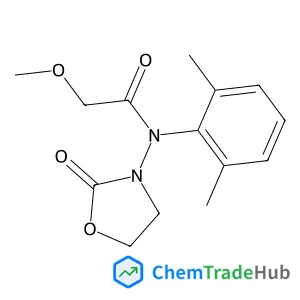
N-(2,6-Dimethylphenyl)-2-methoxy-N-(2-oxo-1,3-oxazolidin-3-yl)acetamide
CAS番号:
77732-09-3
分子式:
C14H18N2O4
![4-[2-(Trichlorosilyl)ethyl]benzenesulfonyl chloride structure](https://static.chemtradehub.com/structs/797/79793-00-3-de16.webp "4-[2-(Trichlorosilyl)ethyl]benzenesulfonyl chloride structure")
おすすめサプライヤー





免責事項
このページに表示される学術雑誌情報は、参考および研究目的のみを目的としています。当社は雑誌出版社とは提携しておらず、投稿の取り扱いも行っておりません。出版に関するお問い合わせは、各雑誌出版社に直接ご連絡ください。
表示されている情報に誤りがある場合は、support@chemtradehub.com までご連絡ください。迅速に確認し、対応いたします。