


Oligonucleotide modifications enhance probe stability for single cell transcriptome in vivo analysis (TIVA)
文献情報
出版日
2017-10-13
DOI
10.1039/C7OB02353G
インパクトファクター
3.876
著者
S. B. Yeldell, B. K. Ruble, I. J. Dmochowski
原文を見る
要旨
Single cell transcriptomics provides a powerful discovery tool for identifying new cell types and functions as well as a means to probe molecular features of the etiology and treatment of human diseases, including cancer. However, such analyses are limited by the difficulty of isolating mRNA from single cells within biological samples. We recently introduced a photochemical method for isolating mRNA from single living cells, Transcriptome In Vivo Analysis (TIVA). The TIVA probe is a “caged” polyU : polyA oligonucleotide hairpin designed to enter live tissue, where site-specific activation with 405 nm laser reveals the polyU-biotin strand to bind mRNA in a target cell, enabling subsequent mRNA isolation and sequencing. The TIVA method is well suited for analysis of living cells in resected tissue, but has not yet been applied to living cells in whole organisms. Adapting TIVA to this more challenging environment requires a probe with higher thermal stability, more robust caging, and greater nuclease resistance. In this paper we present modifications to the original TIVA probe with multiple aspects of enhanced stability. These newer probes utilize an extended 22mer polyU capture strand with two 9mer polyA blocking strands (“22/9/9”) for higher thermal stability pre-photolysis and improved mRNA capture affinity post-photolysis. The “22/9/9 GC” probe features a terminal GC pair to reduce pre-photolysis interactions with mRNA by more than half. The “PS-22/9/9” probe features a phosphorothioated backbone, which extends serum stability from <1 h to at least 48 h, and also mediates uptake into cultured human fibroblasts.
おすすめジャーナル

Journal of Saudi Chemical Society

Organic Process Research & Development

Saudi Pharmaceutical Journal

Russian Chemical Bulletin

Russian Journal of Bioorganic Chemistry

Current Opinion in Colloid & Interface Science

Crystallography Reports

Russian Journal of Coordination Chemistry

Chemistry Education Research and Practice

Journal of Peptide Science
関連文献
Self-assembly of a novel pentanuclear centred-tetrahedral silver species
Edwin C. Constable, Catherine E. Housecroft, Markus Neuburger, Sebastien Reymann, Sylvia Schaffner
2004-03-29
Communication
DOI: 10.1039/B402376E
Rapid cloning and expression of a fungal polyketide synthase gene involved in squalestatin biosynthesis
Russell J. Cox, Frank Glod, Deirdre Hurley, Colin M. Lazarus, Thomas. P. Nicholson, Brian A. M. Rudd, Thomas J. Simpson, Barrie Wilkinson, Ying Zhang
2004-09-24
Communication
DOI: 10.1039/B411973H
Direct conversion of iron stearate into magnetic Fe and Fe3C nanocrystals encapsulated in polyhedral graphite cages
Junfeng Geng, David A. Jefferson, Brian F. G. Johnson
2004-09-21
Communication
DOI: 10.1039/B406227B
Fe–Ce–ZSM-5 a new catalyst of outstanding properties in the selective catalytic reduction of NO with NH3
G. Carja, G. Delahay, C. Signorile, B. Coq
2004-05-17
Communication
DOI: 10.1039/B402660H
Shape of CeO2nanoparticles using simulated amorphisation and recrystallisation
Thi X. T. Sayle, Stephen C. Parker, Dean C. Sayle
2004-09-21
Communication
DOI: 10.1039/B408752F
Synergistic effects in controlling excited-state photodimerisation using multiple supramolecular interactions
Yolanda Vida Pol, Rafael Suau, Ezequiel Perez-Inestrosa, Dario M. Bassani
2004-04-29
Communication
DOI: 10.1039/B402298J
Direct syntheses of functionalized mesostructured silica by using an inexpensive silica source‡
Robert J. P. Corriu, Ahmad Mehdi, Catherine Reyé, Chloé Thieuleux
2004-05-19
Communication
DOI: 10.1039/B314415A
Large scale, templateless, surfactantless route to rapid synthesis of uniform poly(o-phenylenediamine) nanobelts
Xuping Sun, Shaojun Dong, Erkang Wang
2004-04-23
Communication
DOI: 10.1039/B401777C
Convenient magnesiation of aromatic and heterocyclic rings bearing a hydroxy group in presence of LiCl
Felix Kopp, Arkady Krasovskiy, Paul Knochel
2004-08-26
Communication
DOI: 10.1039/B409664A
Poly(vinyl alcohol) star polymers prepared via MADIX/RAFT polymerisation
Martina H. Stenzel, Thomas P. Davis, Christopher Barner-Kowollik
2004-06-02
Communication
DOI: 10.1039/B404763J
こちらもおすすめ
化合物よくある質問
2-氟-4-イオドベンzo酸エチルエステルを取り扱う際の実験室安全事項は何ですか?
2-氟-4-イオドベンzo酸エチルエステルは有機溶媒を用いた反応であり、ドラフトチャンバーでの操作が必要です。漏洩時にはSDS参照の安全措置を講じ、PPE(防護...
205750-82-9Benzoic acid, 2-fluo...
化合物よくある質問
血根碱の主な用途は何ですか?
血根碱は主に医薬分野で利用され、抗炎症や抗がん剤としての潜在的な効果が研究されています。また、化学研究や薬物開発において、新しい薬剤設計の参考となる化合物として...
2447-54-313-Methyl[1,3]benzod...
化合物よくある質問
Methyl 3-methoxythiophene-2-carboxylateの主な用途は何ですか?
Methyl 3-メトキシスチフェン-2-カルボン酸メチルエステルは、薬品合成、染料製造、以及合成中間体としての用途が広がっています。
62353-75-7Methyl 3-methoxythio...
化合物よくある質問
丹磺酰-L-亮氨酸はどのように保存すればよいですか?
丹磺酰-L-亮氨酸は乾燥した場所で、直射日光から保護し、低温(室温以下)で保存してください。密閉容器に入れて保管することをおすすめします。
1100-22-7N-{[5-(Dimethylamino...
化合物よくある質問
5-(苄氧基)ピラミジン-4-アミンの代替品はありますか?
5-(苄氧基)ピラミジン-4-アミンの代替品として、6-メトキシピラミジンや5-フェニルピラミジンなどが挙げられます。これらの化合物は、5-(苄氧基)ピラミジン...
92289-50-45-benzyloxypyrimidin...
化合物よくある質問
8-ヒドロキシノルデコペントアセートの物理化学的性質は何ですか?
8-ヒドロキシノルデコペントアセートはCAS番号84807-87-4の化合物で、分子量は750.02 uです。これは油溶性で、水に溶けにくい特徴があります。反応...
84807-87-4(5Z,8Z,11Z,13E,15S)-...
化合物よくある質問
tert-ブチル(エス)-1-ヒドロキシペンタ-4-エン-2-イルカルバamateの主な用途は何ですか?
tert-ブチル(エス)-1-ヒドロキシペンタ-4-エン-2-イルカルバamateは主に医薬品の合成材料や分析化学の試薬として使用されます。
116613-81-12-Methyl-2-propanyl ...
化合物よくある質問
ブコール-L-2-フローヨルブリンについて適切な法規ガイドラインは何ですか?
ブコール-L-2-フローヨルブリン(CAS番号: 1196107-73-9)は、GHS(グローバルハザードアサessmentシステム)に基づく危害分類と表示が求...
1196107-73-92-Bromo-13,13-dimeth...
化合物よくある質問
6-ブロモ-N-環丙基-2-ピリジニニメタンの市場動向や研究トレンドはどうですか
6-ブロモ-N-環丙基-2-ピリジニニメタンは、薬理学研究や合成化学に使用される化合物であり、特に抗ウイルス薬や抗がん薬の開発に注目されています。市場では、薬物...
959237-20-86-Bromo-N-cyclopropy...
化合物よくある質問
RS-AMPÀはどのように保存すればよいですか?
RS-AMPÀは、遮光容器に保存し、室温(15〜25℃)で保管することが推奨されます。高湿や熱は物質を劣化させるため、湿度は50%以下に保つことが重要です。また...
74341-63-2(RS)-AMPA
掲載誌
Organic & Biomolecular Chemistry

CiteScore:
3.4
自己引用率:
10.3%
年間論文数:
1041
Organic & Biomolecular Chemistry (OBC) publishes original and high impact research and reviews in organic chemistry. We welcome research that shows new or significantly improved protocols or methodologies in total synthesis, synthetic methodology or physical and theoretical organic chemistry as well as research that shows a significant advance in the organic chemistry or molecular design aspects of chemical biology, catalysis, supramolecular and macromolecular chemistry, theoretical chemistry, mechanism-oriented physical organic chemistry, medicinal chemistry or natural products. Articles published in the journal should report new work which makes a highly-significant impact in the field. Routine and incremental work is generally not suitable for publication in the journal. More details about key areas of our scope are below. In all cases authors should include in their article clear rationale for why their research has been carried out.
おすすめ化合物
![2-Hydroxy-4-[({[(4-methylphenyl)sulfonyl]oxy}acetyl)amino]benzoic acid structure](https://static.chemtradehub.com/structs/501/501919-59-1-579f.webp "2-Hydroxy-4-[({[(4-methylphenyl)sulfonyl]oxy}acetyl)amino]benzoic acid structure")
2-Hydroxy-4-[({[(4-methylphenyl)sulfonyl]oxy}acetyl)amino]benzoic acid
CAS番号:
501919-59-1
分子式:
C16H15NO7S
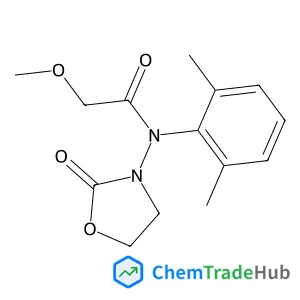
N-(2,6-Dimethylphenyl)-2-methoxy-N-(2-oxo-1,3-oxazolidin-3-yl)acetamide
CAS番号:
77732-09-3
分子式:
C14H18N2O4
おすすめサプライヤー





免責事項
このページに表示される学術雑誌情報は、参考および研究目的のみを目的としています。当社は雑誌出版社とは提携しておらず、投稿の取り扱いも行っておりません。出版に関するお問い合わせは、各雑誌出版社に直接ご連絡ください。
表示されている情報に誤りがある場合は、support@chemtradehub.com までご連絡ください。迅速に確認し、対応いたします。