












Photochemical cooperativity in photosystem II. Characterization of oxygen evolution discontinuities in the light-response curves
文献情報
出版日
2008-09-25
DOI
10.1039/B809294J
インパクトファクター
3.676
著者
M. Fragata
原文を見る
要旨
In two previous papers (Fragata et al., J. Phys. Chem. B, 2005, 109, 14707–14714; Fragata et al., J. Phys. Chem. B, 2007, 111, 3315–3320), it was shown that the variation of oxygen evolution with the light intensity (I) in photosystem II (PSII) in steady state conditions can be formulated according to the Langmuir adsorption isotherm for heterogeneous catalysis. This yielded the expression OEth = OEth(max) I/(L½ + I), where OEth is the theoretical oxygen evolution, OEth(max) the maximum oxygen evolution, and L½ the irradiance giving OEth(max)/2. In this approximation, the photons interaction with the chlorophylls in the PSII reaction center is assumed to be a heterogeneous reaction in which the light is represented as a stream of particles instead of an electromagnetic wave. That is, the chlorophyll molecules are the adsorption surfaces (or heterogeneous catalysts), and the incident (or exciting) photons are the substrate, or the reagent. Recently, the examination of new experimental data obtained with 2,6-dichloro-p-benzoquinone (DCBQ) and p-benzoquinone (pBQ) as exogenous electron acceptors, disclosed the presence of oxygen evolution discontinuities (or transitions) in the light-response curves. The new data were fitted with a mathematical summation of hyperbola of order n(i) > 1, OEth = ∑i [OEth(max)]iIn(i)/[(L½)in(i) + In(i)], where the n(i)’s are the number of sites used by the incident photons in their interaction with the photosynthetic pigments in each population i of PSII centers open for photochemistry. The mathematical simulations yielded only three distinct n(i)’s, that is, 1.8, 4.8, 8.5 and 1.8, 4.2, 8.4 for isolated PSII particles incubated with DCBQ and pBQ, respectively. Implicitly, this means the simultaneous excitation of each PSII reaction center with more than one photon, that is, the excitation of more than one pigment molecule. It is suggested that these transitions have their origin in the cooperative interaction of the photons and the chlorophylls, and most likely also the pheophytins. This indicates that the discontinuities (or transitions) observed in the light-response curves of oxygen evolution are consistent with the hypothesis of photochemical cooperativity in photosystem II.
関連文献
Catalytic polymerization of naphthalene by HF/BF3 super acid: an ab initio density functional theory study
Po-Yu Yang, Hsing-Yin Chen, Chia-Lin Chang, Gao-Shee Leu, Che-Hsin Lin
2018-08-18
Paper
DOI: 10.1039/C8CP02777C
Confinement-driven radical change in a sequence of rotator phases: a study on n-octacosane
Sujeet Dutta, S. Krishna Prasad
2018-08-30
Paper
DOI: 10.1039/C8CP03603A
Metalation and coordination reactions of 2H-meso-trans-di(p-cyanophenyl)porphyrin on Ag(111) with coadsorbed cobalt atoms
2018-09-14
Paper
DOI: 10.1039/C8CP05255G
Computational QM/MM investigation of the adsorption of MTH active species in H-Y and H-ZSM-5‡
S. A. F. Nastase, A. J. Logsdail
2018-12-21
Paper
DOI: 10.1039/C8CP06736H
Exposing catalytic versatility of GTPases: taking reaction detours in mutants of hGBP1 enzyme without additional energetic cost
Ravi Tripathi, Jan Noetzel, Dominik Marx
2018-12-07
Paper
DOI: 10.1039/C8CP06343E
Statistical thermodynamics for the unexpectedly large difference between disaccharide stereoisomers in terms of solubility in water
Tomohiko Hayashi, Masahiro Kinoshita
2018-08-30
Paper
DOI: 10.1039/C8CP04377A
Microscopic origin of pressure-induced phase-transitions in urea: a detailed investigation through first principles calculations
B. Moses Abraham, B. Adivaiah
2018-11-30
Paper
DOI: 10.1039/C8CP04827D
Time-gated triplet-state optical spectroscopy to decipher organic luminophores embedded in rigid matrices
Atul D. Sontakke, Jean-Marie Mouesca, Victor Castaing, Mathieu Salaün, Isabelle Gautier-Luneau, Vincent Maurel, Alain Ibanez, Bruno Viana
2018-08-27
Paper
DOI: 10.1039/C8CP03952F
Spectroscopic and magnetic investigations of a spin-frustrated Mn-doped CoAl2O4 spinel
Suman Kalyan Pradhan, Biswajit Dalal, Ankita Sarkar, Subodh Kumar De
2018-12-07
Paper
DOI: 10.1039/C8CP07140C
Non-covalent complexes of the peptide fragment Gly-Asn-Asn-Gln-Gln-Asn-Tyr in the gas-phase. Photodissociative cross-linking, Born–Oppenheimer molecular dynamics, and ab initio computational binding study
Shu R. Huang, Yang Liu, František Tureček
2019-01-08
Paper
DOI: 10.1039/C8CP06893C
こちらもおすすめ
化合物よくある質問
四氢-3-呋喃羧酰胺を含む廃棄物はどのように処理すべきですか?
四氢-3-呋喃羧酰胺を含む廃棄物の処理は、まず安全に収集し、化学的処理または専門廃棄処理を行うことが推奨されます。高温焼却は一般的な選択肢ですが、環境保護の観点...
871677-92-8Tetrahydro-3-furanca...
化合物よくある質問
DIMETHYL 3-AMINO-2,5-THIOPHENEDICARBOXYLATEについて「に適用される法規ガイドラインは何ですか」
DIMETHYL 3-AMINO-2,5-THIOPHENEDICARBOXYLATE(CAS番号: 785803-74-9)は、GHS( Globally H...
785803-74-9Dimethyl 3-amino-2,5...
化合物よくある質問
5-フェニル-2,2'-ビピリジンはどのように合成されますか?
5-フェニル-2,2'-ビピリジンは、ピリジン環とフェニル基を有する化合物から合成されます。一般的な合成方法は、4-ブロミノ苯と2,2'-ビピリジンの窒素上的ウ...
156972-80-45-Phenyl-2,2'-bipyri...
化合物よくある質問
三溴甲基苯砜とは何ですか?
三溴甲基苯砜はCAS番号17025-47-7の化合物で、(Tribromomethyl)sulfonyl]benzeneと呼ばれています。この物質は、芳香族化合...
17025-47-7[(Tribromomethyl)sul...
化合物よくある質問
四氢吡喃-4,4-二甲酸二甲酯を含む廃棄物はどのように処理すべきですか?
四氢吡喃-4,4-二甲酸二甲酯の廃棄物は、専門の廃棄処理業者に委託して安全に処理することが推奨されます。具体的には、反応性の点から常温で保存し、容器は密閉状態で...
149777-00-4Dimethyl tetrahydro-...
化合物よくある質問
N-叔丁氧羰基-N-甲乙二胺はどのように合成されますか?
N-叔丁氧羰基-N-甲乙二胺は、N-叔丁氧羰基アミンとプロピニルアミンのジアミン反応により合成されます。反応は無機触媒なしで行え、選択性と収率は良好です。
121492-06-62-Methyl-2-propanyl ...
化合物よくある質問
1,2-プロパンジオール-D6はどのように合成されますか?
1,2-プロパンジオール-D6は、プロパン-1,2-ジオールをD6同位体と交換反応を行うことで合成されます。この反応は触媒を必要とし、選択性と収率が良好です。
52910-80-21,2-Propane-d6-diol
化合物よくある質問
4,4'-異プロピルジキレートとは何ですか?
4,4'-異プロピルジキレートは、CAS番号7418-16-8の化合物で、4,4'-(2,2-プロパネディイル)ジシクロヘキサンカーボン酸は、白色の粉末またはク...
7418-16-84,4'-(2,2-Propanediy...
化合物よくある質問
2-メチル-2-プロパンチル (2S)-4-酸化-2-(1,3-チアゾリジン-3-イルカルベニル)-1-ピロリジンカルボキシレートの主な用途は何ですか?
この化合物は主に医薬品の開発に関与しており、特に抗炎症薬や神経保護剤の研究に利用されます。また、有機合成の中間体として工業製品の製造にも応用されることがあります...
401564-36-12-Methyl-2-propanyl ...
化合物よくある質問
ナトリウム5'-O-{ヘキシロキシ[(ヘキシロキシフォスフィニルオキシ)フィロホスフィル]アデノシン}を含む廃棄物はどのように処理すべきですか?
ナトリウム5'-O-{ヘキシロキシ[(ヘキシロキシフォスフィニルオキシ)フィロホスフィル]アデノシン}を含む廃棄物は、適切な化学廃棄処理施設に引き渡す必要があり...
1172-42-5Sodium 5'-O-{hydroxy...
掲載誌
Physical Chemistry Chemical Physics

CiteScore:
5.5
自己引用率:
10.3%
年間論文数:
3036
Physical Chemistry Chemical Physics (PCCP) is an international journal co-owned by 19 physical chemistry and physics societies from around the world. This journal publishes original, cutting-edge research in physical chemistry, chemical physics and biophysical chemistry. To be suitable for publication in PCCP, articles must include significant innovation and/or insight into physical chemistry; this is the most important criterion that reviewers and Editors will judge against when evaluating submissions. The journal has a broad scope and welcomes contributions spanning experiment, theory, computation and data science. Topical coverage includes spectroscopy, dynamics, kinetics, statistical mechanics, thermodynamics, electrochemistry, catalysis, surface science, quantum mechanics, quantum computing and machine learning. Interdisciplinary research areas such as polymers and soft matter, materials, nanoscience, energy, surfaces/interfaces, and biophysical chemistry are welcomed if they demonstrate significant innovation and/or insight into physical chemistry. Joined experimental/theoretical studies are particularly appreciated when complementary and based on up-to-date approaches.
おすすめ化合物
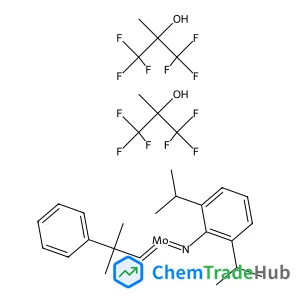
2,6-Diisopropylphenylimidoneophylidene molybdenum(VI) bis(hexafluoro-t-butoxide)
CAS番号:
139220-25-0
分子式:
C30H37F12MoNO2
おすすめサプライヤー




免責事項
このページに表示される学術雑誌情報は、参考および研究目的のみを目的としています。当社は雑誌出版社とは提携しておらず、投稿の取り扱いも行っておりません。出版に関するお問い合わせは、各雑誌出版社に直接ご連絡ください。
表示されている情報に誤りがある場合は、support@chemtradehub.com までご連絡ください。迅速に確認し、対応いたします。