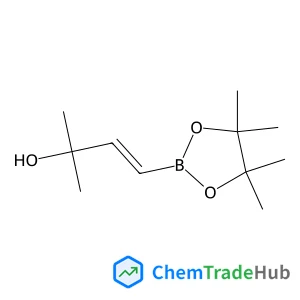
(E)-2-methyl-4-(4,4,5,5-tetramethyl-1,3,2-dioxaborolan-2-yl)but-3-en-2-ol
CAS番号:
581802-26-8
分子式:
C11H21BO3
Tomohiko Hayashi, Masahiro Kinoshita
We unravel the physical origins of the large difference between cellobiose and maltose, which consist of two β-1,4 and α-1,4 linked D-glucose units, respectively, in terms of the solubility in water. We construct a thermodynamic theory where the chemical-potential difference between disaccharides in water and in vacuum is identified as the key free-energy function. Its energetic and entropic components are calculated for cellobiose and maltose by statistical-mechanical theories for solute hydration. The disaccharide structures are taken into account at the atomic level and a molecular model is adopted for water. Molecular dynamics simulations are used to account for the conformational fluctuation of a disaccharide molecule, which also enables us to estimate the conformational entropy. We show that the cellobiose/maltose solubility ratio calculated is in good agreement with the experimental value. The solubility becomes much lower for cellobiose due to conformational-entropy and water-entropy effects. The former effect is relevant to higher stability of the intramolecular hydrogen bond between oxygen atoms in the six-membered ring and in the neighboring hydroxyl group: the hydration alters the fluctuation of a molecular conformation to a larger or less regular one, but the degree of this alteration is smaller. The latter effect is attributed to more separation of two hydroxymethyl groups in a molecule, causing lower probability of the overlap of excluded volumes generated by the groups for water molecules. We suggest that physicochemical properties of disaccharides in water become variable depending on the stereoisomerism through hydration effects and the origins of the variety are entropic.

Chemistry Education Research and Practice

Journal of Saudi Chemical Society

Russian Journal of General Chemistry

Russian Journal of Applied Chemistry

Russian Journal of Organic Chemistry

Chemical Communications

Russian Journal of Coordination Chemistry

New Journal of Chemistry

Organic Process Research & Development

Current Opinion in Solid State & Materials Science
Liying Yang, Tingyu Liu, Jinsong Jiang, Wenqi Song
DOI: 10.1039/D3CP04600A
Branislav Milovanović, Milena Petković
DOI: 10.1039/D3CP03991A
Raktima Basu, Reshma Kumawat, Mrinmay Sahu, Abu Bakkar Miah, Partha Mitra, Goutam Dev Mukherjee
DOI: 10.1039/D3CP01409F
Kevin P. McGuinness, Anton O. Oliynyk, Sangjoon Lee, Beatriz Molero-Sanchez, Paul Kwesi Addo
DOI: 10.1039/D3CP04017H
Kanhu Charan Behera, Mangalampalli Ravikanth
DOI: 10.1039/D3CP04234K
6- bromo-1-cyclopropyl-1H-benzimidazoleは、抗炎症、抗ウイルス作用を持つことが報告されており、新薬開発の研究対象として注目...
取り扱う際には、防護眼鏡と手袋を使用し、ドラフトチャンバー内で操作することを推奨します。漏洩時には適切な手順で処理し、安全データシートを常に参照してください。
2,2’-ジメチル-3,3’-ビピリジンは、ピリジンと2-メチルアクリルアミドを有機合成反応で合成します。この反応では、ピリジンと2-メチルアクリルアミドを含有...
6-甲基ピリジン-2-ボリック酸は、合成化学、医薬品合成、以及研究用途などに広く使用され、特に組換えDNA技術や分子生物学の研究において重要な役割を果たします。
(R)-3-(1-甲基-2-氧環己基)プロpano酸メチルは一定の安全性がありますが、直接的な皮膚接触や吸入は避けるべきです。使用する際は適切な個々の安全データ...
ketorolacは、密封して遮光容器に保管し、直射日光や高温を避けて保存してください。温度は常温で保存し、湿度をなるべく低く保つことが推奨されます。
L-2,3-二氨基丙酸二盐酸盐は腐食性が強く、皮膚や粘膜に刺激を与える可能性があります。取り扱う際は、防塵マスク、ゴーグル、手袋を使用し、適切な排気設備を使用し...
2-(4-溴ピリジン-2-基)乙腈のCAS番号は312325-73-8です。主に結晶形態で存在し、分子量は159.01 g/molです。この化合物は水に溶けやす...
この化合物は毒性は低いですが、直接的な接触や吸入に注意が必要です。PPE(個人防護具)を着用し、ドラフトチャンバーを使用して操作することを推奨します。また、漏洩...
3-(1-氧代-1,3-二氢-2H-2-异吲哚)丙酸は、薬理学研究や医薬品製造において広く用いられる化合物です。また、工業的な用途でも一部の化学反応の触媒や助剤...

Physical Chemistry Chemical Physics (PCCP) is an international journal co-owned by 19 physical chemistry and physics societies from around the world. This journal publishes original, cutting-edge research in physical chemistry, chemical physics and biophysical chemistry. To be suitable for publication in PCCP, articles must include significant innovation and/or insight into physical chemistry; this is the most important criterion that reviewers and Editors will judge against when evaluating submissions. The journal has a broad scope and welcomes contributions spanning experiment, theory, computation and data science. Topical coverage includes spectroscopy, dynamics, kinetics, statistical mechanics, thermodynamics, electrochemistry, catalysis, surface science, quantum mechanics, quantum computing and machine learning. Interdisciplinary research areas such as polymers and soft matter, materials, nanoscience, energy, surfaces/interfaces, and biophysical chemistry are welcomed if they demonstrate significant innovation and/or insight into physical chemistry. Joined experimental/theoretical studies are particularly appreciated when complementary and based on up-to-date approaches.
![4-[(3-Chloro-2-fluorophenyl)amino]-7-methoxy-6-quinazolinyl acetate structure](https://static.chemtradehub.com/structs/740/740081-22-5-f58f.webp "4-[(3-Chloro-2-fluorophenyl)amino]-7-methoxy-6-quinazolinyl acetate structure")