












Peptide/protein–polymer conjugates: synthetic strategies and design concepts
文献情報
出版日
2008-04-17
DOI
10.1039/B719689J
インパクトファクター
6.222
著者
Marc A. Gauthier, Harm-Anton Klok
原文を見る
要旨
This feature article provides a compilation of tools available for preparing well-defined peptide/protein–polymer conjugates, which are defined as hybrid constructs combining (i) a defined number of peptide/protein segments with uniform chain lengths and defined monomer sequences (primary structure) with (ii) a defined number of synthetic polymer chains. The first section describes methods for post-translational, or direct, introduction of chemoselective handles onto natural or synthetic peptides/proteins. Addressed topics include the residue- and/or site-specific modification of peptides/proteins at Arg, Asp, Cys, Gln, Glu, Gly, His, Lys, Met, Phe, Ser, Thr, Trp, Tyr and Val residues and methods for producing peptides/proteins containing non-canonical amino acids by peptide synthesis and protein engineering. In the second section, methods for introducing chemoselective groups onto the side-chain or chain-end of synthetic polymers produced by radical, anionic, cationic, metathesis and ring-opening polymerization are described. The final section discusses convergent and divergent strategies for covalently assembling polymers and peptides/proteins. An overview of the use of chemoselective reactions such as Heck, Sonogashira and Suzuki coupling, Diels–Alder cycloaddition, Click chemistry, Staudinger ligation, Michael’s addition, reductive alkylation and oxime/hydrazone chemistry for the convergent synthesis of peptide/protein–polymer conjugates is given. Divergent approaches for preparing peptide/protein–polymer conjugates which are discussed include peptide synthesis from synthetic polymer supports, polymerization from peptide/protein macroinitiators or chain transfer agents and the polymerization of peptide side-chain monomers.
関連文献
A dendrimer–hydrophobic interaction synergy improves the stability of polyion complex micelles
Marcos Fernandez-Villamarin, Ana Sousa-Herves, Silvia Porto, Noelia Guldris, José Martínez-Costas, Ricardo Riguera, Eduardo Fernandez-Megia
2017-03-28
Paper
DOI: 10.1039/C7PY00304H
Unusual thermal phase transition behavior of an ionic liquid and poly(ionic liquid) in water with significantly different LCST and dynamic mechanism
Wenlong Li, Peiyi Wu
2014-05-16
Paper
DOI: 10.1039/C4PY00593G
Cononsolvency in the ‘drunken’ state: the thermoresponsiveness of a new acrylamide copolymer in water–alcohol mixtures
Niklas Lucht, Steffen Eggers
2017-01-03
Paper
DOI: 10.1039/C6PY01751G
Hyperbranched PEG-based multi-NHS polymer and bioconjugation with BSA
Sigen A, Qian Xu, Dezhong Zhou, Yongsheng Gao, Jeddah Marie Vasquez, Udo Greiser, Wenguang Liu
2017-01-04
Communication
DOI: 10.1039/C6PY01719C
Nanoimprinting-induced molecular orientation in poly(3-hexylthiophene) nanogratings and its extraordinary retention after thermal annealing
Xiaohui Li, Zhijun Hu
2017-03-28
Paper
DOI: 10.1039/C7PY00378A
A highly active chiral (S,S)-bis(oxazoline) Pd(ii) alkyl complex/activator catalytic system for vinyl polymerization of norbornene in air and water
Yingda Huang, Jianyun He, Zhanxiong Liu, Guilong Cai, Shaowen Zhang, Xiaofang Li
2016-12-26
Paper
DOI: 10.1039/C6PY01859A
High solids content nitroxide mediated miniemulsion polymerization of n-butyl methacrylate
Nicholas Ballard, Miren Aguirre, Alexandre Simula, Jose R. Leiza, José M. Asua
2017-02-09
Paper
DOI: 10.1039/C7PY00067G
New violet to yellow light sensitive diketo pyrrolo–pyrrole photoinitiators: high performance systems with unusual bleaching properties and solubility in water
Mariem Bouzrati-Zerelli, Nicolas Zivic, Frédéric Dumur, Didier Gigmes, Bernadette Graff, Jean Pierre Fouassier, Jacques Lalevée
2017-02-28
Paper
DOI: 10.1039/C7PY00202E
Controlling the folding of conjugated polymers at the single molecule level via hydrogen bonding
Beiyue Shao, Xinju Zhu, Kyle N. Plunkett, David A. Vanden Bout
2017-01-06
Paper
DOI: 10.1039/C6PY01871H
Palladium nanoparticles supported on a carbazole functionalized mesoporous organic polymer: synthesis and their application as efficient catalysts for the Suzuki–Miyaura cross coupling reaction
Hui Zhou, Chuanguang Wu, Qiaolin Wu, Bixuan Guo, Wanting Liu, Guanghua Li, Ying Mu
2017-01-26
Paper
DOI: 10.1039/C6PY01784C
こちらもおすすめ
28770-01-62-(2-Isopropyl-1,3-o...
化合物よくある質問
「邻羟基阿托伐他汀内酯标准品」に適用される法規ガイドelinesは何ですか?
CAS番号163217-74-1の「邻羟基阿托伐他汀内酯标准品」は、GHS分類では危険物に分類されず、主にREACH規則とFDA/EPAの管理対象となります。R...
163217-74-1ortho-Hydroxy Atorva...
化合物よくある質問
メチル(3R)-3-アミノ-2,3-ジヒドロ-1-ベンゾファンラニン-5-カルボイル酸塩塩酸塩の主な用途は何ですか?
メチル(3R)-3-アミノ-2,3-ジヒドロ-1-ベンゾファンラニン-5-カルボイル酸塩塩酸塩は、医薬品や合成化学の研究に広く用いられます。また、特定の薬物の前...
2241594-15-8Methyl (3R)-3-amino-...
化合物よくある質問
トランス-4-メチルピロリジン-3-オール塩酸塩はどのように合成されますか?
トランス-4-メチルピロリジン-3-オール塩酸塩は、4-メチルピロリジンの塩酸塩化によって合成されます。一般的な合成方法では、4-メチルピロリジンを塩酸に加えて...
265108-42-7trans-4-Methylpyrrol...
化合物よくある質問
硫雜環丁烷-1,1-二氧化物は安全ですか?
硫雜環丁烷-1,1-二氧化物は安全ではありません。毒性は報告されていませんが、高温下で分解し、可燃性があるため、高圧ガスは注意が必要です。密閉した容器で保管し、...
5687-92-3Thietane 1,1-dioxide
6054-10-02H, 8H-Benzo[1,2-b
化合物よくある質問
9-ヒドロキシエリプチシネ塩酸塩はどのように合成されますか?
9-ヒドロキシエリプチシネ塩酸塩は、エリプチシネから塩酸を添加することで合成されます。選択性は高いですが、収率は約70%です。
52238-35-49-Hydroxyellipticine...
化合物よくある質問
5-塩素-2-(メチルアミノ)フェニル-(2-塩素フェニル)メタン酮の物理化学的性質は何ですか?
5-塩素-2-(メチルアミノ)フェニル-(2-塩素フェニル)メタン酮のCAS番号は5621-86-3です。この化合物は白色の結晶性粉末で、分子量は415.03で...
5621-86-3[5-Chloro-2-(methyla...
化合物よくある質問
1-[2-(4-甲氧基-苯氧基)-乙基]-哌嗪はどのように保存すればよいですか?
1-[2-(4-甲氧基-苯氧基)-乙基]-哌嗪は、直射日光を避けて暗所に、室温(15-25℃)で保管し、密閉容器に入れることで安定性を保つことができます。
117132-44-21-[2-(4-Methoxy-phen...
化合物よくある質問
2-[3-(4-甲氧基フェニル)プロピル]-4,4,5,5-四メチル-1,3,2-ドイボロロールアンの主な用途は何ですか?
2-[3-(4-甲氧基フェニル)プロピル]-4,4,5,5-四メチル-1,3,2-ドイボロロールアンは、医薬品の合成、有機合成化学、および新材料の研究で使用され...
1073371-72-82-[3-(4-Methoxypheny...
掲載誌
Chemical Communications

CiteScore:
8.6
自己引用率:
4.7%
年間論文数:
2458
ChemComm publishes urgent research which is of outstanding significance and interest to experts in the field, while also appealing to the journal’s broad chemistry readership. Our communication format is ideally suited to short, urgent studies that are of such importance that they require accelerated publication. Our scope covers all topics in chemistry, and research at the interface of chemistry and other disciplines (such as materials science, nanoscience, physics, engineering and biology) where there is a significant novelty in the chemistry aspects. Major topic areas covered include: Analytical Chemistry Catalysis Chemical Biology and medicinal chemistry Computational Chemistry and Machine Learning Energy and sustainable chemistry Environmental Chemistry Green Chemistry Inorganic Chemistry Materials Chemistry Nanoscience Organic Chemistry Physical Chemistry Polymer Chemistry Supramolecular Chemistry
おすすめ化合物
phosphoryl}methyl 4-methylbenzenesulfonate structure](https://static.chemtradehub.com/structs/864/864068-45-1-ba7c.webp "{[3-(Hexadecyloxy)propoxy](hydroxy)phosphoryl}methyl 4-methylbenzenesulfonate structure")
{[3-(Hexadecyloxy)propoxy](hydroxy)phosphoryl}methyl 4-methylbenzenesulfonate
CAS番号:
864068-45-1
分子式:
C27H49O7PS
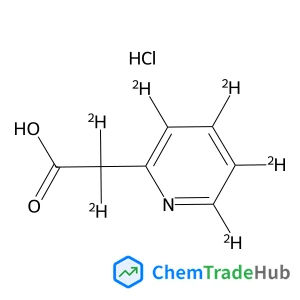
2,2-dideuterio-2-(3,4,5,6-tetradeuterio-2-pyridyl)acetic acid;hydrochloride
CAS番号:
1329799-67-8
分子式:
C7H2ClD6NO2
おすすめサプライヤー





免責事項
このページに表示される学術雑誌情報は、参考および研究目的のみを目的としています。当社は雑誌出版社とは提携しておらず、投稿の取り扱いも行っておりません。出版に関するお問い合わせは、各雑誌出版社に直接ご連絡ください。
表示されている情報に誤りがある場合は、support@chemtradehub.com までご連絡ください。迅速に確認し、対応いたします。