












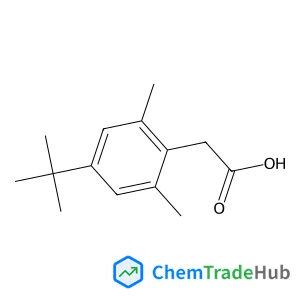
p1,n1 Salts: self-assembled supramolecular structures sequestering racemates. Diastereomeric separation and enantiomeric enrichment of trans-chrysanthemic acid
文献情報
出版日
2006-08-21
DOI
10.1039/B608405B
インパクトファクター
6.222
著者
Goffredo Rosini, Claudia Ayoub, Valerio Borzatta, Andrea Mazzanti, Emanuela Marotta, Paolo Righi
原文を見る
要旨
The occurrence of p1,n1 salts can be exploited to sequester racemates; an application to technical mixtures of chrysanthemic acids (ChA) allowed the separation of trans- and cis-ChA and the recovery of the excess enantiomer of trans-ChA.
関連文献
Naphthobisthiazole diimide-based n-type polymer semiconductors: synthesis, π-stacking, field-effect charge transport, and all-polymer solar cells
Selvam Subramaniyan, Taeshik Earmme, Nishit M. Murari, Samson A. Jenekhe
2014-07-02
Paper
DOI: 10.1039/C4PY00566J
Facile one-pot access to π-conjugated polymers via sequential bromination/direct arylation polycondensation
Hitoshi Saito, Jieran Chen, Junpei Kuwabara, Takeshi Yasuda, Takaki Kanbara
2017-04-25
Paper
DOI: 10.1039/C7PY00332C
The in situ formation of nanoparticles via RAFT polymerization-induced self-assembly in a continuous tubular reactor
Jinying Peng, Chun Tian, Lifen Zhang, Zhenping Cheng, Xiulin Zhu
2017-01-26
Paper
DOI: 10.1039/C6PY02133F
Macroporous uniform azide- and alkyne-functional polymer microspheres with tuneable surface area: synthesis, in-depth characterization and click-modification
Marco Albuszis, Peter J. Roth, Werner Pauer, Hans-Ulrich Moritz
2014-06-17
Paper
DOI: 10.1039/C4PY00709C
Nanoimprinting-induced molecular orientation in poly(3-hexylthiophene) nanogratings and its extraordinary retention after thermal annealing
Xiaohui Li, Zhijun Hu
2017-03-28
Paper
DOI: 10.1039/C7PY00378A
Unusual thermal phase transition behavior of an ionic liquid and poly(ionic liquid) in water with significantly different LCST and dynamic mechanism
Wenlong Li, Peiyi Wu
2014-05-16
Paper
DOI: 10.1039/C4PY00593G
Facile conversion of plant oil (anethole) to a high-performance material
Yangqing Tao, Fengkai He, Kaikai Jin, Jiajia Wang, Yuanqiang Wang, Junfeng Zhou, Jing Sun, Qiang Fang
2017-02-20
Paper
DOI: 10.1039/C7PY00047B
Ultra-pH-sensitive polypeptide micelles with large fluorescence off/on ratio in near infrared range
Liyi Fu, Pan Yuan, Zheng Ruan, Le Liu, Tuanwei Li, Lifeng Yan
2016-12-16
Paper
DOI: 10.1039/C6PY01818A
Preparation of a highly reactive polymer click reagent, PEG nitrile N-oxide, and its application in block and star polymer synthesis
Toyokazu Tsutsuba
2017-02-06
Communication
DOI: 10.1039/C7PY00100B
Tumor-targeted aggregation of pH-sensitive nanocarriers for enhanced retention and rapid intracellular drug release
Wei Wu, Qiujing Zhang, Jiantao Wang, Miao Chen, Shuai Li, Zaifu Lin, Jianshu Li
2014-05-30
Paper
DOI: 10.1039/C4PY00575A
こちらもおすすめ
28770-01-62-(2-Isopropyl-1,3-o...
化合物よくある質問
「邻羟基阿托伐他汀内酯标准品」に適用される法規ガイドelinesは何ですか?
CAS番号163217-74-1の「邻羟基阿托伐他汀内酯标准品」は、GHS分類では危険物に分類されず、主にREACH規則とFDA/EPAの管理対象となります。R...
163217-74-1ortho-Hydroxy Atorva...
化合物よくある質問
メチル(3R)-3-アミノ-2,3-ジヒドロ-1-ベンゾファンラニン-5-カルボイル酸塩塩酸塩の主な用途は何ですか?
メチル(3R)-3-アミノ-2,3-ジヒドロ-1-ベンゾファンラニン-5-カルボイル酸塩塩酸塩は、医薬品や合成化学の研究に広く用いられます。また、特定の薬物の前...
2241594-15-8Methyl (3R)-3-amino-...
化合物よくある質問
トランス-4-メチルピロリジン-3-オール塩酸塩はどのように合成されますか?
トランス-4-メチルピロリジン-3-オール塩酸塩は、4-メチルピロリジンの塩酸塩化によって合成されます。一般的な合成方法では、4-メチルピロリジンを塩酸に加えて...
265108-42-7trans-4-Methylpyrrol...
化合物よくある質問
硫雜環丁烷-1,1-二氧化物は安全ですか?
硫雜環丁烷-1,1-二氧化物は安全ではありません。毒性は報告されていませんが、高温下で分解し、可燃性があるため、高圧ガスは注意が必要です。密閉した容器で保管し、...
5687-92-3Thietane 1,1-dioxide
6054-10-02H, 8H-Benzo[1,2-b
化合物よくある質問
9-ヒドロキシエリプチシネ塩酸塩はどのように合成されますか?
9-ヒドロキシエリプチシネ塩酸塩は、エリプチシネから塩酸を添加することで合成されます。選択性は高いですが、収率は約70%です。
52238-35-49-Hydroxyellipticine...
化合物よくある質問
5-塩素-2-(メチルアミノ)フェニル-(2-塩素フェニル)メタン酮の物理化学的性質は何ですか?
5-塩素-2-(メチルアミノ)フェニル-(2-塩素フェニル)メタン酮のCAS番号は5621-86-3です。この化合物は白色の結晶性粉末で、分子量は415.03で...
5621-86-3[5-Chloro-2-(methyla...
化合物よくある質問
1-[2-(4-甲氧基-苯氧基)-乙基]-哌嗪はどのように保存すればよいですか?
1-[2-(4-甲氧基-苯氧基)-乙基]-哌嗪は、直射日光を避けて暗所に、室温(15-25℃)で保管し、密閉容器に入れることで安定性を保つことができます。
117132-44-21-[2-(4-Methoxy-phen...
化合物よくある質問
2-[3-(4-甲氧基フェニル)プロピル]-4,4,5,5-四メチル-1,3,2-ドイボロロールアンの主な用途は何ですか?
2-[3-(4-甲氧基フェニル)プロピル]-4,4,5,5-四メチル-1,3,2-ドイボロロールアンは、医薬品の合成、有機合成化学、および新材料の研究で使用され...
1073371-72-82-[3-(4-Methoxypheny...
掲載誌
Chemical Communications

CiteScore:
8.6
自己引用率:
4.7%
年間論文数:
2458
ChemComm publishes urgent research which is of outstanding significance and interest to experts in the field, while also appealing to the journal’s broad chemistry readership. Our communication format is ideally suited to short, urgent studies that are of such importance that they require accelerated publication. Our scope covers all topics in chemistry, and research at the interface of chemistry and other disciplines (such as materials science, nanoscience, physics, engineering and biology) where there is a significant novelty in the chemistry aspects. Major topic areas covered include: Analytical Chemistry Catalysis Chemical Biology and medicinal chemistry Computational Chemistry and Machine Learning Energy and sustainable chemistry Environmental Chemistry Green Chemistry Inorganic Chemistry Materials Chemistry Nanoscience Organic Chemistry Physical Chemistry Polymer Chemistry Supramolecular Chemistry
おすすめ化合物
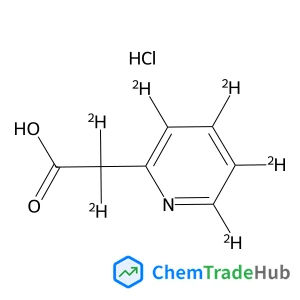
2,2-dideuterio-2-(3,4,5,6-tetradeuterio-2-pyridyl)acetic acid;hydrochloride
CAS番号:
1329799-67-8
分子式:
C7H2ClD6NO2
おすすめサプライヤー





免責事項
このページに表示される学術雑誌情報は、参考および研究目的のみを目的としています。当社は雑誌出版社とは提携しておらず、投稿の取り扱いも行っておりません。出版に関するお問い合わせは、各雑誌出版社に直接ご連絡ください。
表示されている情報に誤りがある場合は、support@chemtradehub.com までご連絡ください。迅速に確認し、対応いたします。