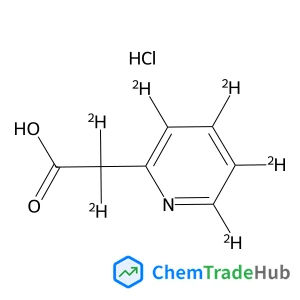
2,2-dideuterio-2-(3,4,5,6-tetradeuterio-2-pyridyl)acetic acid;hydrochloride
CAS番号:
1329799-67-8
分子式:
C7H2ClD6NO2
Wei Wu, Qiujing Zhang, Jiantao Wang, Miao Chen, Shuai Li, Zaifu Lin, Jianshu Li
Development of nanocarriers, which can selectively accumulate and remain within the tumor tissue matrix, is beneficial for non-invasive cancer diagnosis and therapy. In this study, a well-defined pH-sensitive block copolymer, i.e., succinic anhydride (SA)-modified poly(2-diisopropylaminoethyl methacrylate)-block-poly(2-aminoethyl methacrylate hydrochloride) (PDPA-b-PAMA/SA), was prepared by a two-step atom transfer radical polymerization (ATRP) and subsequent amidation. The low critical micelle concentration (CMC, 40.7 × 10⁻⁴ mg mL−1) of PDPA-b-PAMA/SA investigated in pH 7.4 aqueous solution confirmed the adequate thermodynamic stability of its self-assembly. In addition, the pH-sensitive aggregation behaviors of blank and drug-loaded PDPA-b-PAMA/SA were systematically studied at typical pH conditions (7.4 and 6.5) using dynamic light scattering (DLS) and transmission electron microscopy (TEM). Compared with the control sample, i.e., poly(D,L-lactide)-block-poly(2-aminoethyl methacrylate hydrochloride (PLA-b-PAMA/SA), both blank and drug-loaded PDPA-b-PAMA/SA (PDPA-b-PAMA/SA@DOX·HCl) exhibited obvious aggregation through electric interaction between the positive charge of the protonated PDPA block and the negative charge of the PAMA/SA block at tumor sites under slightly acidic condition. Moreover, the drug-loaded nanocarriers exhibited accelerated drug release profiles in response to the acidic condition due to the electric repulsion between the protonated PDPA block and positive DOX·HCl. Cytotoxicity assay results demonstrated that the pH-sensitive block copolymer did not demonstrate obvious cytotoxicity, even at a concentration up to 100 μg mL−1. The enhanced intracellular DOX·HCl distribution in nuclei was also confirmed by confocal laser scanning microscopy (CLSM). Thus, these results suggest that PDPA-b-PAMA/SA provides a feasible platform for efficient tumor-targeted therapy.

Helvetica Chimica Acta

European Journal of Wood and Wood Products

Journal of Heterocyclic Chemistry

Science

Journal of Physics and Chemistry of Solids

Proceedings of the National Academy of Sciences of the United States of America

Organic Preparations and Procedures International

Pure and Applied Chemistry

Journal of Catalysis

Kinetics and Catalysis
Yuting Li, Wael A. Fouad
DOI: 10.1039/C9CP03231B
Jo Hsueh Lee, Cheng-Hung Cheng, Bo-Rong Liao, Shi-Hsin Lin
DOI: 10.1039/C9CP06469A
Enrique Wagemann, Yanbin Wang, Siddhartha Das, Sushanta K. Mitra
DOI: 10.1039/D0CP00200C
Jianhui Chen, Xiaolin Tan, Peng Lin, Baisheng Sa, Jian Zhou, Yinggan Zhang, Cuilian Wen, Zhimei Sun
DOI: 10.1039/C9CP04407H
Thierry Dubroca, Sungsool Wi, Johan van Tol
DOI: 10.1039/C9CP02997D
Yanrong Jiang, Qinqin Yuan, Jonas Warneke, Zhubin Hu, Yan Yang, Xue-Bin Wang
DOI: 10.1039/D0CP00700E
Jesse S. Dondapati, Aicheng Chen
DOI: 10.1039/D0CP01518K
Nguyen V. Hieu, Le T. P. Thao, Nguyen N. Hieu, Huynh V. Phuc, H. D. Bui, M. Idrees, B. Amin, Le M. Duc, Chuong V. Nguyen
DOI: 10.1039/C9CP04689E
Carolina Moreno, María-Teresa Baeza-Romero, Óscar Gálvez, Vicente López Arza, James C. Ianni, Eva Espíldora
DOI: 10.1039/C9CP05601G
Bikash Patra, Subrata Jana, Prasanjit Samal
DOI: 10.1039/C9CP90239B
CAS番号163217-74-1の「邻羟基阿托伐他汀内酯标准品」は、GHS分類では危険物に分類されず、主にREACH規則とFDA/EPAの管理対象となります。R...
メチル(3R)-3-アミノ-2,3-ジヒドロ-1-ベンゾファンラニン-5-カルボイル酸塩塩酸塩は、医薬品や合成化学の研究に広く用いられます。また、特定の薬物の前...
トランス-4-メチルピロリジン-3-オール塩酸塩は、4-メチルピロリジンの塩酸塩化によって合成されます。一般的な合成方法では、4-メチルピロリジンを塩酸に加えて...
硫雜環丁烷-1,1-二氧化物は安全ではありません。毒性は報告されていませんが、高温下で分解し、可燃性があるため、高圧ガスは注意が必要です。密閉した容器で保管し、...
9-ヒドロキシエリプチシネ塩酸塩は、エリプチシネから塩酸を添加することで合成されます。選択性は高いですが、収率は約70%です。
5-塩素-2-(メチルアミノ)フェニル-(2-塩素フェニル)メタン酮のCAS番号は5621-86-3です。この化合物は白色の結晶性粉末で、分子量は415.03で...
1-[2-(4-甲氧基-苯氧基)-乙基]-哌嗪は、直射日光を避けて暗所に、室温(15-25℃)で保管し、密閉容器に入れることで安定性を保つことができます。
2-[3-(4-甲氧基フェニル)プロピル]-4,4,5,5-四メチル-1,3,2-ドイボロロールアンは、医薬品の合成、有機合成化学、および新材料の研究で使用され...

Polymer Chemistry welcomes submissions in all areas of polymer science that have a strong focus on macromolecular chemistry. Manuscripts may cover a broad range of fields, yet no direct application focus is required.
![1-[(4-Methylphenyl)sulfonyl]-3-(4,4,5,5-tetramethyl-1,3,2-dioxaborolan-2-yl)-1H-pyrrolo[2,3-b]pyridine-5-carbonitrile structure](https://static.chemtradehub.com/structs/143/1434747-57-5-fc0d.webp "1-[(4-Methylphenyl)sulfonyl]-3-(4,4,5,5-tetramethyl-1,3,2-dioxaborolan-2-yl)-1H-pyrrolo[2,3-b]pyridine-5-carbonitrile structure")