












Durable and recyclable biomimetic glycol lignin/polyolefin compounds for a circular economy
文献情報
出版日
2024-01-02
DOI
10.1039/D3TA06230A
インパクトファクター
12.732
著者
Jonathon Tanks, Kenji Tamura, Thi Thi Nge, Tatsuhiko Yamada
原文を見る
要旨
Polyolefins are some of the most widely used plastics in the world due to being lightweight, low cost, and resistant to water and most chemicals. However, they are highly susceptible to photo-oxidative degradation under ultraviolet radiation, leading to environmental problems such as microplastic pollution, and furthermore making it difficult to recycle. In this paper, glycol-modified lignin (GL) is blended with polypropylene to form a bio-mimetic structure similar to human skin, in which melanin absorbs UV light and sunburned tissue is removed to reveal fresh skin. We show that GL acts as a simultaneous UV absorbent, antioxidant, and reinforcement, resulting in high retention of mechanical properties even after severe UV exposure, and nearly full recovery of the original properties after mechanical recycling. This performance is attributed to the compatibility of GL with maleic anhydride-grafted PP, which is greater than other types of lignin/polyolefin blends reported in the literature. This improves the durability and in-service performance of polyolefin-based composites and makes their end-of-life recycling possible. These results demonstrate the potential for more sustainable usage of polyolefins and biomass in various applications such as automobiles, containers, household items, and building components.
関連文献
Density functional triple jumping
Jia Deng, Andrew T. B. Gilbert, Peter M. W. Gill
2010-07-07
Paper
DOI: 10.1039/C0CP00242A
Application of multinuclear magnetic resonance and gauge-including projector-augmented-wave calculations to the study of solid group 13 chlorides
Rebecca P. Chapman, David L. Bryce
2009-06-18
Paper
DOI: 10.1039/B906627F
Dynamic nuclear polarization coupling factors calculated from molecular dynamics simulations of a nitroxide radical in water
Deniz Sezer, M. J. Prandolini, Thomas F. Prisner
2009-07-06
Paper
DOI: 10.1039/B905709A
Proton transport in choline dihydrogen phosphate/H3PO4 mixtures
Usman Ali Rana, Paul M. Bayley, R. Vijayaraghavan, Douglas R. MacFarlane, Maria Forsyth
2010-08-02
Paper
DOI: 10.1039/C0CP00156B
Structure of endohedral fullerene Eu@C74
Dmitrij Rappoport, Filipp Furche
2009-06-10
Paper
DOI: 10.1039/B902098E
First-principles simulations of hydrogen peroxide formation catalyzed by small neutral gold clusters
Katarzyna A. Kacprzak
2009-05-27
Paper
DOI: 10.1039/B822765A
TiO2 doping by hydroxyurea at the nucleation stage: towards a new photocatalyst in the visible spectral range
R. Azouani, S. Tieng, K. Chhor, J.-F. Bocquet, P. Eloy, E. M. Gaigneaux, K. Klementiev, A. V. Kanaev
2010-08-16
Paper
DOI: 10.1039/B923548E
Time-resolved single molecule fluorescence spectroscopy of Cy5-dCTP: influence of the immobilization strategy
Manoj K. Singh
2009-06-09
Paper
DOI: 10.1039/B821632K
Motional heterogeneity in single-site silica-supported species revealed by deuteron NMR
Julia Gath, Gina L. Hoaston, Robert L. Vold, Romain Berthoud, Christophe Copéret, Mary Grellier, Sylviane Sabo-Etienne, Anne Lesage, Lyndon Emsley
2009-07-14
Paper
DOI: 10.1039/B907665D
こちらもおすすめ
化合物よくある質問
2-氟-4-イオドベンzo酸エチルエステルを取り扱う際の実験室安全事項は何ですか?
2-氟-4-イオドベンzo酸エチルエステルは有機溶媒を用いた反応であり、ドラフトチャンバーでの操作が必要です。漏洩時にはSDS参照の安全措置を講じ、PPE(防護...
205750-82-9Benzoic acid, 2-fluo...
化合物よくある質問
血根碱の主な用途は何ですか?
血根碱は主に医薬分野で利用され、抗炎症や抗がん剤としての潜在的な効果が研究されています。また、化学研究や薬物開発において、新しい薬剤設計の参考となる化合物として...
2447-54-313-Methyl[1,3]benzod...
化合物よくある質問
Methyl 3-methoxythiophene-2-carboxylateの主な用途は何ですか?
Methyl 3-メトキシスチフェン-2-カルボン酸メチルエステルは、薬品合成、染料製造、以及合成中間体としての用途が広がっています。
62353-75-7Methyl 3-methoxythio...
化合物よくある質問
丹磺酰-L-亮氨酸はどのように保存すればよいですか?
丹磺酰-L-亮氨酸は乾燥した場所で、直射日光から保護し、低温(室温以下)で保存してください。密閉容器に入れて保管することをおすすめします。
1100-22-7N-{[5-(Dimethylamino...
化合物よくある質問
5-(苄氧基)ピラミジン-4-アミンの代替品はありますか?
5-(苄氧基)ピラミジン-4-アミンの代替品として、6-メトキシピラミジンや5-フェニルピラミジンなどが挙げられます。これらの化合物は、5-(苄氧基)ピラミジン...
92289-50-45-benzyloxypyrimidin...
化合物よくある質問
8-ヒドロキシノルデコペントアセートの物理化学的性質は何ですか?
8-ヒドロキシノルデコペントアセートはCAS番号84807-87-4の化合物で、分子量は750.02 uです。これは油溶性で、水に溶けにくい特徴があります。反応...
84807-87-4(5Z,8Z,11Z,13E,15S)-...
化合物よくある質問
tert-ブチル(エス)-1-ヒドロキシペンタ-4-エン-2-イルカルバamateの主な用途は何ですか?
tert-ブチル(エス)-1-ヒドロキシペンタ-4-エン-2-イルカルバamateは主に医薬品の合成材料や分析化学の試薬として使用されます。
116613-81-12-Methyl-2-propanyl ...
化合物よくある質問
ブコール-L-2-フローヨルブリンについて適切な法規ガイドラインは何ですか?
ブコール-L-2-フローヨルブリン(CAS番号: 1196107-73-9)は、GHS(グローバルハザードアサessmentシステム)に基づく危害分類と表示が求...
1196107-73-92-Bromo-13,13-dimeth...
化合物よくある質問
6-ブロモ-N-環丙基-2-ピリジニニメタンの市場動向や研究トレンドはどうですか
6-ブロモ-N-環丙基-2-ピリジニニメタンは、薬理学研究や合成化学に使用される化合物であり、特に抗ウイルス薬や抗がん薬の開発に注目されています。市場では、薬物...
959237-20-86-Bromo-N-cyclopropy...
化合物よくある質問
RS-AMPÀはどのように保存すればよいですか?
RS-AMPÀは、遮光容器に保存し、室温(15〜25℃)で保管することが推奨されます。高湿や熱は物質を劣化させるため、湿度は50%以下に保つことが重要です。また...
74341-63-2(RS)-AMPA
掲載誌
Journal of Materials Chemistry A

CiteScore:
19.5
自己引用率:
4.7%
年間論文数:
2211
Journal of Materials Chemistry A, B & C cover high quality studies across all fields of materials chemistry. The journals focus on those theoretical or experimental studies that report new understanding, applications, properties and synthesis of materials. The journals have a strong history of publishing quality reports of interest to interdisciplinary communities and providing an efficient and rigorous service through peer review and publication. The journals are led by an international team of Editors-in-Chief and Associate Editors who are all active researchers in their fields. Journal of Materials Chemistry A, B & C are separated by the intended application of the material studied. Broadly, applications in energy and sustainability are of interest to Journal of Materials Chemistry A, applications in biology and medicine are of interest to Journal of Materials Chemistry B, and applications in optical, magnetic and electronic devices are of interest to Journal of Materials Chemistry C. More than one Journal of Materials Chemistry journal may be suitable for certain fields and researchers are encouraged to submit their paper to the journal that they feel best fits for their particular article. Example topic areas within the scope of Journal of Materials Chemistry A are listed below. This list is neither exhaustive nor exclusive. Artificial photosynthesis Batteries Carbon dioxide conversion Catalysis Fuel cells Gas capture/separation/storage Green/sustainable materials Hydrogen generation Hydrogen storage Photocatalysis Photovoltaics Self-cleaning materials Self-healing materials Sensors Supercapacitors Thermoelectrics Water splitting Water treatment
おすすめ化合物
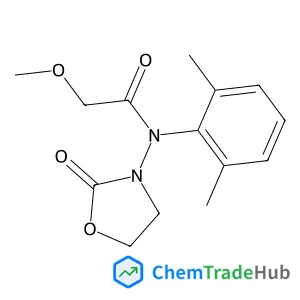
N-(2,6-Dimethylphenyl)-2-methoxy-N-(2-oxo-1,3-oxazolidin-3-yl)acetamide
CAS番号:
77732-09-3
分子式:
C14H18N2O4
おすすめサプライヤー






免責事項
このページに表示される学術雑誌情報は、参考および研究目的のみを目的としています。当社は雑誌出版社とは提携しておらず、投稿の取り扱いも行っておりません。出版に関するお問い合わせは、各雑誌出版社に直接ご連絡ください。
表示されている情報に誤りがある場合は、support@chemtradehub.com までご連絡ください。迅速に確認し、対応いたします。