












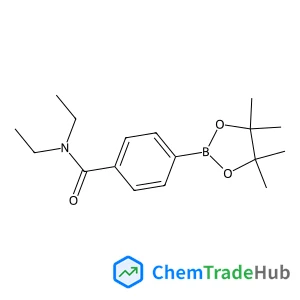
N,N-Diethyl-4-(4,4,5,5-tetramethyl-1,3,2-dioxaborolan-2-yl)benzamide
CAS番号:
325142-99-2
分子式:
C17H26BNO3
Leo W. T. Parsons, James C. Fettinger, Louise A. Berben
The relationship Epvs. ΔGH– correlates the applied potential (Ep) needed to drive organohydride formation with the strength of the hydride donor that is formed: in the absence of kinetic effects Epvs. ΔGH– should be linear but it would be more energy efficient if Ep could be shifted anodically using kinetic effects. Biological hydride transfers (HT) performed by cofactors including NADH and lactate racemase do occur at low potentials and functional modeling of those processes could lead to low energy HT reactions in electrosynthesis and to accurate models for cofactor chemistry. Herein we probe the influence of N-alkylation or N-metallation on ΔGH– for dihydropyridinates (DHP−) and on Ep of the DHP− precursors. We synthesized a series of DHP− complexes of the form (pz2HP−)E via hydride transfer from their respective [(pz2P)E]+ forms where E = AlCl2+, GaCl2+ or Me+. Relative ΔGH– for the (pz2HP−)E series all fall within 1 kcal mol−1, and ΔGH– for (pz2HP)CH3 was approximated as 47.5 ± 2.5 kcal mol−1 in MeCN solution. Plots of Epvs. ΔGH– including [(pz2P)E]+ suggest kinetic effects shift Ep anodically by ∼215 mV.
Ming Wang, Deqing Zhang, Guanxin Zhang, Daoben Zhu
DOI: 10.1039/B808877B
Kumar R. Bhushan, Fangbing Liu, Preeti Misra, John V. Frangioni
DOI: 10.1039/B807930G
Tingyang Dai, Xiujuan Jiang, Shouhu Hua, Xiaoshu Wang, Yun Lu
DOI: 10.1039/B807116K
Kenichi Murai, Maiko Morishita, Ryo Nakatani, Hiromichi Fujioka, Yasuyuki Kita
DOI: 10.1039/B807810F
Pierre-Henri Lanoë, Jean-Luc Fillaut, Loïc Toupet, J. A. Gareth Williams, Hubert Le Bozec, Véronique Guerchais
DOI: 10.1039/B806935B
Hiroshi Yabu, Atsunori Tajima, Takeshi Higuchi
DOI: 10.1039/B809765H
Said Hamad
DOI: 10.1039/B807291D
Juan Manuel Herrera, Enrique Colacio, Corine Mathonière, Duane Choquesillo-Lazarte, Michael D. Ward
DOI: 10.1039/B807364C
Félix Freire, Emilio Quiñoá, Ricardo Riguera
DOI: 10.1039/B806529B
2-溴-9,9-二苯基芴は、医薬品、工業材料、有機合成の研究分野で応用されます。特に、レーザー材料や機能性ポリマーの合成に使用されることがあります。また、蛍光色...
四氯化铱の市場は研究開発分野で注目されており、特にナノ技術や金属有機框架(MOFs)の分野での需要が増加傾向にあります。価格は安定しており、中国や韓国での生産が...
1-(4-溴-3-氟苯基)-2-氯乙酮 (CAS番号: 1260857-14-4) の廃棄物は専門的な廃棄処理が必要です。まず、廃棄物は密閉された容器に収集し、...
苦参酚Kは、CAS番号101236-49-1を持つ化合物で、主に天然由来の生薬から抽出されます。この化合物は、抗炎症作用や抗癌作用を持つことが報告されています。
POTASSIUM (1-(TERTBUTOXYCARBONYL)AZETIDIN-3-YL)TRIFLUOROBORATE を含む廃棄物は、まず安全なエント...
4-庚基-4’-聯苯羧酸は、特殊化学品や合成化学の分野で用いられる化学物質ですが、市場動向としては、研究開発の進展とともに需要が増加しています。また、環境配慮型...
6-ブロモ-3-メトキシ-1-フェニル-1H-インドゾールを含む廃棄物は、適切な化学廃棄処理が必要です。通常、廃棄物は密閉容器に収集され、専門の廃棄処理業者に引...
4,4-二甲基-2-吡咯烷酮は医薬、ポリマー、センサー、半導体などの業界で広く使用されています。特に溶媒としての性能が高く評価されています。
Our journal has a wide-ranging scope which covers the full breadth of the chemical sciences. The research we publish contains the sorts of novel ideas, challenging questions and progressive thinking that bring undiscovered breakthroughs within reach. Your paper could focus on a single area, or cross many. It could be beyond the accepted bounds of the chemical sciences. It might address an immediate challenge, contribute to a future breakthrough or be wholly conceptual. We’re a team from every field of the chemical sciences, and know from experience that breakthroughs that drive the solutions to global challenges can come from anywhere, at any time. You could even start an entirely new area of research. Too bold? Too progressive? No such thing
![5-Methyl-4,5,6,7-tetrahydropyrazolo[1,5-a]pyrazin-2-amine structure](https://static.chemtradehub.com/structs/122/1227210-33-4-8d64.webp "5-Methyl-4,5,6,7-tetrahydropyrazolo[1,5-a]pyrazin-2-amine structure")
![1-[3-(4-Morpholinylsulfonyl)phenyl]methanamine structure](https://static.chemtradehub.com/structs/933/933989-32-3-51af.webp "1-[3-(4-Morpholinylsulfonyl)phenyl]methanamine structure")
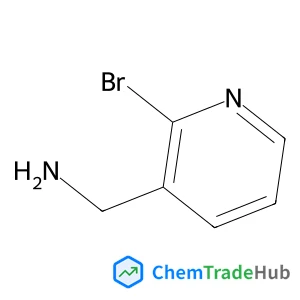
![Pyrazolo[1,5-a]pyridine-3-carbothioamide structure](https://static.chemtradehub.com/structs/885/885275-44-5-aae0.webp "Pyrazolo[1,5-a]pyridine-3-carbothioamide structure")



