












A simple route for fabricating poly(para-phenylene vinylene) (PPV) particles by using ionic liquids and a solvent evaporation process
文献情報
出版日
2008-08-06
DOI
10.1039/B809765H
インパクトファクター
6.222
著者
Hiroshi Yabu, Atsunori Tajima, Takeshi Higuchi
原文を見る
要旨
Particles of a poly(para-phenylenevinylene) (PPV) precursor were prepared from an aqueous solution of the polymer by simple evaporation of water from the solution, which also contained an ionic liquid as a poor solvent (self-organized precipitation (SORP) method); PPV precursor nanoparticles were successfully converted to PPV nanoparticles after annealing at 240 °C under reduced pressure, this simple process constituting a novel route to nanoparticles of functional polymeric materials.
関連文献
Comparison of quenching mechanisms in Gd3Al5−xGaxO12:Ce3+ (x = 3 and 5) garnet phosphors by photocurrent excitation spectroscopy
Tadeusz Lesniewski, Sebastian Mahlik, Kazuki Asami, Jumpei Ueda, Marek Grinberg, Setsuhisa Tanabe
2018-06-11
Paper
DOI: 10.1039/C8CP03176B
Exploring the electron density localization in MoS2 nanoparticles using a localized-electron detector: Unraveling the origin of the one-dimensional metallic sites on MoS2 catalysts
Yosslen Aray, Antonio Díaz Barrios
2018-07-12
Paper
DOI: 10.1039/C8CP03387K
Excited state intramolecular proton transfer in julolidine derivatives: an ab initio study
Šimon Budzák, Denis Jacquemin
2018-09-13
Paper
DOI: 10.1039/C8CP04356F
Spectroscopic characterization of lithium thiophosphates by XPS and XAS – a model to help monitor interfacial reactions in all-solid-state batteries
Christian Dietrich, Raimund Koerver, Michael W. Gaultois, Gregor Kieslich, Giannantonio Cibin, Wolfgang G. Zeier
2018-07-13
Paper
DOI: 10.1039/C8CP01968A
Self-healing and dewetting dynamics of a polymer nanofilm on a smooth substrate: strategies for dewetting suppression
Yu-Hsuan Weng, Yu-Jane Sheng
2018-07-16
Paper
DOI: 10.1039/C8CP03215G
A 4,4′-bis(2-benzoxazolyl)stilbene luminescent probe: assessment of aggregate formation through photophysics experiments and quantum-chemical calculations
Matteo Ambrosetti, Giacomo Ruggeri, Chiara Cappelli, Andrea Pucci
2018-09-24
Paper
DOI: 10.1039/C8CP04450C
Stimulating intra- and intermolecular charge transfer and nonlinear optical response for biphenalenyl biradicaloid dimer under an external electric field
Feng-Wei Gao, Hong-Liang Xu, Shabbir Muhammad, Zhong-Min Su
2018-06-19
Paper
DOI: 10.1039/C8CP00416A
Electrochemical impedance spectroscopy reveals a new mechanism based on competitive binding between Tris and protein on a conductive biomimetic polydopamine surface
Nimisha Singh, Jyotsnamayee Nayak, Khushbu Patel, Suban K. Sahoo, Rajender Kumar
2018-09-14
Paper
DOI: 10.1039/C8CP05391J
Characterization of visible-light photo-Fenton reactions using Fe-doped ZnS (Fex-ZnS) mesoporous microspheres
Qiao Wang, Peng Xu, Guangshan Zhang, Wen Zhang, Limin Hu, Peng Wang
2018-06-20
Paper
DOI: 10.1039/C8CP02609B
Partitioning of nanoscale particles on a heterogeneous multicomponent lipid bilayer
Ran Yang, Xiaodong Tian, Kejie He, Seth Leon Filbrun, Ning Fang
2018-10-17
Paper
DOI: 10.1039/C8CP05710A
こちらもおすすめ
化合物よくある質問
2-ブロモ-9,9-ジフェニル-9H-フルオレンの主な用途は何ですか?
2-溴-9,9-二苯基芴は、医薬品、工業材料、有機合成の研究分野で応用されます。特に、レーザー材料や機能性ポリマーの合成に使用されることがあります。また、蛍光色...
474918-32-62-Bromo-9,9-diphenyl...
化合物よくある質問
四氯化铱の市場動向や研究トレンドはどうですか?
四氯化铱の市場は研究開発分野で注目されており、特にナノ技術や金属有機框架(MOFs)の分野での需要が増加傾向にあります。価格は安定しており、中国や韓国での生産が...
207399-11-9Tetrachloroiridium h...
882-06-44-Nitrocinnamic acid
化合物よくある質問
1-(4-溴-3-氟苯基)-2-氯乙酮を含む廃棄物はどのように処理すべきですか?
1-(4-溴-3-氟苯基)-2-氯乙酮 (CAS番号: 1260857-14-4) の廃棄物は専門的な廃棄処理が必要です。まず、廃棄物は密閉された容器に収集し、...
1260857-14-41-(4-Bromo-3-fluorop...
化合物よくある質問
苦参酚Kとは何ですか?
苦参酚Kは、CAS番号101236-49-1を持つ化合物で、主に天然由来の生薬から抽出されます。この化合物は、抗炎症作用や抗癌作用を持つことが報告されています。
101236-49-1Kushenol K
化合物よくある質問
POTASSIUM (1-(TERTBUTOXYCARBONYL)AZETIDIN-3-YL)TRIFLUOROBORATE を含む廃棄物はどのように処理すべきですか?
POTASSIUM (1-(TERTBUTOXYCARBONYL)AZETIDIN-3-YL)TRIFLUOROBORATE を含む廃棄物は、まず安全なエント...
1430219-73-0Potassium (1-(tert-b...
化合物よくある質問
4-庚基-4’-联苯羧酸の市場動向や研究トレンドはどうですか?
4-庚基-4’-聯苯羧酸は、特殊化学品や合成化学の分野で用いられる化学物質ですが、市場動向としては、研究開発の進展とともに需要が増加しています。また、環境配慮型...
58573-94-74'-Heptyl-4-biphenyl...
化合物よくある質問
6-ブロモ-3-メトキシ-1-フェニル-1H-インドゾールを含む廃棄物はどのように処理すべきですか?
6-ブロモ-3-メトキシ-1-フェニル-1H-インドゾールを含む廃棄物は、適切な化学廃棄処理が必要です。通常、廃棄物は密閉容器に収集され、専門の廃棄処理業者に引...
1332527-03-36-Bromo-3-methoxy-1-...
化合物よくある質問
4,4-二甲基-2-吡咯烷酮はどの業界で使用されていますか?
4,4-二甲基-2-吡咯烷酮は医薬、ポリマー、センサー、半導体などの業界で広く使用されています。特に溶媒としての性能が高く評価されています。
66899-02-34,4-dimethylpyrrolid...
51312-42-6Sodium Phosphotungst...
掲載誌
Chemical Communications

CiteScore:
8.6
自己引用率:
4.7%
年間論文数:
2458
ChemComm publishes urgent research which is of outstanding significance and interest to experts in the field, while also appealing to the journal’s broad chemistry readership. Our communication format is ideally suited to short, urgent studies that are of such importance that they require accelerated publication. Our scope covers all topics in chemistry, and research at the interface of chemistry and other disciplines (such as materials science, nanoscience, physics, engineering and biology) where there is a significant novelty in the chemistry aspects. Major topic areas covered include: Analytical Chemistry Catalysis Chemical Biology and medicinal chemistry Computational Chemistry and Machine Learning Energy and sustainable chemistry Environmental Chemistry Green Chemistry Inorganic Chemistry Materials Chemistry Nanoscience Organic Chemistry Physical Chemistry Polymer Chemistry Supramolecular Chemistry
おすすめ化合物
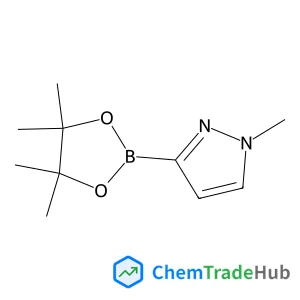
1-Methyl-3-(4,4,5,5-tetramethyl-1,3,2-dioxaborolan-2-yl)-1H-pyrazole
CAS番号:
1020174-04-2
分子式:
C10H17BN2O2
おすすめサプライヤー







免責事項
このページに表示される学術雑誌情報は、参考および研究目的のみを目的としています。当社は雑誌出版社とは提携しておらず、投稿の取り扱いも行っておりません。出版に関するお問い合わせは、各雑誌出版社に直接ご連絡ください。
表示されている情報に誤りがある場合は、support@chemtradehub.com までご連絡ください。迅速に確認し、対応いたします。