












![N-{[(2-Methyl-2-propanyl)oxy]carbonyl}-L-methionylglycine structure](https://static.chemtradehub.com/structs/234/23446-03-9-e1e5.webp "N-{[(2-Methyl-2-propanyl)oxy]carbonyl}-L-methionylglycine structure")
Synthesis and charge-transport properties of novel π-conjugated polymers incorporating core-extended naphtho[2,1-b:3,4-b′]dithiophene diimides
文献情報
出版日
2023-11-28
DOI
10.1039/D3PY01186K
インパクトファクター
5.582
著者
Lingli Zhao, Yanyan Cao, Hanwen Qin, Xi He, Zhiyuan Zhao, Yunlong Guo, Huajie Chen
原文を見る
要旨
We report the synthesis and characterization of a core-extended acceptor building block, 2,7-dibromobenzo[2,1-b:3,4-b′]dithiophene diimides (abbreviated as 2Br–NTI), by extending the mellophanic diimide core with a 2,7-dibromobenzo[2,1-b:3,4-b′]dithiophene unit. This design strategy makes it possible to achieve high electron affinity and tunable solubility enabled by two dicarboxylic acid imide groups and imide-N alkylation, respectively. Moreover, a large-size, near-coplanar π-conjugated structure allows access to 2Br–NTI and their conjugated copolymers (CPSs). Consequently, alternative embedding of the NTI acceptor and electron-rich species (e.g., bithiophene, difluorobithiophene, and biselenophene) into the polymer backbones endows the target D–A type CPSs with near-linearly π-extended conjugation and intriguing photophysical/electrochemical properties. Experimental investigations combined with theoretical calculation reveal that three NTI-based CPSs show a near-coplanar main-chain, impressive decomposition temperature (Td > 450 °C), a low-lying highest occupied molecular orbital level (HOMO < −5.45 eV), strong light-capturing capacities in the visible light area, and compact π–π packing with a preferred face-on orientation. All the polymers behave as p-type semiconductors in solution-processed field-effect transistors, with the best performance for the copolymer containing a fluorinated bithiophene donor. This work offers a facile core-extended strategy to construct novel aromatic diimides and demonstrates its promising potential in engineering organic/polymeric semiconductors.
関連文献
Compositional-asymmetry influenced non-linear optical processes of plasmonic nanoparticle dimers
Anke Horneber, Anne-Laure Baudrion, Pierre-Michel Adam, Alfred J. Meixner, Dai Zhang
2013-03-07
Communication
DOI: 10.1039/C3CP43349H
Raman spectral characteristics of 4-aminobenzenethiol adsorbed on ZnO nanorod arrays
Kwan Kim, Kyung Lock Kim, Kuan Soo Shin
2013-05-09
Paper
DOI: 10.1039/C3CP51204E
Unraveling the atomic structure of Ge-rich sulfide glasses
Gabriel J. Cuello, Shinji Kohara, Chris J. Benmore, David L. Price, Eugene Bychkov
2013-04-08
Paper
DOI: 10.1039/C3CP50536G
K-edge XANES investigation of octakis(DMSO)lanthanoid(iii) complexes in DMSO solution and solid iodides
Paola D'Angelo, Valentina Migliorati, Riccardo Spezia, Simone De Panfilis, Ingmar Persson, Andrea Zitolo
2013-04-17
Paper
DOI: 10.1039/C3CP50842K
Elucidation of structure and nature of the PdO–Pd transformation using in situ PDF and XAS techniques
Jonathan Keating, Gopinathan Sankar, Timothy I. Hyde, Shinji Kohara, Koji Ohara
2013-04-26
Paper
DOI: 10.1039/C3CP50600B
In situXRD studies of nanocrystallization of Fe-based metallic glass: a comparative study by reciprocal and direct space methods
Jozef Bednarcik, Stefan Michalik, Vladimir Kolesar, Uta Rütt, Hermann Franz
2013-04-15
Paper
DOI: 10.1039/C3CP44445G
C60fullerene aggregation in aqueous solution
Yuriy I. Prylutskyy, Anatoly S. Buchelnikov, Dmitry P. Voronin, Viktor V. Kostjukov, Uwe Ritter, John A. Parkinson, Maxim P. Evstigneev
2013-04-16
Paper
DOI: 10.1039/C3CP50187F
A XAS study of the luminescent Eu centers in thiosilicate phosphors
Katleen Korthout, Anthony B. Parmentier, Philippe F. Smet, Dirk Poelman
2013-03-22
Paper
DOI: 10.1039/C3CP44334E
Morphology-controlled preparation and enhanced simulated sunlight and visible-light photocatalytic activity of Pt/Bi5Nb3O15 heterostructures
Ling Chen, Wan Guo, Yuxin Yang, Ang Zhang, Shengqu Zhang, Yihang Guo, Yingna Guo
2013-03-25
Paper
DOI: 10.1039/C3CP00084B
Model of the photoexcitation processes of a two-level molecule coherently coupled to an optical antenna
Masatoshi Nakatani, Atsushi Nobuhiro, Nobuhiko Yokoshi, Hajime Ishihara
2013-03-18
Paper
DOI: 10.1039/C3CP43834A
こちらもおすすめ
化合物よくある質問
3-イチチルビフェニルはどのように合成されますか?
3-イチチルビフェニルは、ビフェニルとイチプロピオニトリルを回収率約90%で反応させて合成されます。触媒は通常、亜リチウムホウ素を用います。
5668-93-93-Ethylbiphenyl
化合物よくある質問
8-溴-5-三氟甲基喹啉はどのように合成されますか?
8-溴-5-三氟甲基喹啉は、5-トリフルオロメチル-2-メチル-1,3-ベンゼンジオールをブロモエタノールと反応させて生成します。この反応は塩基性条件下で行われ...
917251-92-48-Bromo-5-(trifluoro...
化合物よくある質問
ジメチル4-(4,4,5,5-テトラメチル-1,3,2-ドioxaborolan-2-基)-2,6-ピリジンジカルボイル酸フェニルアミニドの代替品はありますか?
ジメチル4-(4,4,5,5-テトラメチル-1,3,2-ドioxaborolan-2-基)-2,6-ピリジンジカルボイル酸フェニルアミニドの代替品としては、4-...
741709-66-0Dimethyl 4-(4,4,5,5-...
化合物よくある質問
N-(3,5-ヘキサクロロ-4-ピリドインイル)-8-メチオキシ-5-キノリンカーボン酸の市場動向や研究トレンドはどのようなものでしょうか?
N-(3,5-ヘキサクロロ-4-ピリドインイル)-8-メチオキシ-5-キノリンカーボン酸の市場動向は、主に産業用途での需要により影響を受けます。研究トレンドとし...
199871-63-1N-(3,5-Dichloro-4-py...
化合物よくある質問
イソステアロイルグリセリルは安全ですか?
イソステアロイルグリセリルは一般的に安全性が高いとされていますが、過度な使用や個人差により皮�owsん炎などの反応が起こる可能性があります。使用前に医師に相談す...
222723-55-92-[(5Z,8Z,11Z,14Z)-5...
化合物よくある質問
1-(二苯甲基)-3,3-二氟-氮杂环丁烷の市場動向や研究トレンドはどうですか?
1-(二苯甲基)-3,3-二氟-氮杂环丁烷の市場動向は、医薬品や合成化学の研究分野で注目を集めています。新興研究は、該当化合物の合成改良と生体内での作用メカニズ...
288315-02-61-Benzhydryl-3,3-dif...
化合物よくある質問
3-チオフェンスチオールの物理化学的性質は何ですか?
3-チオフェンスチオールのCAS番号は7774-73-4です。結晶性の白色粉末で、分子量は122.17です。この化合物は水に微溶解し、エタノールやジクロロメタン...
7774-73-43-Thiophenethiol
化合物よくある質問
2-Methyl-2-propanyl (2S)-2-(aminomethyl)-1-piperidinecarboxylateは安全ですか?
2-Methyl-2-propanyl (2S)-2-(aminomethyl)-1-piperidinecarboxylateは一定の安全性基準を満たしていま...
475105-35-22-Methyl-2-propanyl ...
化合物よくある質問
CAS番号1316822-90-8の化合物は安全ですか?
CAS番号1316822-90-8の化合物は安全性に関しては評価が不足していますが、一般的には生物学的に活性な物質であり、取り扱いには適切な安全防護措置が必要で...
1316822-90-8Gal beta(1-3)[Neu5Ac...
化合物よくある質問
Tert-butyl 2-(2-羟基乙基)哌嗪-1-羧酸はどのように保存すればよいですか?
Tert-butyl 2-(2-羟基乙基)哌嗪-1-羧酸は、冷暗所で保存し、直射日光から遠ざけてください。容器は密閉し、高湿度や高温を避けて保管してください。
517866-79-4Tert-butyl 2-(2-hydr...
掲載誌
Polymer Chemistry

CiteScore:
8.6
自己引用率:
7.3%
年間論文数:
457
Polymer Chemistry welcomes submissions in all areas of polymer science that have a strong focus on macromolecular chemistry. Manuscripts may cover a broad range of fields, yet no direct application focus is required.
おすすめ化合物
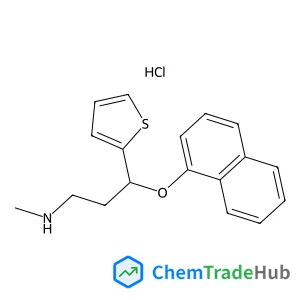
N-Methyl-3-(1-naphthyloxy)-3-(2-thienyl)-1-propanamine hydrochloride (1:1)
CAS番号:
1188266-11-6
分子式:
C18H20ClNOS
おすすめサプライヤー




免責事項
このページに表示される学術雑誌情報は、参考および研究目的のみを目的としています。当社は雑誌出版社とは提携しておらず、投稿の取り扱いも行っておりません。出版に関するお問い合わせは、各雑誌出版社に直接ご連絡ください。
表示されている情報に誤りがある場合は、support@chemtradehub.com までご連絡ください。迅速に確認し、対応いたします。