












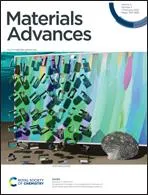
One-step simultaneous liquid phase exfoliation-induced chirality in graphene and their chirality-mediated microRNA delivery
文献情報
出版日
2023-10-04
DOI
10.1039/D3MA00611E
インパクトファクター
0
著者
原文を見る
要旨
Graphene (G) has established itself as an exciting prospect for a broad range of applications owing to its remarkable properties. Recent innovations in chiral nanosystems have led to sensors, drug delivery, catalysis, etc. owing to the stereospecific interactions between various nanosystems and enantiomers. As the molecular structure of G itself is achiral introducing chirality in G by simple attachment of a functional group (a chiral ligand) on the G nanosheet may result in more diverse applications. Herein, we demonstrate direct liquid phase exfoliation and chiral induction in G nanosheets abbreviated as L-graphene and D-graphene in the presence of chiral L-tyrosine and D-tyrosine and by applying high-temperature sonication. The obtained exfoliated nanosheets demonstrated stable chirality confirmed by circular dichroism. Fourier transform infrared (FTIR) spectra, Raman spectroscopy, transmission electron microscopy (TEM), X-ray photoelectron spectroscopy (XPS), and differential scanning calorimetry (DSC) showed functional, structural, morphological, surface, and thermal characteristics of L-graphene and D-graphene. The hemo-compatibility of these chiral graphenes was evaluated for the very first time utilizing human red blood cells. Lastly, for the very first time, an attempt was made to explore enantiomeric binding between chiral L-graphene and D-graphene with microRNA (miR-205) and their possibility towards chirality-mediated gene delivery in prostate cancerous cells.
関連文献
Reliable carbon nanotube field-effect transistors for pH sensing
Yongzeng Jiang, Jing Dong, Fazhi Wang, Jianfei Zhang, Xiaoxin Du, Xiaoming Li, Di Wu, Shuo Wang, Feng Gao
2023-12-19
Paper
DOI: 10.1039/D3NJ05514K
Efficient room-temperature hydrogenation of nitroaromatic compounds to primary amines using nitrogen-doped carbon-supported palladium catalysts
Yuandie Ma, Huanyu Zhao, Shiying Zhang, Jie He, Zehui Zhang
2024-01-12
Paper
DOI: 10.1039/D3NJ05050E
A self-synthesised non-homogeneous MoS2/Fe–Co–N–BC composite catalyst as an activator for peroxomonosulfate activation for efficient degradation of perfluorooctanoic acid
Ling Tao, Jiepu Zhang, Fangke Yu
2023-12-18
Paper
DOI: 10.1039/D3NJ05139K
Novel butane sulfonic acid-functionalized core–shell magnetic nanocatalysts for ultrasound-assisted coumarin synthesis
Somayeh Soleimani-Amiri, Yasaman Salemi
2023-12-27
Paper
DOI: 10.1039/D3NJ04912D
A potent multifunctional ZIF-8 nanoplatform developed for colorectal cancer therapy by triple-delivery of chemo/radio/targeted therapy agents
Sonia Iranpour, Mahdieh Dayyani
2024-01-02
Paper
DOI: 10.1039/D3TB02571C
Effect of multi arm-PEG-NHS (polyethylene glycol n-hydroxysuccinimide) branching on cell adhesion to modified decellularized bovine and porcine pericardium
Sreypich Say, Mika Suzuki, Yoshihide Hashimoto, Tsuyoshi Kimura, Akio Kishida
2023-12-21
Paper
DOI: 10.1039/D3TB01661G
Copper(ii)-infused porphyrin MOF: maximum scavenging GSH for enhanced photodynamic disruption of bacterial biofilm
Yaoxin Zhang, Linpei Li, Hui Liu, Haixia Zhang, Menghao Wei, Yanwei Yang, Mengnan Wu, Zhaowei Chen, Faming Wang, Qiang Wu, Jiahua Shi
2024-01-02
Paper
DOI: 10.1039/D3TB02577B
Electrogelated drug-embedded silk/gelatin/rGO degradable electrode for anti-inflammatory applications in brain-implant systems
Zhen-Kai Lin, Jing-Syu Lin, Zih-Huei Chen, Hung-Wei Cheng, Wei-Chen Huang
2024-01-02
Paper
DOI: 10.1039/D3TB02715E
Advances in reparative materials for infectious bone defects and their applications in maxillofacial regions
Ziyi Han, Jingdi Xiong, Xiaohan Jin, Qinyue Dai, Mingyue Han, Hongkun Wu, Jiaojiao Yang, Haiqin Tang, Libang He
2023-12-05
Review Article
DOI: 10.1039/D3TB02069J
こちらもおすすめ
化合物よくある質問
N-乙酰基-L-精氨酸はどのように合成されますか?
N-乙酰基-L-精氨酸は、L-精氨酸をエタノールと酸化アクリル酸で反応させて得られます。この合成過程では、酸化アクリル酸がL-精氨酸のN-アミノグループに結合す...
155-84-0N~2~-Acetyl-L-argini...
化合物よくある質問
カウウェルパリミタートを含む廃棄物はどのように処理すべきですか?
カウウェルパリミタートの廃棄物は、化学廃棄物として適切に収集し、専門的な廃棄処理業者に委託します。処理には、有害物質の除去と環境への影響最小化が重要です。温度は...
81760-45-4Kahweol palmitate
化合物よくある質問
タテライル1,4,8,11-テトラエチルアセートの代替品はありますか?
タテライル1,4,8,11-テトラエチルアセートの代替品として、他のエチルエステル化合物や、有機窒素化合物が考えられます。ただし、代替品の選択は目的や使用条件に...
126320-57-8Tetraethyl 1,4,8,11-...
化合物よくある質問
異丁卡因を取り扱う際の実験室安全事項は何ですか?
異丁卡因は毒性があり、皮膚や目を刺激する可能性があります。作業中は保護目鏡、防護手袋、防護マスクを使用し、ドラフトチャンバーで扱うべきです。漏えいした場合、その...
94-14-4Isobutamben
化合物よくある質問
4-氯-2-丙基吡啶を取り扱う際の実験室安全事項は何ですか?
4-氯-2-丙基吡啶は有毒で、吸入や皮膚接触を避けることが重要です。PPEとしてゴーグル、マスク、長袖のガウン、手袋を使用し、ドラフトチャンバーを用いて操作しま...
93856-98-54-Chloro-2-propylpyr...
化合物よくある質問
9,10-脱水阿霉素について適用される法規ガイドラインは何ですか?
CAS番号80996-23-2の9,10-脱水阿霉素は、GHS分類においては第3類毒性物質に分類され、REACH規則においてはカテゴリー1の急性毒性物質とされて...
80996-23-29,10-Anhydroadriamyc...
化合物よくある質問
4-(3-溴苯基)噻唑-2-甲酸の物理化学的性質は何ですか?
4-(3-溴苯基)噻唑-2-甲酸の分子量は265.01です。この化合物は水に微溶です。反応性は中程度で、酸性やアルカリ性の条件下で分解する可能性があります。
808128-00-94-(3-Bromophenyl)-1,...
化合物よくある質問
3-(4-塩素フェニル)-3-オキセタニアミン塩酸塩はどの業界で使用されていますか?
3-(4-塩素フェニル)-3-オキセタニアミン塩酸塩は、医薬業界、ポリマー業界、センサー業界、半導体業界などで使用されています。この化合物は薬物開発の一部として...
1245782-61-93-(4-Chlorophenyl)-3...
化合物よくある質問
氮卓斯汀杂质Eを取り扱う際の実験室安全事項は何ですか?
氮卓斯汀杂质E(CAS番号: 20526-97-0)を扱う際は、ゴーグルとシールド付きの手袋を使用し、漏洩がある場合はドラフトチャンバーを使用して処理することを...
20526-97-03-(4-chlorobenzylide...
化合物よくある質問
デシシボチル-n-ブチルボルテゾミブはどのように保存すればよいですか?
デシシボチル-n-ブチルボルテゾミブは室温で保管し、直日光から遠ざけて密栓容器に保管することが推奨されます。
1104011-35-9Desisobutyl-n-butyl ...
掲載誌
おすすめ化合物
![2-Methyl-2-propanyl [1-(3-nitro-2-pyridinyl)-4-piperidinyl]carbamate structure](https://static.chemtradehub.com/structs/833/833452-36-1-7af5.webp "2-Methyl-2-propanyl [1-(3-nitro-2-pyridinyl)-4-piperidinyl]carbamate structure")
2-Methyl-2-propanyl [1-(3-nitro-2-pyridinyl)-4-piperidinyl]carbamate
CAS番号:
833452-36-1
分子式:
C15H22N4O4
おすすめサプライヤー





免責事項
このページに表示される学術雑誌情報は、参考および研究目的のみを目的としています。当社は雑誌出版社とは提携しておらず、投稿の取り扱いも行っておりません。出版に関するお問い合わせは、各雑誌出版社に直接ご連絡ください。
表示されている情報に誤りがある場合は、support@chemtradehub.com までご連絡ください。迅速に確認し、対応いたします。