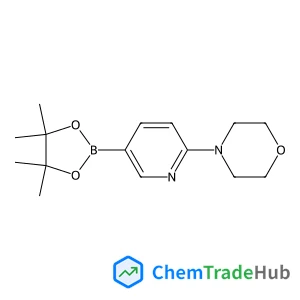
4-(5-(4,4,5,5-tetramethyl-1,3,2-dioxaborolan-2-yl)pyridin-2-yl)morpholine
CAS番号:
485799-04-0
分子式:
C15H23BN2O3
Sumit Kumar Verma, Remya Sasikala, Pankaj Kishore, C. O. Mohan, P. Ganesan, Pandurengan Padmavathy, Nagarajan Muralidharan, Bindu Jaganath, Soottawat Benjakul
Microwave processing is used in industry for drying food commodities as it improves the quality of products and reduces the drying period. In the present study, the effects of microwave power of 600 W (105 and 100 min), 800 W (95 and 90 min), and 1000 W (80 and 65 min) and temperature (60 and 70 °C) on the drying kinetics and quality of microwave-dried shrimp were investigated. The results revealed that increasing the microwave power and temperature increase the drying rate. During the drying process, protein, fat, and ash content increased, whereas the moisture content decreased. The energy value of the dried shrimp increased from 54.41 to 287 kcal g−1. The yield of dried shrimp was in the range of 24–25%. The pH, trimethylamine nitrogen (TMA-N), total volatile base nitrogen (TVB-N), free fatty acids (FFA), thiobarbituric acid-reactive substances (TBARS), and non-protein nitrogen (NPN) values increased slightly in the dried shrimp. Moreover, the hardness of the fried shrimp decreased, while its springiness, gumminess, cohesiveness, and chewiness increased slightly. The lightness (L*), redness (a*), yellowness (b*), chroma, browning index, whiteness index, and ΔE increased in the dried shrimp. The results indicated that the quality of the dried shrimp and drying time decreased when the microwave power was increased.

Critical Reviews in Solid State and Materials Sciences

Colloid Journal

Topics in Catalysis

Medicinal Chemistry Research

Bioorganic & Medicinal Chemistry Letters

Heteroatom Chemistry

Chinese Journal of Chemistry

Journal of Asian Natural Products Research

Journal of the Indian Institute of Science

Main Group Chemistry
Giovanni Bottari, Tomás Torres
DOI: 10.1039/B411960F
Richard T. Baker, Leila Naji, Karen Lochhead, John A. Chudek
DOI: 10.1039/B301039B
DOI: 10.1039/B300963G
Moonhyun Oh, Charlotte L. Stern, Chad A. Mirkin
DOI: 10.1039/B408084J
Cinzia Chiappe, Elsa Leandri, Daniela Pieraccini
DOI: 10.1039/B410796A
Nobuhito Imanaka, Yasuhiro Kato
DOI: 10.1039/B300691C
Alan Armstrong, James N. Scutt
DOI: 10.1039/B316142K
Atsushi Shimojima
DOI: 10.1039/B411794H
Serge Vilminot, Mireille Richard-Plouet, Gilles André, Tahar Mhiri, Mohamedally Kurmoo
DOI: 10.1039/B411304G
Xian-Zheng Zhang, Chih-Chang Chu
DOI: 10.1039/B301423A
環戊烷-1,3-二甲酸甲酯は、環戊烷と塩酸によるヒンデンブルク反応を経由して合成されます。この反応では、環戊烷が塩酸と作用し、1,3-ジカルボキシ基が導入されま...
4-メトキシ-1,2,3-スチアゼ-3,5-ジオンは、CAS番号107843-77-6の化合物で、(E)-ベンジル3-(3,4-ジヒドロキシフェニル) acry...
プロスタグランジンA2 (CAS番号: 41691-92-3) は、化学物質の安全管理に関する規制として、GHS (危険物質の国際的ハザード分類・ラベル付けシス...
4-アミノ-1-ナフタレン sulfonic 酸のCAS番号は84-86-6です。この化合物は結晶性で、分子量は212.15 g/molです。アルコールや水など...
N-GlcNAc-生物素は吸収性があり、皮膚や目への接触を避けることが重要です。PPE(個体保護具)は使用し、ドラフトチャンバーは必要に応じて使用します。漏洩時...
CAS番号1209781-11-2の3-アミノメチルフローラノピペリジン-1-カルボニル酸テルブチルエステルは、有機化合物の一種で、化学式はC10H17FNO3...
6- bromo-1-methyl-1H-benzotriazoleは、ブロモフリオリンと1-メチル-1H-ベンゾ[d][1,2,3]三氮唑の反応により合成され...
4-硫代尿苷は、尿素とD-リボシルヒドロキシアルデヒドを用いてスルホン化反応を経て合成されます。通常は塩酸ヒドロキシチオニルスルホン酸などの触媒を使用し、選択性...
ブレインナトリユリックペプチド32ラット(CAS番号: 133448-20-1)は、心臓で作られるホルモンの一つで、心不全の診断や予後評価に使用されます。
CAS番号810680-60-5の1-(3-氮杂啶)-4-羟基哌啶双盐酸盐は、白色の結晶性粉末である。分子量は360.84 g/molで、水に溶けやすい。反応活...