


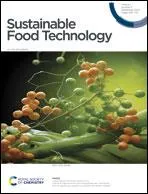
A metamaterial based sensor for moisture and density of cereal flours
文献情報
出版日
2023-11-07
DOI
10.1039/D3FB00126A
インパクトファクター
0
著者
Aswathi P. V., Anju Sebastian, Lulu Varghese, Joseph V. P., Jolly Andrews
原文を見る
要旨
The dielectric properties of cereal grain flours are studied by varying the moisture content and density, using a novel metamaterial Wire Split Ring Resonator (WSRR) based sensor working in the microwave frequency range at room temperature. Four types of cereal grains ground into fine powders are used as the test samples. The WSRR sensor is kept in the electromagnetic field that exists between two monopole antennas connected to the receiving and transmitting ports of a Vector Network Analyzer (VNA) which serves as the measuring device. The LC resonance behavior of the WSRR on interacting with the electromagnetic field and the shift in its resonance frequency in response to any changes in the dielectric environment around it form the basis of sensing. The variation in the moisture content and density of cereal flour samples will cause corresponding changes in the capacitive environment of the sensor which is reflected as the resonance frequency shift. From the resonance–density calibration plot, the maximum packing density of cereal grain powders is found which is useful in determining the efficient use of the available packing space. The moisture content, an essential requirement in ensuring the shelf life of cereal grain powders, is analyzed from the resonance–moisture calibration plot. This simple and accurate metamaterial-inspired measuring technique may find wide applications in the food industry in optimizing the shelf life and packing space of cereal grain powder products.
おすすめジャーナル

Journal of the Indian Institute of Science

Journal of Chemical Sciences

Electroanalysis

Medicinal Chemistry Research

Cellulose

Herald of the Russian Academy of Sciences

Main Group Chemistry

Biocatalysis and Biotransformation

Acta Metallurgica Sinica-English Letters

Critical Reviews in Solid State and Materials Sciences
関連文献
Water-soluble supramolecular bowls formed by intra-clipping of resorcin[4]arene-based ligands with Pd(ii) ions
Seong Jin Park, Dong Mok Shin, Shigeru Sakamoto, Kentaro Yamaguchi, Young Keun Chung, Myoung Soo Lah
2003-03-19
Communication
DOI: 10.1039/B212855A
Al(OPri)3-catalysed halogen exchange processes of relevance to atom transfer radical polymerization: the effect depends on the metal electronic structure
François Stoffelbach, Rinaldo Poli
2004-10-13
Communication
DOI: 10.1039/B409992C
The dynamic desorption of krypton from the zeolite chabazite
S. P. Cork, G. Cressey, R. H. Jones, S. J. Teat, V. L. Zholobenko
2004-11-05
Communication
DOI: 10.1039/B410366C
Crystalline oligopyrene nanowires with multicolored emission
Liangti Qu, Gaoquan Shi
2004-11-03
Communication
DOI: 10.1039/B412638F
Cyclodehydrogenation of di- and tetra(benzimidazol-2-yl)benzenes to give model heteroaromatic discotic systems
Weicheng Wu, Andrew. C. Grimsdale, Klaus Müllen
2003-04-07
Communication
DOI: 10.1039/B301512M
Chiral Co(iii)(salen)-catalysed hydrolytic kinetic resolution of racemic epoxides in ionic liquids
Dong Joon Choo, Woo Ho Shim, Dong Hoon Lee, Eun Joo Roh, Sang-gi Lee, Choong Eui Song
2003-04-02
Communication
DOI: 10.1039/B301490H
Comment: 2004’s fastest organic and biomolecular chemistry!
Caroline V. Potter, Sarah Thomas, Janet L. Dean, Adrian P. Kybett, Richard Kidd, Melanie James, Helen Saxton
2004-11-26
Comment
DOI: 10.1039/B417565B
Fabrication of nanowires with polymer shells using treated carbon nanotube bundles as macro-initiators
Yuyang Liu, Jing Tang, J. H. Xin
2004-10-26
Communication
DOI: 10.1039/B412282H
Controlled assembly of luminescent racks based on heteroleptic dinuclear lanthanide complexes
M. Margarita Castaño-Briones, Andrew P. Bassett, Linette L. Meason, Peter R. Ashton, Zoe Pikramenou
2004-10-26
Communication
DOI: 10.1039/B412999G
Fabrication of a stable inorganic–organic hybrid multilayer film with uniform and dense inorganic nanoparticle deposition
Xurong Xu, Joong Tark Han, Kilwon Cho
2003-03-18
Communication
DOI: 10.1039/B300581J
こちらもおすすめ
化合物よくある質問
環戊烷-1,3-二甲酸甲酯はどのように合成されますか?
環戊烷-1,3-二甲酸甲酯は、環戊烷と塩酸によるヒンデンブルク反応を経由して合成されます。この反応では、環戊烷が塩酸と作用し、1,3-ジカルボキシ基が導入されま...
2435-36-1Dimethyl 1,3-cyclope...
化合物よくある質問
4-メトキシ-1,2,3-スチアゼ-3,5-ジオンとは何ですか?
4-メトキシ-1,2,3-スチアゼ-3,5-ジオンは、CAS番号107843-77-6の化合物で、(E)-ベンジル3-(3,4-ジヒドロキシフェニル) acry...
107843-77-6(E)-Benzyl 3-(3,4-di...
化合物よくある質問
プロスタグランジンA2について「に適用される法規ガイドラインは何ですか?'
プロスタグランジンA2 (CAS番号: 41691-92-3) は、化学物質の安全管理に関する規制として、GHS (危険物質の国際的ハザード分類・ラベル付けシス...
41691-92-316,16-DIMETHYL PROST...
化合物よくある質問
4-アミノ-1-ナフタレン sulfonic 酸についての物理化学的性質は何ですか?
4-アミノ-1-ナフタレン sulfonic 酸のCAS番号は84-86-6です。この化合物は結晶性で、分子量は212.15 g/molです。アルコールや水など...
84-86-64-Amino-1-naphthalen...
化合物よくある質問
N-GlcNAc-生物素を取り扱う際の実験室安全事項は何ですか?
N-GlcNAc-生物素は吸収性があり、皮膚や目への接触を避けることが重要です。PPE(個体保護具)は使用し、ドラフトチャンバーは必要に応じて使用します。漏洩時...
1272755-69-72-Acetamido-2-deoxy-...
化合物よくある質問
3-アミノメチルフローラノピペリジン-1-カルボニル酸テルブチルエステルとは何ですか?
CAS番号1209781-11-2の3-アミノメチルフローラノピペリジン-1-カルボニル酸テルブチルエステルは、有機化合物の一種で、化学式はC10H17FNO3...
1209781-11-22-Methyl-2-propanyl ...
化合物よくある質問
6-溴-1-甲基-1H-ベンゾ[d][1,2,3]三氮唑はどのように合成されますか?
6- bromo-1-methyl-1H-benzotriazoleは、ブロモフリオリンと1-メチル-1H-ベンゾ[d][1,2,3]三氮唑の反応により合成され...
944718-32-56-Bromo-1-methyl-1H-...
化合物よくある質問
4-硫代尿苷はどのように合成されますか?
4-硫代尿苷は、尿素とD-リボシルヒドロキシアルデヒドを用いてスルホン化反応を経て合成されます。通常は塩酸ヒドロキシチオニルスルホン酸などの触媒を使用し、選択性...
6741-73-71-(4-thio-beta-D-rib...
化合物よくある質問
ブレインナトリユリックペプチド32ラットとは何ですか?
ブレインナトリユリックペプチド32ラット(CAS番号: 133448-20-1)は、心臓で作られるホルモンの一つで、心不全の診断や予後評価に使用されます。
133448-20-1Brain Natriuretic Pe...
化合物よくある質問
1-(3-氮杂啶)-4-羟基哌啶双盐酸盐の物理化学的性質は何ですか?
CAS番号810680-60-5の1-(3-氮杂啶)-4-羟基哌啶双盐酸盐は、白色の結晶性粉末である。分子量は360.84 g/molで、水に溶けやすい。反応活...
810680-60-51-(3-Azetidinyl)-4-p...
掲載誌
おすすめ化合物
![N-[(9H-Fluoren-9-ylmethoxy)carbonyl]-beta-phenyl-L-phenylalanine structure](https://static.chemtradehub.com/structs/201/201484-50-6-c2fc.webp "N-[(9H-Fluoren-9-ylmethoxy)carbonyl]-beta-phenyl-L-phenylalanine structure")
![N-[(1S,2R,4S)-2-Amino-4-(dimethylcarbamoyl)cyclohexyl]-N'-(5-chloro-2-pyridinyl)ethanediamide structure](https://static.chemtradehub.com/structs/480/480452-37-7-0898.webp "N-[(1S,2R,4S)-2-Amino-4-(dimethylcarbamoyl)cyclohexyl]-N'-(5-chloro-2-pyridinyl)ethanediamide structure")
おすすめサプライヤー





免責事項
このページに表示される学術雑誌情報は、参考および研究目的のみを目的としています。当社は雑誌出版社とは提携しておらず、投稿の取り扱いも行っておりません。出版に関するお問い合わせは、各雑誌出版社に直接ご連絡ください。
表示されている情報に誤りがある場合は、support@chemtradehub.com までご連絡ください。迅速に確認し、対応いたします。