












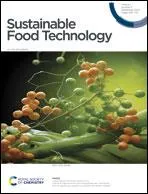
Recovery of anthocyanins from Eugenia spp. fruit peels: a comparison between heat- and ultrasound-assisted extraction
文献情報
出版日
2023-10-30
DOI
10.1039/D3FB00115F
インパクトファクター
0
著者
M. Beatriz P. P. Oliveira
原文を見る
要旨
Natural colorants have gained increased popularity among consumers and food producers due to their reputation as safer and healthier alternatives to commonly used artificial analogues. These natural pigments can be obtained from by-products resulting from food processing, such as the fruit peels of the Brazilian species Eugenia brasiliensis and Eugenia involucrata, thus contributing to the valorisation and circularity of these undervalued raw materials. Therefore, since these fruit peels present anthocyanin concentrations that justify their exploitation, this study aimed to optimize and compare the recovery of these pigments from these plant by-products using heat- and ultrasound-assisted extraction (HAE and UAE, respectively) methods. For process optimization, a central composite rotatable design coupled with response surface methodology was implemented, considering time, ethanol/water ratio, and temperature (for HAE) or ultrasonic power (for UAE) as relevant independent variables. While UAE resulted in higher extraction yields (40–42%, w/w), HAE led to higher anthocyanin contents (18 mg g−1 from E. involucrata and 323 mg g−1 from E. brasiliensis). Furthermore, the HAE global optimum involved only 2 min of processing. Both theoretical models were experimentally validated by applying the model-predicted extraction conditions, and the obtained anthocyanin-rich extracts were analysed for colour and in vitro bioactive properties. In general, the extraction method did not greatly affect the colour or the antimicrobial and cytotoxic activities of the extracts. However, only E. brasiliensis extracts showed cytotoxicity on human tumour cell lines, which also stood out for their antioxidant activity, possibly due to the higher anthocyanin content. Thus, Eugenia spp. fruit peels could be an alternative renewable source of natural food colourants with bioactive properties. Nonetheless, since E. brasiliensis extracts displayed moderate toxicity towards normal cells, the toxicity threshold should be further investigated to ensure the safe exploitation of this raw material as a possible source of natural food colourants.
関連文献
Monitoring the formation of biosilica catalysed by histidine-tagged silicatein
Muhammad Nawaz Tahir, Patrick Théato, Werner E. G. Müller, Heinz C. Schröder, Andreas Janshoff, Jian Zhang, Joachim Huth, Wolfgang Tremel
2004-10-27
Communication
DOI: 10.1039/B410283E
Ensemble hybridisation – a new method for exploring sequence dependent fluorescence of dye–nucleic acid conjugates
Olaf Köhler, Dilip Venkatrao Jarikote, Oliver Seitz
2004-10-14
Communication
DOI: 10.1039/B411877D
Concerning the relative importance of enantiomorphic site vs. chain end control in the stereoselective polymerization of lactides: reactions of (R,R-salen)- and (S,S-salen)–aluminium alkoxides LAlOCH2R complexes (R = CH3 and S-CHMeCl)
Malcolm H. Chisholm, Nathan J. Patmore, Zhiping Zhou
2004-11-25
Communication
DOI: 10.1039/B413266A
A novel migrative addition reaction of hydrazines to the diketone derivative of C60
Sho-ichi Iwamatsu, Fumiaki Ono
2003-05-02
Communication
DOI: 10.1039/B302080K
Phase-transfer alkylation reactions using microreactors
Masaharu Ueno, Hideaki Hisamoto, Takehiko Kitamori, Shū Kobayashi
2003-03-27
Communication
DOI: 10.1039/B301638B
Zeolitenanoparticles with immobilized metal ions: isolation and MALDI-TOF-MS/MS identification of phosphopeptides
Yahong Zhang, Xijuan Yu, Xiaoyan Wang, Wei Shan, Pengyuan Yang, Yi Tang
2004-10-25
Communication
DOI: 10.1039/B411336E
The dynamic desorption of krypton from the zeolite chabazite
S. P. Cork, G. Cressey, R. H. Jones, S. J. Teat, V. L. Zholobenko
2004-11-05
Communication
DOI: 10.1039/B410366C
The role of isomorphism in synthetic analysis. Pruning the search tree by finding disjoint isomorphic substructures
Steven H. Bertz, Toby J. Sommer
2003-03-25
Communication
DOI: 10.1039/B300935A
Cyclopropyl fatty acids implicate a radical but not a cation as an intermediate in P450BM3-catalysed hydroxylations
Max J. Cryle, Julia M. U. Stuthe, Paul R. Ortiz de Montellano, James J. De Voss
2004-01-27
Communication
DOI: 10.1039/B315911F
A novel clean catalytic method for waste-free modification of polysaccharides by oxidation
Svetlana L. Kachkarova-Sorokina, Pierre Gallezot, Alexander B. Sorokin
2004-11-04
Communication
DOI: 10.1039/B411694A
こちらもおすすめ
化合物よくある質問
環戊烷-1,3-二甲酸甲酯はどのように合成されますか?
環戊烷-1,3-二甲酸甲酯は、環戊烷と塩酸によるヒンデンブルク反応を経由して合成されます。この反応では、環戊烷が塩酸と作用し、1,3-ジカルボキシ基が導入されま...
2435-36-1Dimethyl 1,3-cyclope...
化合物よくある質問
4-メトキシ-1,2,3-スチアゼ-3,5-ジオンとは何ですか?
4-メトキシ-1,2,3-スチアゼ-3,5-ジオンは、CAS番号107843-77-6の化合物で、(E)-ベンジル3-(3,4-ジヒドロキシフェニル) acry...
107843-77-6(E)-Benzyl 3-(3,4-di...
化合物よくある質問
プロスタグランジンA2について「に適用される法規ガイドラインは何ですか?'
プロスタグランジンA2 (CAS番号: 41691-92-3) は、化学物質の安全管理に関する規制として、GHS (危険物質の国際的ハザード分類・ラベル付けシス...
41691-92-316,16-DIMETHYL PROST...
化合物よくある質問
4-アミノ-1-ナフタレン sulfonic 酸についての物理化学的性質は何ですか?
4-アミノ-1-ナフタレン sulfonic 酸のCAS番号は84-86-6です。この化合物は結晶性で、分子量は212.15 g/molです。アルコールや水など...
84-86-64-Amino-1-naphthalen...
化合物よくある質問
N-GlcNAc-生物素を取り扱う際の実験室安全事項は何ですか?
N-GlcNAc-生物素は吸収性があり、皮膚や目への接触を避けることが重要です。PPE(個体保護具)は使用し、ドラフトチャンバーは必要に応じて使用します。漏洩時...
1272755-69-72-Acetamido-2-deoxy-...
化合物よくある質問
3-アミノメチルフローラノピペリジン-1-カルボニル酸テルブチルエステルとは何ですか?
CAS番号1209781-11-2の3-アミノメチルフローラノピペリジン-1-カルボニル酸テルブチルエステルは、有機化合物の一種で、化学式はC10H17FNO3...
1209781-11-22-Methyl-2-propanyl ...
化合物よくある質問
6-溴-1-甲基-1H-ベンゾ[d][1,2,3]三氮唑はどのように合成されますか?
6- bromo-1-methyl-1H-benzotriazoleは、ブロモフリオリンと1-メチル-1H-ベンゾ[d][1,2,3]三氮唑の反応により合成され...
944718-32-56-Bromo-1-methyl-1H-...
化合物よくある質問
4-硫代尿苷はどのように合成されますか?
4-硫代尿苷は、尿素とD-リボシルヒドロキシアルデヒドを用いてスルホン化反応を経て合成されます。通常は塩酸ヒドロキシチオニルスルホン酸などの触媒を使用し、選択性...
6741-73-71-(4-thio-beta-D-rib...
化合物よくある質問
ブレインナトリユリックペプチド32ラットとは何ですか?
ブレインナトリユリックペプチド32ラット(CAS番号: 133448-20-1)は、心臓で作られるホルモンの一つで、心不全の診断や予後評価に使用されます。
133448-20-1Brain Natriuretic Pe...
化合物よくある質問
1-(3-氮杂啶)-4-羟基哌啶双盐酸盐の物理化学的性質は何ですか?
CAS番号810680-60-5の1-(3-氮杂啶)-4-羟基哌啶双盐酸盐は、白色の結晶性粉末である。分子量は360.84 g/molで、水に溶けやすい。反応活...
810680-60-51-(3-Azetidinyl)-4-p...
掲載誌
おすすめ化合物
![N,N'-1,2-Ethanediylbis[2-(vinylsulfonyl)acetamide] structure](https://static.chemtradehub.com/structs/667/66710-66-5-b556.webp "N,N'-1,2-Ethanediylbis[2-(vinylsulfonyl)acetamide] structure")
![N-[(1S,2R,4S)-2-Amino-4-(dimethylcarbamoyl)cyclohexyl]-N'-(5-chloro-2-pyridinyl)ethanediamide structure](https://static.chemtradehub.com/structs/480/480452-37-7-0898.webp "N-[(1S,2R,4S)-2-Amino-4-(dimethylcarbamoyl)cyclohexyl]-N'-(5-chloro-2-pyridinyl)ethanediamide structure")
おすすめサプライヤー




免責事項
このページに表示される学術雑誌情報は、参考および研究目的のみを目的としています。当社は雑誌出版社とは提携しておらず、投稿の取り扱いも行っておりません。出版に関するお問い合わせは、各雑誌出版社に直接ご連絡ください。
表示されている情報に誤りがある場合は、support@chemtradehub.com までご連絡ください。迅速に確認し、対応いたします。